| Home | | | Items For Sale | | | Shops | | | Current Auctions | | | Auction Information | | | Auction Schedule | | | My Vervendi | | | Seller Registration | | | Bidder Registration (free) |
| Directory: (25549) |
|
Auctions MAIN CATEGORIES
|
Haruko Watanabe
$120.00 A role of cloth (tanmono) for a cotton kimono (yukata) with shibori. Shibori technique is one kind of Chidori shibori (plovers) which was invented in 1920s. Mostly in good condition but has a slightly indigo faded part in the selvedge. 1920s to 1980. W:30.5cm, L: about 7m40cm (before ironing with steam)
Zentner Collection
$6,000.00 Edo Japanese Fukusa Embroidery pair minogame turtle turstles amounst the Sea and surf. Dtails in gold in silver on a deep purple silk base. Backed in original orange material.
Edo Japanese fudog fukusa embroidery. The silk panel is embroidered in gold with detailed pair of minogames. Japanese mythical turtle that is said to live 1,000 years.
Zentner Collection
$8,250.00 Rare Edo Japanese fudog fukusa embroidery. The silk panel is embroidered in gold with detailed fu dog climbing the mountainous terrain. Backed on its original green velvet organic material.
In the 17th–19th centuries, fukusa were used to wrap gifts in a ceremonial setting. They were more decorative than functional, and were used to add beauty to the gift and to show the refinement of the donor and recipient. In Japan, the color purple is considered yin (female) and red/ora...
Zentner Collection
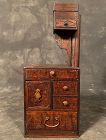
SOLD An antique Japanese sewing box called Haribako in the traditional form made of Toneriko (Ash) and Kurinoki (Walnut). The main body features 5 drawers of varying sizes where sewing accoutrements were stored. The neck supports a storage box with hinged top hiding a pin cushion and a small drawer for additional storage. The top of the neck has a slot where the textile ruler called Shaku was stored and the small hole at the inverted shoulder used to hang a clip considered the third hand.
Ag...
2ezr
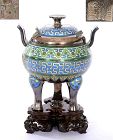
Inquire for Price 1920's Chinese Solid Silver Enamel Censer with 3 Goats on Wood Carved Stand Marked "Beijing Bao Hengxian yinqi xing zu wen" 北京寶恒祥銀器行足紋
It is 8.5 inches (21.59 cm) tall by 7.5 inches (19.05 cm) wide measured without stand. It is 872.5 gram measured without stand. It is tarnished and has dents, enamel bruising, enamel cracks, missing enamels, and surface wears and scratches (as seen in the photos). Our Guarantee: We stand behind all of the items ... Exceptional Pair of Tall Chinese Western Han Dynasty Painted Pottery Jars (Fang Hu)
This outstanding pair of painted pottery jars was made during the Western Han Dynasty (206 BC - AD 8). They are relatively highly-fired and have been made from flat slabs of pottery that have been luted together in imitation of an archaic bronze vessel. Their form is unique to the Western Han period and is known as a "fang hu". Both jars and covers have been elaborately decorated in various cold-painted pigme...
Kodo Arts
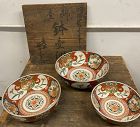
$550.00 Lovely set of 3 nesting Meiji Period Ca. 1900 Imari bowls with original wood box. Very good condition. Ask for shipping quote.
t a t a m i
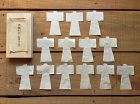
$200.00 OHARAE KATASHIRO Traditional Japanese Shinto paper doll as the substitute for a person, used as the target for a prayer or curse called 'Katashiro', used in the great purification rituals called 'Oharae' (ref. https://www.kamigamojinja.jp/en/rituals/nagoshi-no-oharae-purification-ritual/). This is an old dead stock set with no written name or age as unused. Showa period, 20th century. Katashiro - 12.2 x 8 cm (4.80 x 3.14in) each. *Wooden box was attached in the ...
Brian Page Oriental Art
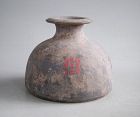
GBP £950 Fine & Rare Chinese Han Dynasty Inscribed Pottery Jar with Oxford TL Test
This very rare and fine-quality pottery jar was made during the Han Dynasty (206 BC - AD 220). It is skilfully potted, made from a fine-grained pale grey pottery that is quite highly-fired and has a very smooth surface. It has a wide, almost semi-spherical body with a short neck and flared mouth. The wide base is flat with a bevelled edge. To the shoulder is an inscription in red pigment, the characters being in th...
Brian Page Oriental Art
GBP £695 Fine & Rare Chinese Han Dynasty Inscribed Pottery Jar
This very rare and fine-quality pottery jar was made during the Han Dynasty (206 BC - AD 220). It is skilfully potted, made from a fine-grained pale grey pottery that is quite highly-fired and has a very smooth surface. It has a wide, almost semi-spherical body with a short neck and flared mouth. The wide base is flat with a bevelled edge. To the shoulder is an inscription in red pigment, the characters being in the traditional/archai...
Brian Page Oriental Art
GBP £695 Fine & Rare Chinese Han Dynasty Inscribed Pottery Jar
This very rare and fine-quality pottery jar was made during the Han Dynasty (206 BC - AD 220). It is skilfully potted, made from a fine-grained pale grey pottery that is quite highly-fired and has a very smooth surface. It has a wide, almost semi-spherical body with a short neck and flared mouth. The wide base is flat with a bevelled edge. To the shoulder is an inscription in red pigment, the characters being in the traditional/archai...
Brian Page Oriental Art
GBP £220 Chinese Song / Yuan Dynasty Buddhist Pottery Zodiac Jar
This interesting pottery jar was made during the Song Dynasty (AD 960 - 1279), or possibly the Yuan Dynasty (AD 1279 - 1368) and has been been excavated from a Buddhist site in Yunnan province. Various decorative methods have been applied to this jar. Strips of clay have been applied to the outer wall to form four lotus leaves. Within the lotus leaf panels there are appliqués of human figures. Around the lower body there are appl...
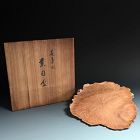
The Kura
sold A wooden tray carved in the shape of a lotus leaf which seems to be almost as thin as the real thing, and amazing feat for the artist. It is 31 x 30 x 1 cm (roughly 12 inches diameter) and in excellent condition dating from the early 20th century and enclosed in a period wooden storage box titled Hasunoha-gata Kashibon.
2ezr
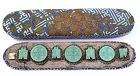
Inquire for Price 1900's Chinese Solid Silver Carved Turquoise Coin Shaped Bracelet Marked with Box
The box is 0.98 inch (2.5 cm) tall by 8.27 inches (21 cm) long and 1.85 inches (4.7 cm) wide. The bracelet is 6.89 inches (17.5 cm) in inner circumference by 1.3 inches (3.3 cm) wide. The bracelet is 35.5 gram. The total weight is 0.2 Lb. It is tarnished and has chips, a hairline crack and inclusions at the turquoise, and surface wears and scratches. The clasp will not stay closed (as seen in the photos)...
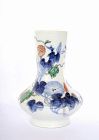
2ezr
Inquire for Price 1930's Japanese Imari Arita Studio Porcelain Vase Marked Genroku Tominaga 富永源六
It is 7.5 inches (19 cm) tall by 5.3 inches (13.5 cm) wide. It is 1.8 Lb. It has skip glazes, glaze burst at the lip, glaze crazing at the bottom, and surface wears and scratches (as seen in the photos). 16672210093224oby Our Guarantee: We stand behind all of the items that we sell. That is to say, if you purchase an item from us and are unhappy with it for any reason, return it...
2ezr
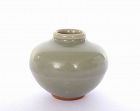
Inquire for Price Chinese Yuan Longquan Celadon Small Jar
It is 2.5 inches (6.4 cm) tall by 2.9 inches (7.4 cm) wide. It is 0.3 Lb. It has skip glaze, surface wears and scratches (as seen in the photos). Our Guarantee: We stand behind all of the items that we sell. That is to say, if you purchase an item from us and are unhappy with it for any reason, return it for a 100% refund of the amount you originally paid. All you need to do is return the item to us within 10 days of receipt and i...
2ezr
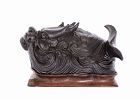
Inquire for Price 1930's Chinese Porcelain Imitation Bronze Dragon Fish Statue 独占鳌头 with Wood Stand
It is 5.7 inches (14.5 cm) tall with stand and 4.7 inches (12 cm) tall without stand by 9.4 inches (24 cm) wide. Total weight is 4.9 Lb. It has mild rubbing paints, dark spots, skip glaze, excess clay at the bottom, chip at the tail, hairline crack at the beard, surface wear and scratches (as seen in the photos). Our Guarantee: We stand behind all of the items that we sell. That i...
Southeast Asian : Hardstones : Pre 1970
item #1499002
(stock #dr13191)
2ezr
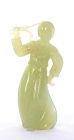
Inquire for Price Chinese Cultural Revolution Serpentine Carved Korean Girl
It is 5.55 inches (14.1 cm) tall by 2.75 inches (7 cm) wide. It is 0.6 Lb. It has small chips at the leaves, inclusions, surface wears and scratches (as seen in the photos). 16710805023724oby Our Guarantee: We stand behind all of the items that we sell. That is to say, if you purchase an item from us and are unhappy with it for any reason, return it for a 100% refund of the amount you originally paid. All ... |