| Home | | | Items For Sale | | | Shops | | | Current Auctions | | | Auction Information | | | Auction Schedule | | | My Vervendi | | | Seller Registration | | | Bidder Registration (free) |
| Directory: (25573) |
|
Auctions MAIN CATEGORIES
|
Zentner Collection
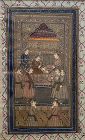
$750.00 Antique Indian miniature painting of 10 noblemen. Most likely a scene from an Islamic text, the noblemen focus their attention toward the figure in the center with the purple plume. The surrounding architecture is decorated with ornate floral motifs. Painted in gauche mineral colors on paper. Framed.
Dimensions: 11 5/8" high x 9 5/8" wide (in frame). Image: 7" high x 4 1/4" wide
GALERIE TIAGO
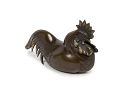
SOLD Okimono bronze sculpture of a reclining rooster.
In the Kojiki (lit. “Records of Ancient Matters”), a collection of myths about the origins
of Japan, the rooster manages to lure the solar deity Amaterasu out of her cave by
using his song and a magic mirror.
Japan – Meiji era (1868-1912)
Width: 3.1 in (8 cm) – depth: 7.9 in (20 cm) – height: 4.3 in (11.8 cm)
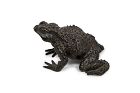
Okimono bronze sculpture of a toad.
The toad or the frog (kaeru) is associated with good luck and wealth. Kaeru means both
“toad” or “frog” and “to return home” in Japanese. This meaning is due to the toad’s
ability to return each year to the pond of its birth. A gong in the shape of a toad can
sometimes be used as a door hammer or to protect house.
Japan – Meiji era (1868-1912)
Width: 4.3 in (11.5 cm) – depth : 4.7 in (12.5 cm) – height: 2.4 in (6.8 cm)
GALERIE TIAGO
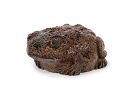
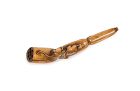
sold Sculpture in varnished bamboo representing a toad.
The wood, before being carved, was attacked by xylophagous insects, which hollowed it out
by forming cavities. After treating and stabilizing the wood, the sculptor was able to use this
appearance to depict the toad's grainy skin: its skin is pustular.
In the Japanese bestiary, the toad occupies a special place, carrying positive values. Both the
toad and the frog, called kaeru (蛙) return every year and no matter how far away from the ...
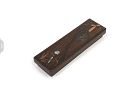
Brush box (fudebako) made of wood and lacquer. On the lid, lacquer decoration
representing sagittarius, a flower inlaid with ceramic and a leaf inlaid with mother-of-
pearl (raden).
Interior and base of the box in nashi-ji lacquer.
Japan - Taisho Era (1912-1926)
Height: 1.4 in / 3.5 cm - width: 2.8 in / 7.2 cm - depth: 9.4 in / 23.9 cm
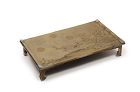
Rectangular bundai writing table on four legs in gold lacquer with black highlights on
a nashi-ji background. The top is decorated with a lake landscape with plum trees, pine
trees and the clover-shaped coat of arms mon (maru ni katabami) of one of the clans
descended from the Matsudaira family in takamaki-e and kirigane lacquer and silver
inlays.
Silvered bronze mounting.
Japan – Edo period (1602-1868)
Hauteur : 4.5 in / 11.5 cm – largeur : 22.8 in / 58 cm – profondeur : 13.4 i...
Curious netsuke or Okimono repurposed as netsuke made of dear antler. It represents a bag,
probably full of rice that is held closed by three stings. On the top of the curve are two mouse
or dormice. Their fur and tails are detailed, and eyes made of buffalo horn.
Unidentified signature
Japon – Meiji era (1868-1912)
Length: 7 cm – width: 3 cm
GALERIE TIAGO
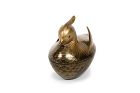
sold Gold lacquer kogo incense box in the shape of a mandarin duck. Its feathers are
delicately rendered in takamaki-e on the back and hiramaki-e on the belly. Gold, silver
and copper nashi-ji lacquer interior.
Inlaid horn eyes.
Japan – Edo period (1603-1868)
Height: 3.5 in / 9.5 cm – width: 2.7 in / 7 cm – depth: 4.7 in / 12 cm
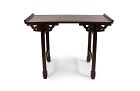
Chinese altar also used as console or side table. Made of exotic hard wood, probably
zitan, with a dark patina. It features voluptuous flared edges and spandrels carved in
cloud motives. The console stands on four feet also carved with Chinese cloud motive;
they are joined by two pairs of lateral bars.
China – Qing dynasty (1644-1911), XIXe siècle
Height : 86,5 cm – length : 116 cm – depth : 36,5 cm
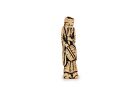
Netsuke representing Jurôjin standing, he is holding his long beard his left hand and
in his right hand he holds a fan. He is wearing a long robe decorated with cloud
motives and a traditional hat
Jurôjin is a god of longevity and among the Seven Gods of Happiness, according to the
Taoist beliefs. He is depicted as an old man with a long white beard, wearing a high
hat and a long robe. His attributes are the fan and the pilgrim stick. The deer, also
symbol of longevity, often serve ...
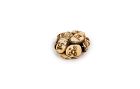
Ivory manjû netsuke featuring a Noh masks group. Among the eleven masks, there
are Okame, Hannya, Shôjo, Hyottoko, Oni, and Obeshimi.
The multiple masks, delicately carved and the significant spacing between them,
revealing the interior of the netsuke. It highlights the remarkable skill of the artist in
ivory carving.
Signature in a carved reserve underneath: “Chikuyosai” by Chikuyosai Tomochika (竹
陽齋友親).
Japan, Chikuyosai Tomochika (竹陽齋友親) – Edo period (160...
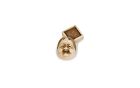
Ivory netsuke with the Noh mask of Okame and a masu rice box.
Okame, also known as Suzume, is the divinity of cheerfulness and good humour.
Masu are traditional square measuring containers made of cypress wood, used for
measuring foodstuffs such as rice, or for drinking sake.
Signed Mitsuyuki (光之).
Japan – Meiji era (1869-1912)
Height: 0.7 in / 1.7 cm – width: 1.1 in / 2.8 cm – depth: 1.2 in / 3 cm
Zentner Collection
2500.00 Antique Japanese jingasa, samurai helmet made of hammered copper. Bulbous form with rounded rim. Zinc lining and copper hooks with a hemp cord. A single character mon in black lacquer on the front. On a custom metal stand.
The samurai class in feudal Japan, as well as their retainers and footsoldiers (ashigaru), used several types of jingasa made from iron, copper, wood, paper, bamboo, or leather. Age: Edo Period (late 19th century) Dimensions: 22 1/2" high (on stand...
Japanese : Woodblock Prints : Pre 1930
item #1499254
(stock #Foujita004)
Era Woodblock Prints
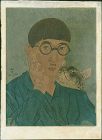
SOLD Leonard Tsuguharu Foujita (1886-1968)
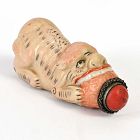
Self-Portrait with Cat Date: ca 1928. Edition: 44/120. Stamp on back reads, "OF ONE HUNDRED TWENTY PRINTED FOR SALE OF WHICH THIS NUMBER IS (44)." Size: 15.25 x 11.125 inches. Signed by the artist in the image in English and Japanese. "Made in Japan" stamped on verso. Medium: Japanese woodblock print. Condition: Toned paper. Fading. A molded and painted Chinese biscuit porcelain snuff bottle in the shape of a playful Buddhist lion with a ball in his jaws. The stopper and spoon made of metal, the top worked in coral imitating glass. Condition: few traces of usage. Dimension: c. 7.8 cm long.
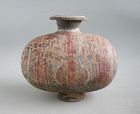
Chinese Western Han Dynasty Painted Pottery Cocoon Jar (206 BC - AD 8)
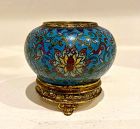
This pottery "cocoon" jar was made over 2,000 years ago during the Western Han Dynasty (206 BC - AD 8). It is made from a relatively highly-fired grey pottery and has been decorated by "cold painting" different coloured pigments in a design featuring cloud patterns within vertical bands. Height 22.25 cm, length of body 26 cm. This is a very good example. It has a high degree of the original coloured surface pigments ... An imperial Chinese cloisonne water-pot on integral gilt bronze base, Qianlong mark and period. 6 cms diam.
The last image shows an almost identical water-pot sold at Christie's Hong Kong, 27.11.2013, for HK$225,000, purchased originally from Spink in 1985.
GALERIE TIAGO
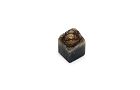
Sold Amusing ink seal (hanko) in the shape of a tripod toad carved in hardstone (such as
nephrite or jadeite), Chinese scripture on one faces of the pedestal. This kind of
creature are very appreciated in Asia, especially in Japan and China, from where it
takes its origins. The tripod toad is thought to protect riches, to increase revenue, and
to ward off bad luck.
China, end of XIX th century
Height: 5cm – length : 3 cm – width: 3 cm
|