| Home | | | Items For Sale | | | Shops | | | Current Auctions | | | Auction Information | | | Auction Schedule | | | My Vervendi | | | Seller Registration | | | Bidder Registration (free) |
| Directory: Japanese (12509) |
|
Auctions MAIN CATEGORIES
|
Modern Japanese Ceramics
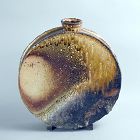
sold, thank you An historically important work by Furutani Hiromu (Churoku I) from the initial firing of their newly established Nobori-gama climbing kiln in 1974. This type of work is called Hatsugama, or first from the kiln. It is the only piece in the show from the climbing kiln (which has not been fired in over 20 years) and the earliest piece in the show as well. It is 32 x 8 x 35 cm (13 x 3 x 14 inches) and in excellent condition, directly from the family...
Zentner Collection
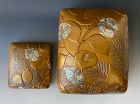
Price on Request Antique Japanese makie lacquer suzuri bako (writing box) and matching large stationary box signed with bold signatures on the bottom reading: 光琳 青々Kо̄rin Seisei, an artist name used by Ogata Kōrin (1658 – 1716).
Both boxes have domed lids and are decorated entirely in gold lacquer with highly raised designs of flowers and silver pine branches. The flowers are further embellished with inlaid shell...
Zentner Collection
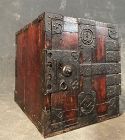
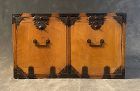
$2,250.00 An antique Japanese Funa Tansu (ship chest) made of Keyaki (Zelkova) wood. All original hand forged iron fittings and finish. Top handle in the Warabite design for carrying. Safe door opens to reveal 5 drawers where important documents, papers, writing brushes, an inkstone and valuables were stored. A trick secret storage box was used to hide important trinkets...
Conservatoire Sakura
$900.00 Hard porcelain dish from the Arita kilns. Decor painted in cobalt blue underglaze high-fire. A couple of fallow deer are represented in an autumnal landscape. It would seem that the female is reluctant to fall mating because she is lying down while the male at her side rears up desperately to attract attention. In the background clouds (erotic symbol of the "game of clouds and rain") and a maple tree for autumn. On the right a weeping willow tree symbol of lovers...
Conservatoire Sakura
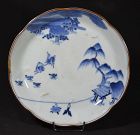
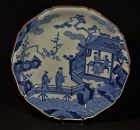
$7,300.00 Hard porcelain dish decorated in underglaze cobalt blue. The scene represents a pavilion in a garden raised on the edge of a lake, several characters animate it. Probably scholars. The designs are artistically stylized in a very Japanese spirit. In the sky the clouds are drawn in a style typical of this period. The edge is glazed in brown. On the reverse appears the mark "Fuku". The quality is excellent, the blue is bright, the designs precise and the firing perfect...
Haruko Watanabe
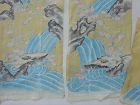
$300.00 Hemp cloth for child's ceremonial kimono with katazome (stencil-resist-dye) and hand-painting, the technique is called Kata-Yuzen. The weft and warp are hand plied. Both long cloths have cuts in the center for the neck and front cloth is narrower than back cloth. Generally, in good condition except for a bit of color fading. 19th century. Two short pieces, W:35.6cm, L:49cm, A short piece, W:35cm x 134cm, Two long pieces for a body part, W:35cm &27.5cm, L:236cm
t a t a m i
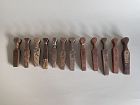
$350.00 TOOL LIKE MORTISE-SAMPLE Details and usage really unknown, but would be a sort of old Japanese architectural wooden tool, like size or form sample of mortise (for mortise joint with a combination of mortise and tenon). Happy first encounter, very rare find. Showa period, early-mid 20th century. Large: 14.5 x 2.5 x 3cm (5.70 x 0.98 x 1.18in), Small: 11.5 x 2.5 x 2.5cm (4.52 x 0.98 x 0.98in)...
Conservatoire Sakura
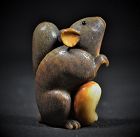
$4,800.00 Netsuké representing a squirrel, perhaps a dormouse. The little animal is carved from a boar's tooth. He has just been surprised and stands on his hind legs momentarily abandoning the vegetable (eggplant?) he was nibbling. Its inset eyes were carved from a shiny black material, probably horn. The imotoshi is natural, formed by the base of the tail. The artist knew how to breathe life into this little animal...
AntiqueTica.com
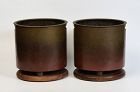
$1,600.00 A pair of Japanese old bronze Hibachi brazier pots.
Hibachi is a traditional Japanese heating device. Age: Japan, Showa Period, Early 20th Century
Conservatoire Sakura
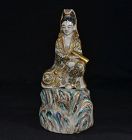
$1,900.00 Kyoto ceramic statuette of Guanyin. The clay is not earthenware, but rather stoneware fired at low temperature. An enamel decoration, applied to a cracked glaze, covers the entire statuette. The rock-base is enamelled in green and blue, stained with gold. The dress of the deity is enamelled with stylized flowers and scrolls in blue, green and red, but the whole is dominated by gold. This statuette is of excellent quality, elegant and rare...
Kyoto Ceramics and Fine Art
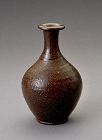
$550.00 Tokoname pottery has a rich history that dates back over a thousand years. Originating in the town of Tokoname in Aichi Prefecture, Japan, this pottery tradition has flourished due to the region's abundant red clay deposits. The history of Tokoname pottery can be traced to the 12th century when the art form was greatly influenced by Chinese ceramics, specifically, by the Yixing clay pottery tradition. Over the centuries, Tokoname pottery evolved to develop its unique style characteri...
Modern Japanese Ceramics
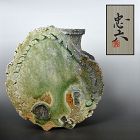
sold, thank you An incredible work by Furutani Hirofumi enclosed in the original signed wooden box titled Shigaraki Shizen-yu Hen Hanaire. Crystaline green glass pools on one side, reaching down a hand to grasp the blackened shell impressions near the base surrounded in raw sunburnt clay. Opposite red discs surround shell marks where it was stacked in the kiln, beads of green forming like dew drops defying gravity on the rim. In between the earth is scorched and blackened, rivulets of olive running between. ...
Zentner Collection
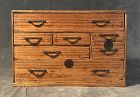
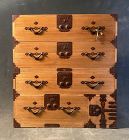
$925.00 Antique Japanese small ko tansu (chest for personal use). Made all of kiri wood. 7 drawers of various size, each with a bronze hirute shaped drawer pull. Two of the drawers have round lock plates. Nice overall patina.
Age: Meiji Period (1868-1912) Dimensions: 18 3/4" high x 28" wide x 12 1/4" deep
Zentner Collection
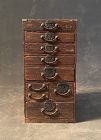
$975.00 Antique Japanese tall merchant's box. Made all of kiri (paulownia) wood with iron hardware. The box has a total of 9 small drawers: upper drawers most likely held writing implements, tools or documents while the ink stains on the inside of the lower drawers reveal they once held ink, seals and ink stone. Each drawer has an iron hirute shaped pull and a round lock for keeping important items like the merchant's signature seals safe.
Age: Edo Period (1603-1867) Dimensions: 1...
Zentner Collection
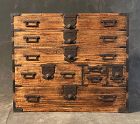
$2,750.00 Antique Japanese tansu with 9 drawers. Made of kiri (paulownia) wood with traces of black lacquer. The upper portion of the chest has three full-width drawers. The lower portion of the chest has five drawers of various sizes including three very small drawers. Iron hardware includes square drawer pulls and heavy lock plates. Nice patination over all.
Age: Edo Period (1603-1867) Dimensions: 25 3/4" high x 29 3/4" wide x 14" deep
Zentner Collection
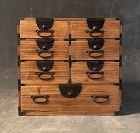
2500.00 Antique Japanese small tansu with 7 drawers. The frame is made of chestnut while the front of the chest is all kiri (paulownia) wood. Sugi (cryptomeria-Japanese cedar) is use for the drawer interiors. The upper portion of the chest has six drawers in two rows. The bottom portion has a single full-width drawer. The hardware is made of iron and consists of half-round lock plates and warabite shaped handles on each drawer.
Age: Meiji Period (1868-1912) Dimensions: 24" high x...
Zentner Collection
4500.00 Antique Japanese hangai tansu (captain's chest for business transactions). Two door panels outfitted with heavy iron work set into the frame and open to reveal five drawers on either side. The exterior frame of of the box is made of sugi (cryptomeria - Japanese cedar) while the drawers are made of kiri (paulownia) wood. The exterior has square iron handles while the interior has iron warabite shaped drawer pulls. It comes with a key.
Age: Edo Period (1603-1867) Dimensions: ...
Zentner Collection
SOLD Antique Japanese Nihon Matsu isho tansu (clothing chest) in two sections from the Nihonmatsu area of Fukushima Prefecture. Made all of kiri (paulownia) wood. Iron hardware has a deep red lacquer finish and includes hirute shaped drawer pulls and large square lock plates with shōchikubai symbols (three friends of winter: plum, pine and bamboo) and a butterfly key hole cover. The top section has 2 large full-width drawers. The bottom section has two drawers and a safe box in the lower right ha...
|