| Home | | | Items For Sale | | | Shops | | | Current Auctions | | | Auction Information | | | Auction Schedule | | | My Vervendi | | | Seller Registration | | | Bidder Registration (free) |
| Directory: Japanese: Samurai (315) |
|
Auctions Shops Active In This Category
MAIN CATEGORIES
|
DEVAGATI
USD $480 Rare Extra-Long Samurai Yari-Saya (Spear Scabbard), Edo Period, 18th Century
Wood with laquer finish.Yari saya( spear scabbards) were made in wide variety of shapes , colors and finishes and were subject to Shogunate approval of use by certain Samurai families. Often shapes would be unique to a particular family and act as an insignia during campaign's and marshes. Fine original condition. With some expected minor abrasions due to a very significan...
Conservatoire Sakura
$2,500.00 This Japanese weapon has unusual dimensions; its proportions are those of a tanto rather than a wakizashi. In one of the photos, it is shown with a standard-sized tanto, allowing the size difference to be appreciated. The blade bears several clearly legible characters, which will help identify the swordsmith. It has been rubbed, the temper is worn away, and the handle has three holes, indicating numerous reassemblies...
DEVAGATI
USD $950 Spectacular Samurai Jingasa Hat with Gilded Crests, Edo Period (17th–18th Century)
An impressive and highly unusual samurai jingasa (war hat), dating to the Edo period, circa 17th–18th century. The exterior is finished in a deeply textured black lacquer surface, boldly decorated with circular gilded crests, creating a striking contrast and strong visual presence. The hat remains in good original condition, showing expected abrasions, surface wear, and small losse...
Conservatoire Sakura
Price on Request The blade is signed by Ujifusa, a renowned swordsmith active in the 17th century. It is in perfect condition, kept separately in a shirasaya (a type of wooden holster). The tang has numerous holes from repeated remounting. The scabbard is lacquered in dense nashiji of the finest orange. The hilt is made of shakudo inlaid with solid gold Kirimon, not simply gilded as is more common...
2ezr
Inquire for Price 19th Century Japanese Set of 12 Mixed Metal Kozuka Knife with Sea Creatures & Figures
They are 7.87 inches (20 cm) long by 0.78 inch (2 cm) wide. The kozuka is 3.85 inches (9.8 cm) long by 0.63 inch (1.6 cm) wide. The total weight is 1.1 Lb. They are tarnished and have oxidation, rubbing of gold, and surface wears and scratches (as seen in the photos). Our Guarantee: We stand behind all of the items that we sell...
Objets D'Art
$350.00 This is a Japanese jingasa, a traditional lacquered war hat or helmet, likely from the Edo period (1603-1867). Jingasa were worn by samurai or common soldiers (ashigaru). It is likely made from leather, or lacquered wood. The dragon motif is worked in high relief and lacquered in yellow and red on a textured dark ground. Dragons amidst clouds are a common decorative scheme on armor. The underside of the hat is often lacquered black...
Objets D'Art
$275.00 This is a Japanese jingasa, a traditional lacquered war hat or helmet, likely from the Edo period (1603-1867). Jingasa were worn by samurai or common soldiers (ashigaru) and often featured family crests (mon) as seen in gold on this piece. They were typically made from durable materials like iron, leather, or lacquered wood or paper. This one is likely made from wood or leather. The brown or vermilion lacquer finish was common and served both decorative and protective purposes...
Objets D'Art
$950.00 Japanese sword guard, known as a tsuba. The inscription on the tsuba reads "Mogarashi Nyudo Soten-sei" (藻柄子入道宗典製), meaning "made by Mogarashi Nyudo Soten". He was a master craftsman from Hikone in Goshu Province (modern-day Shiga Prefecture) during the mid-Edo period. The piece is made of iron and features intricate sukashi (openwork) and iroe-taka-zogan (raised inlay) in gold, silver, and copper.
Perfect condition.
3” x 2 ¾ “.
7.5 x 7.2 sm
Objets D'Art
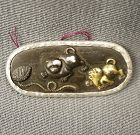
$450.00 The motive features two puppies playing with a rope, abalone shell on the foreground. Silver, shakudo and gold inlays. It may be a menuki or other sword or tobacco pouch decoration, turned into a brooch with a silver mounts. Perfect condition.
2” x 1”.
Spoils of Time
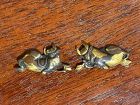
$225.00 A pair of Japanese, Edo period, copper alloy menuki depicting buffalo. Horns, hooves and spots highlighted with gold hirazogan overlay. Good condition. Each about 1 1/8 inches.
Objets D'Art
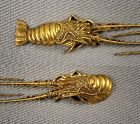
$1,300.00 A pair of left and right menuki depicting lobsters in a paulownia wood box.
Unsigned, gold finish, shakudo base, Yobori carving, attributed to Kyoto workshops.
2 ¼” long.
Zentner Collection
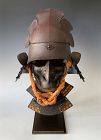
$15,000.00 An Edo period (1603–1868) suji-bachi kabuto, constructed of 64 individual iron plates (ken), each carefully riveted to create a strong, ribbed dome. The surface bears a russet iron (tetsu sabiji) finish, showcasing the natural strength and patina of the iron...
Zentner Collection
Price on Request An impressive Edo period (1603–1868) samurai kabuto, forged in a bold, swept-back form with feather-like detailing across the crown. Each raised ridge is sculpted to evoke the layered plumes of a bird, giving the helmet both a dynamic sense of movement and a distinctive profile...
Zentner Collection
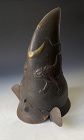
Price on Request A rare Edo period eboshi kabuto, masterfully forged in iron, featuring high-relief repoussé designs of prowling tigresses along the tall, tapering crown...
Zentner Collection
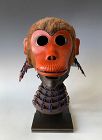
Price on Request This rare Edo period kabuto takes the form of a monkey, a highly unusual and striking design, crafted in lacquer over iron with real monkey fur applied to the head and ears for lifelike realism. Armorers of the time built the base of the helmet from expertly hammered iron plates, shaped to create a rounded, protective bowl. Multiple coats of urushi lacquer were then applied, both to strengthen the iron and to resist weathering in battle...
Spoils of Time
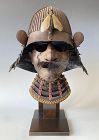
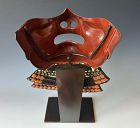
$2,250.00 An early Edo period iron Sōmen (full face mask). The nose is a replacement from the same material, period and school. As the nose is interchangeable by design, this is not objectionable and priced accordingly. As part of a samurai’s armor, a Sōmen would provide greater protection than a menpo. This Sōmen is lighter than later, fanciful Edo period “parade” examples.
Zentner Collection
Price on Request An exceptional and rare eboshi kabuto (samurai helmet) from the Edo period, forged in iron and formed in the shape of the tall ceremonial court cap. The helmet is richly adorned with a finely rendered repoussé tiger—a symbol of courage and martial strength—prowling across the surface in mid-stride...
Zentner Collection
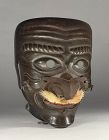
$7,200.00 Edo-period Tetsu Sabiji Yasurime Menpō, a refined example of samurai facial armor featuring a russet iron finish with deliberate yasurime—scribed diagonal lines that add both texture and symbolism to the surface.
This menpō retains its original red lacquer interior, and features white horsehair whiskers above the lip, a detail that enhances its lifelike presence... |