| Home | | | Items For Sale | | | Shops | | | Current Auctions | | | Auction Information | | | Auction Schedule | | | My Vervendi | | | Seller Registration | | | Bidder Registration (free) |
| Directory: Japanese: Textiles (1033) |
|
Auctions Shops Active In This Category
MAIN CATEGORIES
|
Haruko Watanabe
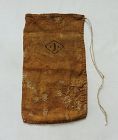
$90.00 Bag made of one kind of hemp, probably imported one, such as jute or sisal, which is used for coins. It has many mending patches.
Late 19th to early 20th century. W:38.5cm, L:70cm
japanes antique textile saiyuu2
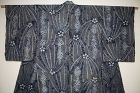
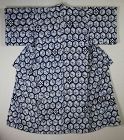
sold thank you This is a Japanese antique shibori cotton kimono.
Indigo dyeing and Plant dyeing. To dye it black, you first dye it with a liquid made by boiling the nuts of trees such as tsurbami and yasya, then soak it in a liquid containing iron to develop the color.There are some remaining grains (protrusions) from the aperture.
It is in good condition with no damage.
Size: Length: 136cm (38.5") / Cuff to cuff, full back: 122cm (48")
Conservatoire Sakura
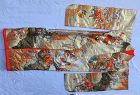
$3,800.00 Wedding Kimono (Uchikake) Silk embroidery and gold and silver metallic ribbons. Some metal ribbon details are iridescent. This Uchikake is a unique model created in a single copy, in fact the decoration is not composed of assembling pieces of fabric with repetitive decoration as most often, but the scene takes place without interruption...
Haruko Watanabe
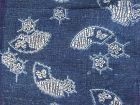
Sold. Thank you. Cotton cloth with katazome pattern which is called "Narumi-Kongata", imitating Arimatsu-Narumi shibori pattern. It is called "Urumi-zome among craftspeople. It uses plural stencils and requires high dyeing technique. In good condition but has two mending patches for the cut which used to be the neck part and in one side of selvedges. The Meiji period (1868 to 1912). W:33cm, L:180cm
The Kura
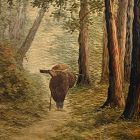
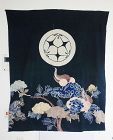
sold, thank you A striking image of an itinerant monk carrying his few earthly possessions though the cedar forest in draped in a mino straw-raincoat and hat, all performed with colored thread in silk embroidery. Behind glass, it has been well protected over the last 100 plus years. The wide dark frame is stained Nara (a form of oak) emulating the arts and crafts style. The inner joints have shrunk, a testament to age...
Haruko Watanabe
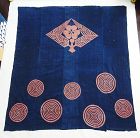
$450.00 Cotton futonji with katazome (stencil-resist dye), which is remade from yogi (one kind of futon in the shape of kimono). It is made of hand spun cotton and dyed with vegetable indigo. The reddish-brown color is bengara (iron oxide red pigment). 19th century. In good condition except for three mending patches. one snag and some small holes. W:153cm, L:165cm
Haruko Watanabe
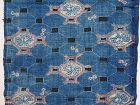
Sold, Thank you. Cloth with katazome (stencil-resist dye) which is hand spun and vegetable indigo and pigment dye. In good condition, however slightly colors faded. 19th century. W:32.5cm, L:180cm
Haruko Watanabe
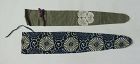
Sold. Thank you. Two long bags made of hand spun cotton, probably bags for swords. The top one is katazome "tsuta", ivy motif. The purple belt is made of silk crepe. The bottom one is katazome and vegetable indigo dye. Both are in excellent condition. 19th century. Top:12cm x 75cm, Bottom:16cm x 78cm
Haruko Watanabe
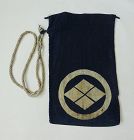
$50.00 A bag made of hand spun cotton and vegetable indigo dye. It has a family crest, "Maru-ni-Yotsumebishi". It has lining made of also hand spun cotton and vegetable indigo dye. The cord is hemp. In good condition but has some holes. The latter half of the 19th century. W:30.5cm, L:48cm
Haruko Watanabe
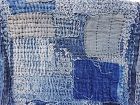
Sold. Thank you. Hanten with sashiko and mending patches which is from Shonai region in Yamagata prefecture. It is made of many indigo dye cotton fragments as cotton was precious in regions with cold climate. It has beautiful vegetable indigo faded and worn-out parts. The first half of the 20th century. W:85cm, L:90cm
japanes antique textile saiyuu2
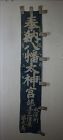
$530.00 This is the indigo-dyed cotton Tsutsugaki Nobori flag dedicated to the Inari Shrine during the Edo period.
Among the characters of tsutsugaki, it is an item written with very high technology.
This is an indigo-dyed cotton fabric with a very nice texture that was made in 1825 during the Edo period bunsei 8 years.
Hand-spun natural indigo-dyed cotton...
japanes antique textile saiyuu2
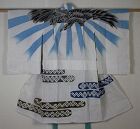
$680.00 Festival costumes for children made and used in the Kanto region. Since this item was used in the summer, men-chijimi is used. This material was the highest quality item for children in the late Edo period. The finest materials are used by skilled craftsmen to draw the finest lines, which are extremely sharp and delicate. The blurring technique gives the hawk movement and makes it dynamic.
The cotton material is hand-spun men-chijimi.
There are some small stains, but they are not noticeable...
Haruko Watanabe
$1,500.00 Futonji with tsutsugaki (glue resist dye by free hand) made of hand spun cotton. It has traditional "Karajishi-Botan", imaginary lion and peony motif. The green ground cloth is dyed with vegetable indigo and natural yellow, the painting is colored with pigments. It is remade to futonji from originally yogi, which is a futon in the shape of kimono. The tsutsugaki technique is excellent and in excellent condition. Meiji period (1868~1912).
Haruko Watanabe
Sold, Thank you. Bashofu kimono hand-woven of ito-basho, which is a family of banana tree. Both wefts and warps are hand-plied. The brown warp kasuri yarns are dyed with extract liquid from tree or root of "sharinbai", which is a family of rose, and the very dark blue weft kasuri yarns are dyed with Ryuku-ai, vegetable indigo in Okinawa. Bashofu has been woven in many Islands in Okinawa for everyday kimono or work wear. 20th century. It has some stains and holes. W:106cm, L:116cm
Haruko Watanabe
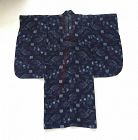
Sold, Thank you. Girl's kimono made of hamp, made in Ohmi region in Shiga prefecture, and it is called Ohmi-jofu. It has kasuri pattern, whose motifs are phoenix, cloud and flower. Warps are machine-spun and wefts are hand-plied. Red cloth inside is silk. Meiji period (1868~1912) In excellent condition. W:97cm, L:107cm
Haruko Watanabe
Sold. Thank you. Cotton cloth with beautiful katazome (stencil-resist dye) with mum motif, which is made of hand spun cotton and vegetable indigo and natural brown dye. In good condition, however colors fades a bit from washing. 19th century.
W:35cm, L:168cm
japanes antique textile saiyuu2
$560.00 This is an indigo-dyed Shibori cotton kimono made by Arimatu Narumi during the Taisho period. Shibori is squeezed by hand, so the Shibori pattern changes little by little. You can enjoy the interesting changes in the handiwork of folk craftsmen. There are a couple of slight stains, but they are not noticeable. condition is good.
Length 147cm x Width 128cm Box.G
Haruko Watanabe
$600.00 Young woman's katabira (unlined kimono made of asa, hemp or ramie) with long sleeves. It is made of Echigo-chijimi, which was woven in Echigo region, now Niigata prefecture. It is handwoven of choma (ramie) whose wefts and warps are hand-plied, and the surface has light shrinkage from twisted warps and wefts. It has hand-painted flower motifs. The lining of collar cloth is thin silk, probably dyed with benibana (safflower). In excellent condition, no hole or no stain. 19th century...
|