| Home | | | Items For Sale | | | Shops | | | Current Auctions | | | Auction Information | | | Auction Schedule | | | My Vervendi | | | Seller Registration | | | Bidder Registration (free) |
| Directory: Japanese: Textiles (1033) |
|
Auctions Shops Active In This Category
MAIN CATEGORIES
|
japanes antique textile saiyuu2
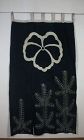
$ 488.80 This is a Japanese antique tsutsugaki textile thick cotton noren made in the Edo period. It is dyed a deep green color by mixing natural indigo and sappan.
Since ancient times, young pine trees have been painted in a refreshing, bold and beautiful manner, with the hope that the future will be more prosperous.
The cotton is thick hand-spun cotton. There is a slight stain, but it is not noticeable. You can see that it has been kept in very good condition...
Haruko Watanabe
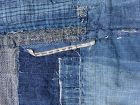
$130.00 Small boro which is used to be a futonji. It is made of handwoven and vegetable indigo dyed cotton. The second half of the 19th century. W:63cm, L:106cm
Haruko Watanabe
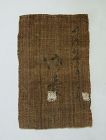
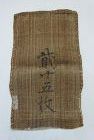
Sold, Thank you. Hemp bag with age, Meiji 24 (1892) and the owner's name, Sahiko (佐彦)、whose warps and wefts are hand-plied. It has very well-done mending and reinforcement stitches, and also a mending patch. It has letters "25 sheets", but it is not clear what was put in. It is from Niigata prefecture. In good condition. W:29.5cm, L:52cm
Haruko Watanabe
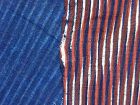
$80.00 Han-juban (short under kimono) made of handspun cotton with shibori (tie-dye), which is ai-gaeshi Miura Shibori. Ai-gaeshi is dyeing twice with indigo. Both sleeves are removed. In good condition, but some brownish stains around neck in spite it is washed. Late 19th to early 20th century. W:62cm, L:72cm
Haruko Watanabe
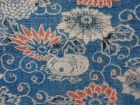
Sold, Thank you. Fragment of katazome with mum motif, made of handspun cotton, dyed with natural dye, such as benibana (safflower), sumi (ink) and vegetable indigo. One side has much faded colors, but the other has a bit more vivid colors. The first half of the 19th century. In good condition. W:34cm, L:72cm
Haruko Watanabe
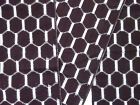
Sold, Thank you. A roll of cotton cloth (tanmono) of the Kurume kasuri with Kikko (hexagonal), tortoiseshell pattern. Kurume kasuri was invented by Inoue Den around 1800, a woman lived in Kurume in Fukuoka prefecture in Kyushu. This cloth is for a kimono. The technique of weaving kasuri in Kurume changed from handloom to machine weaving around 1883.
In excellent condition with warranty tags. 20th century. 38.5cm x 11m40cm
Haruko Watanabe
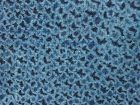
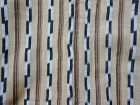
Sold, Thank you. A piece of Iyo-zome cloth which is made of hand-spun cotton and has katazome (stencil-resist-dye) pattern. The name Iyo-zome is originated from Iyo sudare (bamboo screen) since the pattern looks like wood grain by looking through two layers of them. Stripes are dyed with two katagami (stencil paper), one is vegetable indigo and the other is natural brown dye. Two katagami are dyed by displacing them so that they make wood grain like pattern...
Haruko Watanabe
Sold, Thank you. Asa (hemp or ramie) unlined kimono with kasuri and stripes pattern, which is natural dye. In excellent condition. 20th century. W:128cm, L:156cm
japanes antique textile saiyuu2
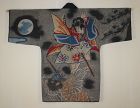
sold thank you This is a Japanese antique tsutsugaki textile cotton Fireman Sashiko hanten coat made in the Edo period. It has been stored almost unused. The subject of the painting is a scene of Yoshitune Minamoto, one of Japan's most famous samurai fighters, confronting a Karasutengu monster on Mount Kurama outside Kyoto as a child. This motif is often depicted in Edo woodblock prints.
The condition is very good. There is no fading or damage...
t a t a m i
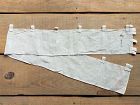
$280.00 BANNER TEMPLATE WITH PROTECTING EMBROIDERY AGAINST EVIL Very rare type with various embroidery of 'jufu' (talismans), early 20th century, Japan. 128 x 14.5 cm (50.39 x 5.70in)...
DEVAGATI
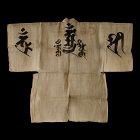
sold Pilgrim’s Jacket (Ohenro-gi) with Text of the Heart Sutra and Pilgrimage Stamps
This beige linen jacket, known as an Ohenro-gi, served as both garment and spiritual record for a Buddhist pilgrim journeying through one of Japan’s many sacred circuits—often comprising thirty-three or eighty-eight temples, numbers imbued with spiritual meaning in Buddhist cosmology...
japanes antique textile saiyuu2
$ 180.00 This is a Japanese antique indigo dye cotton zanshi textile.No stains or damage.
Size::length/404cm Width/28cm
Haruko Watanabe
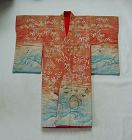
$380.00 Cotton girl's kimono with auspicious motifs, such as plum blooms, bamboos, pine trees, which are kata Yuzenzome (stencil-resist dye and colored by hand), and hand painted turtles and waves. The ground cloth is benibana (safflower) dye which is very precious. Safflower has been grown in Yamagata prefecture in Tohoku district...
Haruko Watanabe
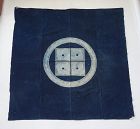
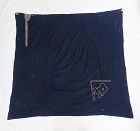
Sold, Thank you. Furoshiki (wrapping cloth) with tsutsugaki kamon (family crest), Maruni-Yotsume. It is made of hand spun cotton and vegetable indigo dyed. It has indigo color bleeding in the kamon. It is not sure whether it is original dye, or bleeding from washing, however, it gives some depth and taste. Generally in good condition but has some breaks and some tiny holes. Late 19th to early 20th century.
W:134cm, L:132cm
Haruko Watanabe
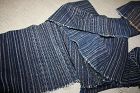
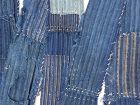
$120.00 A long belt made of many cotton fragments, which are all hand spun and vegetable indigo dyed, with stripes and checks. It has one to two layers. It is probably lining for #14041 Horse reins.
19th century. W:10cm, L:4m56cm
japanes antique textile saiyuu2
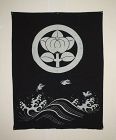
$ 460.00 This is a japanese antique indigo dye cotto tsutsugaki futon cover.It is a design of plovers, waves and family crests.Hand-spun, natural indigo-dyed cotton that is thick and has a very nice texture.There is a very light stain, but it is not noticeable. It is in very good condition with no damage.
Size::length:162㎝ / Width129cm
Haruko Watanabe
$70.00 Cotton furoshiki, indigo dye wrapping cloth with shop's name , which is chain stitched with cotton yarn. It also has sashiko in two corners. Some small rips and mending patches. The first half of the 20th century. W:136cm, L:134cm
Haruko Watanabe
Sold, Thank you. Hemp bag with age, Meiji 24 (1892) and the owner's name, Sahiko (佐彦)、whose warps and wefts are hand-plied. It has very well-done mending and reinforcement stitches, and also a mending patch. It has letters "25 sheets", but it is not clear what was put in. It is from Niigata prefecture. In good condition. W:29.5cm, L:52cm
|