| Home | | | Items For Sale | | | Shops | | | Current Auctions | | | Auction Information | | | Auction Schedule | | | My Vervendi | | | Seller Registration | | | Bidder Registration (free) |
| Directory: Japanese: Textiles (1033) |
|
Auctions Shops Active In This Category
MAIN CATEGORIES
|
Zentner Collection
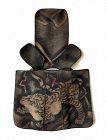
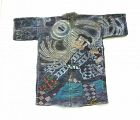
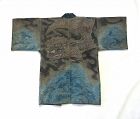
$3,500.00 Antique Japanese fireman's hood. Made of layers of indigo cotton sashiko and decorated on the inside with a scene of a tiger and lightening storm.
Fires were common in Japanese urban areas due to the dense population as well as construction material (primarily wood and paper). Fire brigades were made up of samurai class (buke hikeshi) as well as common class (machi hikeshi). Their primary goal in containing a fire was to tear down the surrounding buildings so the fire had no more fuel...
Haruko Watanabe
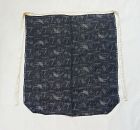
Sold, Thank you. Maekake (apron) made of Ohmi jofu which is hand-woven of hemp with kasuri pattern. Weft kasuri yarns are clamp-board dye, so that it has bar-code like white lines in both selvedges. In excellent condition except for both white cotton belts have dirt. Late 19th to early 20th century. W:66cm, L73cm
Haruko Watanabe
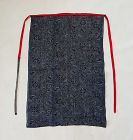
$40.00 Maekake, apron made of Ohmi jofu, which is asa (hemp) with kasuri pattern. Weft kasuri yarns are board-clamp dye, so that both selvedges have bar-code like white lines. All hand-sewn and in excellent condition. It has red cotton belts. Late 19th to early 20th century. W:49cm, L:73cm
Haruko Watanabe
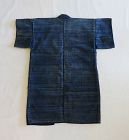
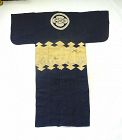
Sold, Thank you. Sakiori coat whose wefts are strips from old vegetable indigo dye cotton cloth and warps are hemp yarn. Wefts are fine strips comparing with other sakiori items. The short sleeves are for ease of movement, as it is "hamagi", worn at the seaside. In good condition except for two mending patches. The first half of the 20th century. W:85cm, L:92cm
japanes antique textile saiyuu2
$368.80 This is han-jyuban in Edo period(1800-1867). Silk tsumugi itajime of the safflower dye is an arabesque motif in the lion. The shoulder surrounding is scenery of the travel (Tokaido) in Edo period. The katazome is very exact and beautiful. The material of katazome is wool. There are a little color variation and a small hole. The state is very good. It is very rare han-jyuban. size:90cm x 85cm (35.4" x 33.5")
Size:Length:86cm( 33.8") / Cuff to cuff, across the back: 91cm (35.8")
Haruko Watanabe
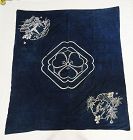
$120.00 Large furoshiki made of hand spun cotton and vegetable indigo dye. It has tsutsugaki (freehand drawing with paste-resist-dye technique) crane and turtle motif. Used and has some stains and tiny holes. The second half of the 19th century. The crest is "Ken-ni-Katabami Mon, (sword and oxalis). W:132cm, L:145cm
Haruko Watanabe
$800.00 Katsugi or Kazuki which is worn over the head down and fully covers the body, which is made of hemp, whose wefts and warps are hand-plied. Originally, the kazuki was worn by a noble woman when she went out from Heian to Kamakura period (about 9th to 13th century) over kimono. The collar is lowered to cover a head. This one is probably made in early Meiji period (the latter half of the 19th century) in Shonai region in Yamagata Prefecture and worn at the wedding...
Haruko Watanabe
$150.00 Cotton juban (under kimono) with shibori pattern whose techniques are Miura shibori and Ori-nui shibori. The collar cloth is silk crepe with woven pattern. It has thin wool muslin with pattern in both sleeves. In good condition except for several small moth holes. It is from Tohoku district where has cold weather in winter. The first half of the 20th century. W:123cm, L:125cm
Haruko Watanabe
Sold, Thank you. Fireman's hanten made of thick cotton and hand-stitched sashiko (quilting). It has hand painted "Edo Machi Hikeshi" (town fireman) with "Matoi" which was hold by fireman to show his own "Kumi", brigade. It also has hand painted birds and waves design inside. 19th century. In good condition. W:118cm, L:91cm
Haruko Watanabe
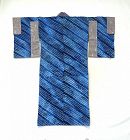
$600.00 Bashofu kimono hand-woven of ito-basho, which is a family of banana tree, for both wefts and warps. The blue stripe yarn is dyed with Ryukyu-ai, vegetable indigo in Okinawa. Bashofu has been woven in many Islands in Okinawa from old days, for everyday kimono or work wear. The first half of the 20th century. In good condition except for a few brownish stains. W:120cm, L:117cm
Haruko Watanabe
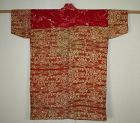
$700.00 Bashofu kimono hand-woven of ito-basho, which is a family of banana tree, for both wefts and warps. The brown weft kasur and stripe yarns are dyed with extract liquid from tree or root of "sharinbai", which is a family of rose. Bashofu has been woven in many Islands in Okinawa for everyday kimono or work wear. The first half of the 20th century. In good condition except for a bit of wear in front. W:110cm, L:98cm
Haruko Watanabe
$150.00 Girl's hanten worn at the festival or ceremony with the girl's name "Kimiko" in front. Itis made of hand-spun cotton and cotton lining with katazome (stencil-resist-dye) crane motif. In excellent condition except for two tiny holes in front. Late 19th to early 20th century. W:73cm, L:53cm
Haruko Watanabe
Sold, Thank you. Kajibanten (fireman's jacket) with sashiko, made of cotton. It has hand-drawn "shachi" motif, which is a mythical carp with the head of a lion and the body of a fish and it is an auspicious protecter. Generally, in good condition but some wear in the neck and brownish stain near hem. 19th century.
W:122cm, L:87cm
Haruko Watanabe
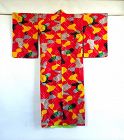
$150.00 Silk meisen lined kimono with geometric pattern in red, green, yellow, black and gray. Both wefts and warp kasuri yarn are paper stencil dye. Mid 20th century. In good condition. W:126cm, L:145cm
japanes antique textile saiyuu2
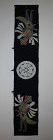
$1580.00 This Umakake was used in the Shinshu region during the Edo period, and Umaya-zaru was drawn with Tsutsugaki. Umaya-zaru was believed to be the guardian deity of horses. These days, it is a very rare item that is rarely seen. Cotton cloth is hand-spun and thick. The cleverly designed Umaya-zaru is interesting. There is no stain damage at all. Size:Width 33cm x Length 178cm Box G.
Haruko Watanabe
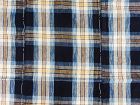
Sold. Thank you. Cotton futonji with beautiful kasuri in check pattern, which is handwoven. Warps and wefts are both hand-spun and vegetable dye, indigo and brown color. It is from Fukuyama city in Hiroshima prefecture (Bingo-gasuri). The first half of the 20th century. In excellent condition. W:131cm, L:140cm
Haruko Watanabe
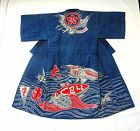
$700.00 Maiwai is a kimono having been given to fishermen from a fish boat owner on the occasion of the large catch. It is seen along the Pacific Ocean, from Aomori to Izu Peninsula in Shizuoka prefecture. The motifs of the picture are auspicious ones such as crane, turtle, large sake cup and sea birds, and also the name of boat in the banner with katazome (stencil-resist-dye). It is vegetable indigo dye and colored with pigments...
Haruko Watanabe
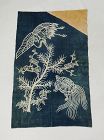
Sold. Thank you. Cotton cloth, called "yu-age”, which is used for a newborn baby. It is ordered by parents of a mother as a congratulatory gift. It has tsutsugaki auspicious motifs, such as a crane, a turtle, pine tree, plum blooms and bamboos. Red part in the top corner is for wiping baby's face, because red color is thought to be good for baby's eyes. It is from Izumo region in Shimane prefecture. In good condition, but the red and indigo blue are a bit faded. Meiji period (1868∼1912)65㎝ x 103cm
|