| Home | | | Items For Sale | | | Shops | | | Current Auctions | | | Auction Information | | | Auction Schedule | | | My Vervendi | | | Seller Registration | | | Bidder Registration (free) |
| Directory: (25585) |
|
Auctions MAIN CATEGORIES
|
Japanese : Tea Articles : Contemporary
item #1371916
(stock #TRC18617)
Kyoto Ceramics and Fine Art
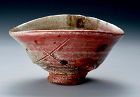
Sold, Thank You! One of the more innovative and international minded ceramicists on the Japanese pottery scene, Ryoji Koie’s interests and expertise cannot be confined to one narrow genre—as he often integrates non-traditional methods and materials. Born in the town of Tokonmae in 1938, from a young age he studied potting—a staple of the local economy—and later went on to do independent research, open his own kiln, travel widely participating in international conferences and workshops, and finally to bec...
The Kura
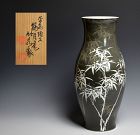
sold, thank you A large porcelain vase covered in olive green upon which grows a rush of white bamboo and a brief epitaph by Miura Chikusen I enclosed in the original signed wooden box dating to the late Meiji or early Taisho period. It is 15 inches (37.5 cm) tall and in excellent condition. The box has much darkened with age. Works of this size by Chikusen, who largely specialized in the minute world of Sencha ware are quite rare.
Miura Chikusen I (1854-1915) made a name for himself as a strict adhere...
The Kura
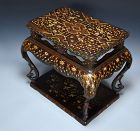
sold, thank you A rare 17th century Japanese Lacquer table performed in the Nanban style exhibited in 1972 at the Kyoto National Museum (including paperwork from the museum). Overall it is in excellent condition, enclosed in an older wooden storage box. It is 12 x 17 x 14 inches (31 x 43 x 36 cm).
According to the Met: The Portuguese and Spanish who visited Japan during the Momoyama period were fascinated by the beauty and exotic appearance of luxurious gold-decorated lacquerwares associated with the t...
Welcome To Another Century
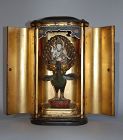
Inquire for Price Large two-door shrine holding inside the figure of Kujaku Myoo sitting on a lutus dais on the back of a peacock. Kujaku means peacock and is revered for transmuting the "poisons" of greed and anger and for eliminating karmic hindrances. The peacock (in India) eats poisonous plants and snakes and is thus thought to guard against evils from poisoning or calamity. Kujaku has four arms, holding a pomegranate, peacock feather, and either a lotus flower or a Buddha-fruit (one attribute is missing). Wo...
Welcome To Another Century
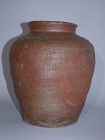
$1,500.00 Storage jar with tapering body, broad shoulder and slightly everted lip. Used for storing tea leaves.
Stoneware with some inclusions, pitted surface and natural ash glaze patches. Iga ware, Mie Prefecture, Japan, Edo period, 17th or possibly a little later (early 18th century). Comes with wooden storage box of a later date. H 10-1/2 inches Excellent condition From the Collection of Osborne and Victor Hauge and their wives
TRIKOMSA ART&ANTIQUES
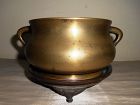
Price on Request Width approximately 19 cm (across the handles). The stand isn't available. In good condition.
TRIKOMSA ART&ANTIQUES
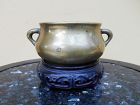
Price on Request Width approximately 16 cm (across the handles). In good condition.
TRIKOMSA ART&ANTIQUES
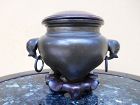
Price on Request Width approximately 16.5 cm (across the elephant handles). In good condition.
TRIKOMSA ART&ANTIQUES
Price on Request Height approximately 51 cm. In good condition.
Diameter approximately 11 cm. In good condition.
Harubang Antiques
SOLD A Very Fine Chinese White Jade Handle/Mirror Back Hand Held Mirror:
China, Qing dynasty, 18th/19th century.
The mirror inset is round shape with a floral foliage around in gilt copper frame, a very fine
white jade handle with a scrolled end with a pear flower head carved both ends decorated with over incised with 3pheonyx medallions on the front and 3Chinese characters “Shou-longivity”, its mirror back attached with also fine white jade with reach green veins in plain decoration,
...
Zentner Collection
$1,200.00 Chinese Song Dynasty ceramic bowl, incised with 3 flower design. The underglaze cream white with brown flecks. Eggshell thin body with a dramatic tapered form. The foot is recessed with the center left in buff.
Song Dynasty (960-1279 AD) Dimensions: 6.75" x 2.25" H
Zentner Collection
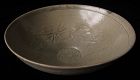
$1,200.00 Antique Korean bowl with crackle celadon glaze. The bowl's interior is incised with design of flowers and filigree, with a line incision just below the rim. The outer body is slightly ribbed, tapering to the recessed foot.
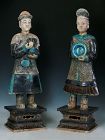
14th Century Koryo Dynasty Dimensions: 7" x 2.75" H An amazing matching pair of a male and a female glazed pottery attendants from the Ming Dynasty, 1368-1644 AD.
This type & size is very rare and were made as tomb figures for wealthy and prominent people during the Ming Dynaasty. The male attendant with greyish-black robe over a cobolt blue and torquoise glazed dress and a round red hat and with black rim. Many nice details. He is standing a tray and a mug or cup in his hands. Around his waist he carries a special b... During the Qing Dynasty, Chinese court gentlemen and ladies used elaborate hair styles.
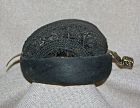
To assist in these construction of the "hairdo's", they used a wire form was covered with a mesh fabric.
This particular "cap" was used to cover a bun of hair on the center of the head. The silver flat "hairpin" was used to hold the cap in place by pushing it through one side hole, between the hair bun and the scalp and through the other side hole.
The inside of the cape clearly shows its age and use.
Indian Subcontinent : Himalayas : Pre 1920
item #1371702
(stock #ZT202)
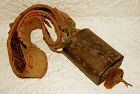
Until the mid 1900's, transporting goods along the silk road was accomplished by camel caravans ...and it was important not to lose the camels in sand storms along the way...
Each camel from Tibet was "adorned" with 3 bells...one large bell hang from a strap around the camel's belly, a 2nd bell was strapped around the neck, and the 3rd bell was hung from the camels tail.
This old camel's bell was used on the caravans travailing between Tibet, across China and into Mongolia.
It comes with th...
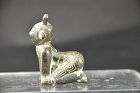
Small figurine finely cast in the shape of a human being in a crouching posture, with horn shaped hairdo. Bronze, with reddish-green patina. This particular object appears to be the support of a large bronze base, as shown on a picture of similar objects exhibited at the National Historical Museum in Beijing (cat. Bronzes, NHM, Beijing, 1995, no. 1037, p. 287), which we show on our last photograph. The piece dates back to the Warring States period (475-221 BC). Length: 4.4 cm. Height: 5.2 cm. Ve...
japanes antique textile saiyuu2
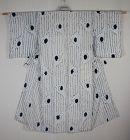
sold thank you Japanese antique handspun & natural indigo dyeing cotton shirakage shibori (Tie-dye)kimono meij era(1868-1912).
It is rare in the pattern of kemari(japanese ball game) on willow.
Kemari (Japanese: kemari) is a ball game that was popular in Japan during the Heian Period. Kemari has been revived in modern times.
There are thin stains and small damage. There is a mark of repair on the back.They are not disturbing, and as a whole it is in very good condition.
size:Length 125cm (49.2inch) slee...
|