| Home | | | Items For Sale | | | Shops | | | Current Auctions | | | Auction Information | | | Auction Schedule | | | My Vervendi | | | Seller Registration | | | Bidder Registration (free) |
| Directory: (25551) |
|
Auctions MAIN CATEGORIES
|
Indian Subcontinent : Himalayas : Pre 1920
item #1471606
Global Ceramics
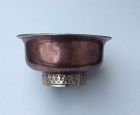
$150.00 Red copper and silver bowl, Tibetan and probably used for buttered tea. Silver lining and foot rim, the latter with a border of stylized leaves, embossed and chased, probably early 20th century. Tibetan silver normally lacks hallmarks and this bowl tested for a silver content of 500/1000. Diameter "3 3/4 / 9.7 cm, height "2/ 5 cm. Condition: fine.
Indian Subcontinent : Himalayas : Pre 1920
item #1471603
Global Ceramics
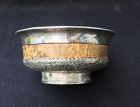
$400.00 Burl wood and silver bowl, used for Tsampa, the traditional Tibetan porridge, and for buttered tea. The silver lining plain, the exterior with chased and delicately engraved decoration of flowers. Tibetan silver normally lacks hallmarks and this bowl tested for a silver content of 925 /1000. Probably antique, late 19th or early 20th century. Diameter "4 ½ / 11 cm, height "2 ¼ / 5.7 cm. Condition: fine.
japanes antique textile saiyuu2
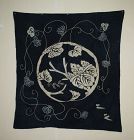
$288.00 A japanese antique natural indigo dyed cotton tsutsugaki furoshiki from the Edo period.(1800-1867) This family crest is rare.
It's thick, and this cotton is hand-spun. This one has some stains on the white part. There is a small hole here, but there is no big damage.
Since this was used to wrap things, there is a part where the cloth is slightly stretched.
Size::length 140cm x 130cm (55.1" x 51.1")
Gallery Rex
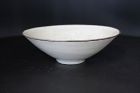
sold Porcelain pieces made at the Jingdezhen kiln are famous for their blueish white color, they are also called "影青".
This tea bowl has beautiful curving on the surface, they are blueish, and it has silver cover on the edge of rim.
YouTube: https://www.youtube.com/watch?v=Q-DA3flydEI
Size: 17.8cm(D) 5.5cm(H)
Accessary: wooden box
Certification: by Noriki Shimazu the famous researcher of Asian antiques in Japan
Gallery Rex
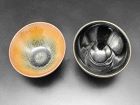
sold 2 Types of Jian small cup, "烏盞 Wuzhan" and 灰被 Haikatsugi Ashes covered" These types of small Jian cup would be used to examine water at "闘茶 Doucha" tea ceremony. Wuzhan is deep beautiful black. Haikatsugi(called in Japan) was covered by ashes in firing, it's has been loved in Japan particularly.
YouTube: https://studio.youtube.com/video/-F2HLl_oRXw/edit
YouTube: https://studio.youtube.com/video/-TnSQWn6k8k/edit
Size: Wuzhan 9.4cm(D) 4.3cm(H) Haikatsugi 9.4cm(D) 4.0cm(H)
Acces...
Welcome To Another Century
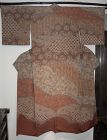
$275.00 Chirimen (crepe) silk kimono imprinted with Okinawa bingata design of irregular bands of flowers and plants of the seasons, in roundels, on waves, on vines etc. The outlines and basic forms are in brown, ochre and brown-red, while the flowers and leaves are colored in the red, yellow, green, and purple. Along the bottom is a band of stylized waves in red and brown.
On the inside white silk or rayon lining in top half. The bottom half, the inside of the lower part of the lapels and along th...
Haruko Watanabe
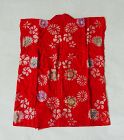
$60.00 Han-juban (short under kimono) made of plain weave silk and beni-itajime (clamp-board dye) with hand painted Yuzen design. The red dye is chemical which was practiced from Meiji period (late 19th century), after beni-itajime with beni(safflower), practiced in Kyoto in Edo period. The last image is beni-itajime with Yuzen dye. The lining is cotton. In excellent condition. W:57cm, L:70cm
...
Welcome To Another Century
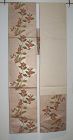
$95.00 A silk fukuro obi sash. In jacquard weave with 2 hues of gold-thread and red, green, yellow and brown silk. Clematis meandering upwards against a yellow-golden background, partially obscured by copper-golden stylized flower shapes.
The back of the obi is plain cream-colored silk, as is about 1.5 meters on the front, which would be invisible when wrapped around the body. The last 16.5 inches of the obi seamlessly fit onto the rest of the design. Japan, Showa era, ca. 1960s-1990s. ...
Conservatoire Sakura
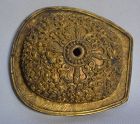
$600.00 Kapala lid in embossed copper and gilded with mercury technic.Dimension: 96x103x35mm
Good condition, slightly worn gilding on the reliefs. Beautiful old patina. Tibet 19th century or before.
Haruko Watanabe
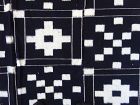
$120.00 Kurume kasuri futonji (bedding) with geometric pattern. Kurume kasuri was invented by Inoue Den around 1800, a woman lived in Kurume in Fukuoka prefecture in Kyushu. This futonji is made of hand-spun cotton and vegetable indigo dye. Weaving of Kurume kasuri changed from handloom to machine weaving around 1883, so it may be woven before 1883.
In excellent condition Late 19th century. 130cm x 144cm
japanes antique textile saiyuu2
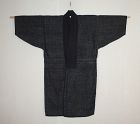
$880.80 This is a thick zanshi long boronoragi from the Meiji era. Hand-spun hemp and cotton threads are mixed with thick indigo threads. There is light dirt, but there is no damage. Size: Length: 1 cm (43.3 inches) Cuff to cuff: 122 cm (48 inches)
Zentner Collection
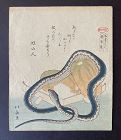
$1,400.00 Antique Japanese surimono woodblock print by Hokkei (1780-1850) entitled "The Chomonju - Snake and Melons". A snake entwined with a tray of melons. The poem above speaks of how the snake will become a dragon which will make clouds of white cherry blossoms in the mountains. Snakes and dragons are closely associated with water. The poems alludes to a wish for rain and the blossoming of Spring.
Dimensions: Unframed: 21.2 cm x 17.7 cm. Framed: 15 1/4" x 15 1/4"
Zentner Collection
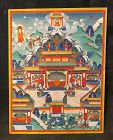
$3,000.00 Antique thangka painting with Buddha seated high above and also ascending from a heavenly realm. A palace below with many llamas and attendants. An altar is spread with auspicious objects. At the very bottom of the scene, figures relax in palace rooms flanking a garden. Painted in mineral colors on cotton.
Age: circa 1900 Dimensions: 56" high x 43 1/2" wide
Zentner Collection
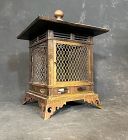
SOLD An old Japanese temple lantern made entirely of bronze. Sacred jewel called Hoju is represented in the finial. Hinged door allows access to the interior.
Zentner Collection
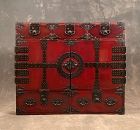
$2,750.00 Japanese choba tansu (merchant's chest) with hinged biraki doors. Made of keyaki (zelkova elm) wood with a deep red lacquer finish. The upper portion of the chest has three exterior drawers over the doors which open to reveal a large compartment and four small interior drawers. The lower portion of the chest has two large exterior drawers. Extensive iron hardware includes cross bracing moko shaped drawer pulls, lock plates, and foliate corner brackets. Comes with 5 keys.
Age: Tai...
Zentner Collection
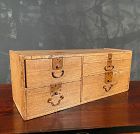
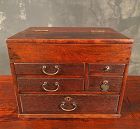
$650.00 Antique Japanese small box with 5 drawers. Made all of kiri (paulownia) wood. Drawers of various sizes with two on the left and 3 on the right. The top two drawers are lacquered a deep red on the inside. Hardware with both moko and warabite shape and lock plates of graduating size.
Age: Taisho Period (1912-1926) Dimensions: 7 1/2" high x 19 1/8" wide x 6 3/4" deep
Zentner Collection
SOLD Antique Japanese small haribako (sewing box). Made with 5 small drawers of various sizes. A hinged lid on top flips up to reveal a tray for storing a pin cushion and sewing supplies. This pulls out to reveal a secret hidden drawer behind it. To the right of this is a flip up holder for the third hand clip. Sakura (Cherry) body and Kuri (Chestnut) wood drawer fronts, Kiri (Paulownia) wood drawer interiors. Bronze hardware with Warabite drawer pulls.
Age: Taisho Period (1912-1926) ...
Harubang Antiques
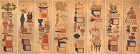
SOLD A Very Fine Korean 책가도-冊架圖) 8 Panel Screen-19th C.:
Scholar’s accoutrements (Chaekgori), Korea, Joseon dynasty, 19th century.
Chaekgeori paintings always included books, bronzed, boxes of various
kinds, lacquer, porcelain flower vase and bowls of fruit, writing paraphernalia (rolled scrolls of paper, brushes, ink sticks, and ink stone) and glass fishbowls, among other objects. There is literary evidence for the tradition of Ch’aekgori from the late 18th century.
It’s in...
|