| Home | | | Items For Sale | | | Shops | | | Current Auctions | | | Auction Information | | | Auction Schedule | | | My Vervendi | | | Seller Registration | | | Bidder Registration (free) |
| Directory: (25586) |
|
Auctions MAIN CATEGORIES
|
Lilly Parker Antiques, Inc.
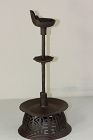
$950.00 Korean casted Wrought Black Iron Oil Lamp, Ca. 1900 or little before, Joseon Dynasty(Yi dynasty), 17 1/2" high, 7 3/4" diameter-bottom width, 2 3/4" diameter-top rim, cut out design of alternate Chinese Characters on the bottom base, that attached to the midway to a small octagonal shape shallow cup, continues to the top to a little shallow cup to hold the oil container(no oil container), higher back support to preventing the wind and also catch the fire. The condition is good, this oil lamp is...
Lilly Parker Antiques, Inc.
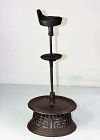
$950.00 Korean casted Wrought Black Iron Oil Lamp, Ca. 1900 or before during Joseon Dynasty(Yi Dynasty), 17 1/2" high, 7" diameter-bottom width, 3" diameter-top rim, cut out design of repeated Chinese Characters on the bottom section attached to midway to small cup and continues to the top little shallow cup to hold the oil container(no oil container), higher back support to preventing the wind and also catch the fire. The condition is good.
The Kura
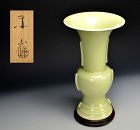
sold, thank you A trumpeting Chinese form by Miyanaga Tozan I enclosed in the original signed wooden box titled Kiji Kodo Gata Kabin (Yellow Porcelain Vase in the Shape of Ancient bronze) and retaining the original Rosewood base. It is 12-1/2 inches (31 cm) tall plus the base, and in excellent condition.
Miyanaga Tozan I (1868-1941) is one of the most important names in Kyoto ceramics. He was born in Ishikawa prefecture, and graduated from the (now) Tokyo University of Art. While a government employee, h...
Modern Japanese Ceramics
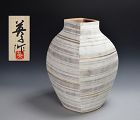
sold, thank you A large tsubo in gold and white slip by Miyashita Hideko enclosed in the original signed wooden box titled Haku-a Kaki Rin to Shite Yo. The title speaks of standing up alone, and the artist told me it was a piece she created when she came to terms with the grief of her husband passing away and had decided to make a fresh go of life. The form was influenced by ancient Chinese maternal sculptures, thus the forward, broad stance. An image of one of the sculptures can be seen on a ticket stub fro...
Lilly Parker Antiques, Inc.
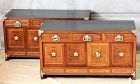
$5,250.00 Pair Korean rare Burlwood and White Brass Scholar's Chests, "Mungap", 32" wide 14" deep, 18" high, with white bass square handles on four(4) lift up style doors and flower shape white brass lock plate on the beautiful grain of burlwood panel doors under the 4 drawer. Second drawer from the right lift up first with key into the key hole and pull out towards front will open all rest of 3 drawers one by one after push to the same slot, it is secret doors and must know how to open all the drawers o...
Southeast Asian : Hardstones : Pre 1920
item #1372131
Zentner Collection
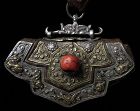
$6,500.00 Antique Tibetan flint carrying pouch (also mechag or chuck muck), made of leather with heavy plaques of silver and gold with inlaid coral front. Motifs of filigree and animals are seen through the silver plating. The backside of the pouch features a central image of a coiling silver dragon. The pouch is suspended by a red leather strap with rivets.
19th century Dimensions: 5" x 3" x 3" (10.5" from end of strap)
Zentner Collection
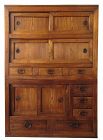
SOLD Rare antique Japanese 2-Section Mizuya (kitchen tansu) made from Keyaki wood (elm). The top section contains 2 roomy e compartments behind sliding door panels with floral motif pulls and 3 drawers along the bottom. The lowermost section holds another compartment with sliding doors, 3 small and two larger drawers along the bottom. The sides of the piece are reinforced with horizontal panels.
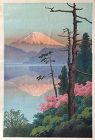
Dates from the Meiji Period c 1900 Dimensions: 44" L x 17" D x 63" H Japanese shin hanga woodblock print by Ito Yuhan (1882-1951) titled "Fuji from Taganoura" published by Nishinomiya Yosaku in the 1930's. Signed at the lower right corner of the image. Paper: 16 1/8" x 10 5/8" (image: 14 1/2" x 9 3/4"). The painterly effect in Ito Yuhan's woodblock prints are achieved through the elimination of black key block lines. Very good overall condition. This print was never framed and has excellent color and full margins. There are some vertical wrinkles down the c...
Lilly Parker Antiques, Inc.
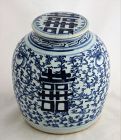
$250.00 Chinese Blue and White Porcelain Double Happiness Ginger jar with old top, Ca. 1900, later part of 1800 to up to 1900, 8" high, 7 1/2" wide-middle section, with typical design of underglaze blue double happiness character among the scrolling vines and snow peas floral decoration. The cover is fitted inside the jar top rim, the decoration of blue continued all the way to the top of the rim on the main body, and some black ink writings under the top. The condition is good, nice quality of strait...
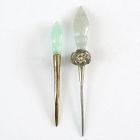
Two old hair ornaments from China, made of a gilt silver alloy, with carved leaf-shaped jade top. One marked "14K". Condition: few traces of usage, gilding worn. Dimension: c. 11.8 cm and 9.6 cm long.
The Kura
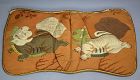
sold, thank you An antique Japanese saddle pad covered with a Korean tapestry of two frolicking lion-dogs in green and white. It features gilded leather piping (which has come loose in some places, see photos), and typical Japanese backing cloth with deer-leather ties. The pad is roughly 116 x 56 cm (46 x 22 inches). Exceptionally rare,
Zentner Collection
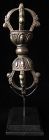
SOLD "Vajra" is a Sanskrit word meaning both thunderbolt and diamond. Additionally, it is a weapon won in battle which is used as a ritual object to symbolize both the properties of a diamond (indestructibility) and a thunderbolt (irresistible force). The vajra is essentially a type of club with a ribbed spherical head. The ribs may meet in a ball shaped top, or they may be separate and end in sharp points with which to stab. The vajra is a weapon of the Vedic rain and thunder deity Indra, and is us...
Zentner Collection
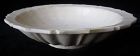
$400.00 Antique Chinese small porcelain plate from the Yuan Dynasty. The body of the plate has a foliate form with scalloped rim, white glaze. The entire foot is left unglazed and is slightly recessed.
Late Yuan Dynasty (13th/14th century) Dimensions: 5.25" x 1.25" H
Zentner Collection
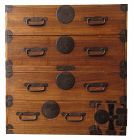
SOLD Antique Japanese 2-section isho tansu (chest on chest for clothing). Made with kiri (paulownia) wood. Original finish. Classic motifs include the round iron lock plates and warabite drawer pulls. The bottom corner of the piece holds two of the smallest drawers behind a safe door.
Meiji Period (1868-1912) Dimensions: 38" L x 17.25" D x 40.75" H
Zentner Collection
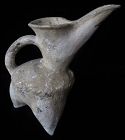
SOLD Chinese Neolithic tripod earthenware ewer (gui) of the Dawenkou culture (4th-3rd millennium BCE) meant for use in religious ceremonies. The vessel has a flared, upwards pointing mouth with a single ribbed handle on its back, ribbing along the body's edges, and its tripod legs are dramatically tapered to the feet.
Dimensions: 4.5" x 3" x 5.25" H
japanes antique textile saiyuu2
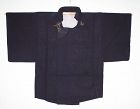
$430.00 Japanese Antique handspun & natural dark Indigo dye thick cotton and sarasa katazome samurai dochugi long coat of tha Edo era(1800-1867) rare.
It has a slight discoloration.It has stains in the invisible part when wearing it.
However, It is no damage.They are not disturbing, and as a whole it is in very good condition. The collar is a very rare design, it is very charming. That button is not attached.
The lining sarasa is a very precious design.
size:size: Length 87cm (34.2inch) sleeve to s...
Kodo Arts
$325.00 Signed on the reverse with a chiseled signature by the artist: Keiten (Takahashi Keiten, born 1920). Showa era, circa 1960 – 1970. Born in 1920 in Yamagata Prefecture, Takahashi Keiten first studied metal casting under Nagano Tetsushi in 1950. His work was first accepted into the government-sponsored 7th Nitten exhibition in 1951. In 1963, he won the encouragement prize at the Nihon Dento Kogei Ten (Japan Traditional Crafts Exhibition) and from 1972 served as a judge for the exhibition. He ha...
Zentner Collection
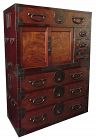
$6,000.00 Antique Japanese 2-section choba tansu (merchant's chest) from the Matsumoto region. Made with Keyaki (elm/zelkova) dramatic burl hardwood front panels. The upper section features a pair of sliding panels, with an open shelved compartment inside over two small drawers. One drawer has a slot above it to deposit money inside. There is also a secret hidden compartment, holding a small treasure box with kanji inscription.
This style of chest is quite rare.
Meiji Period (1868-1912) ... |