| Home | | | Items For Sale | | | Shops | | | Current Auctions | | | Auction Information | | | Auction Schedule | | | My Vervendi | | | Seller Registration | | | Bidder Registration (free) |
| Directory: Japanese (12525) |
|
Auctions MAIN CATEGORIES
|
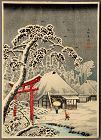
Japanese chuban format shin hanga woodblock print by Takahashi Shotei, also known as Hiroaki (1871 - 1945) depicting two figures walking in the snow in the foreground, one holding a parasol walking toward a hut, the second crossing a bridge over a stream. A snow laden tree and torii gate are at the left. Titled "Snow at Ozawa; Torii Gate and a Cottage," the print was published by Watanabe prior to 1930. The title and artist's red Shotei seal are at the upper left...
Kyoto Ceramics and Fine Art
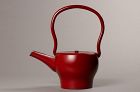
Sold, Thank You! A very modern and sleek interpretation of the classic lacquer sake warmer otherwise known as a “chōshi” in Japanese. The author of this piece, Kado Isaburō, was born in the town of Wajima in Ishikawa in 1940. Born into a crafting family, he learned the family trade from a young age from both his mother and father and would later go on to do an apprenticeship under Hashimoto Tetsuhiro...
Japanese : Tea Articles : Pre 1900
item #1473774
(stock #TRC230208)
Kyoto Ceramics and Fine Art
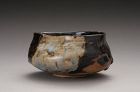
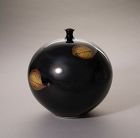
Sold, Thank You! Oribe is a visual style named after the late-16th-century tea master Furuta Oribe (1544-1615). Kuro Oribe pieces are the most common with their jet-black glazes and feldspar ornamentation tending towards the minimalistic, abstract; and, some would say, Zen-like aesthetic. While the piece shown here is not entirely typical of Oribe pieces, the black glaze, contrast window, and unmistakable kutsugata shape all point to this genre of Minō pottery...
Japanese : Tea Articles : Pre 1800
item #1473773
(stock #TRC230211)
Kyoto Ceramics and Fine Art
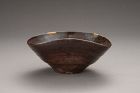
Sold, Thank You! Like many pottery traditions in Japan, Karatsu takes its name from the city where it originated. As early as the 15th century, Korean potters heavily influenced the development of this form—helping to endow it with the earthy, simple, and natural qualities it is so appreciated for...
Global Ceramics
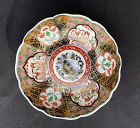
$250.00 Interesting Arita Imari bowl, late Edo with scalloped rim and panels with reserves of flowers and figural scenes of an elderly teacher (?) surrounded by pupils, the reserves contoured in raised overglaze black. Brocade or diaper patterns in green, red, blue and gilt surrounding a stylized turtle in underglaze blue. The exterior shows three Buddhist symbols repeated three times in underglaze blue, red enamels and gilt. Bull’s eye base and a green-glazed Uzu-Fuku mark...
Dragon's Pearl
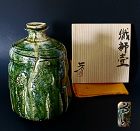
$1,500.00 A contemporary Hanaire, flower vase of Oribe yaki by Sone Yoshiyuki
Powerfully build vase in the distinctive colours of Oribe, fresh green glaze capturing the atmosphere of forest undergrowth and spring moss.
It comes with artist’s information paper, a stamped cloth and fully inscribed and signed storage box.
H 25 x 16 cm.
Perfect condition.
Sone Yoshiyuki (1951- ).
Born in Toki City, Gifu Prefecture. Graduated from the Ceramics Department of Tajimi Technical High School...
Zentner Collection
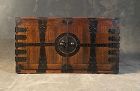
$950.00 Antique Japanese kannon biraki tansu. Single section with hinged doors which open to reveal 4 interior drawers; two large and two small. Made all of kiri (paulownia) wood with iron hardware. The large, round lock plate and cross bracing are classical aspects of this type of chest. Used for storing clothing and outfitted with handles for carrying.
Age: Meiji Period (1868-1912) Dimensions: 20 1/2" high x 37" wide x 16 1/4" deep
Conservatoire Sakura
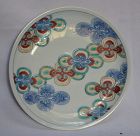
$3,500.00 Nabeshima hard porcelain dish. Okawachi kilns. Decoration in underglaze cobalt blue and overglaze enamels. Although the model already exists at the beginning of the 18th century, we do not believe that the dish presented here is authentic. The enamels are perfect, one can distinguish with a magnifying glass discreet wear of use and the enamels show age cracks, but the cobalt blue on the reverse is too pale. It is not a modern copy, as it has been in the Sakura collection for about forty years...
Kodo Arts
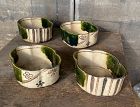
$275.00 Very art deco set of 4 Oribe serving bowls. Geometrical disigns and stripes. Ca. 1920. Featuring the distictive olice green glazes and iron rich clays. 5" long by 2 1/2" tall. Ask for shipping quote.
Zentner Collection
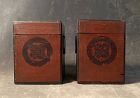
SOLD Antique Japanese pair of armor boxes. Made of kiri (paulownia) wood and lacquered a deep reddish orange color with black details. Iron hardware including carrying handles. The crest is that of two crossing hawk feathers (Takanoha), possibly the crest of the Abe Clan. The Abe Clan (安倍氏, Abe-shi) was a samurai family that was close to the Tokugawa shogunate.
Age: Edo Period (1603-1867) Dimensions: 19 1/2" high x 14 3/4" wide x 14 1/4" deep (each box)
Zentner Collection
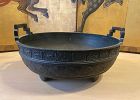
$8,750.00 Antique Japanese large temple bronze hibachi. Round form with handles on either side and standing on three low feet. Decorated with raised bands of archaic motifs including alternating chimera and kylin mythical creatures.
Age: Edo Period (1603-1867) Dimensions: 12" high x 23 3/4" wide (9 1/4" high to top of rim)
Zentner Collection
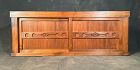
SOLD Antique Japanese single section Mizuya Tansu (kitchen chest). Made with Hinoki (Cypress) and Sugi (Cryptomeria) woods. Restored to reveal the beauty of the natural wood grain. Pair of matched sliding panels open to a spacious storage area. Addition of an optional simple, strong, Japanese inspired shelf if you so choose for us to construct it.
Age: Meiji Period (1868 - 1912) Dimensions: 74" L x 28" H x 14" D
Kyoto Ceramics and Fine Art
$850.00 A technique most commonly seen in Tenmoku tea bowls, “konoha” is accomplished by applying a coating to an actual leaf and then attaching the leaf to the surface of an artwork before firing. The exact details of this process seem somewhat murky as it appears to be a well-guarded secret among potters. After some research we were unable to identify the potter; and, although there is a signature on the bottom that appears to read “Raishō,” we could find no potter by this name...
Japanese : Tea Articles : Pre 1700
item #1473641
(stock #TRC240207)
Kyoto Ceramics and Fine Art
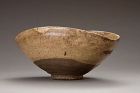
$3,750.00 At various times over the long history of tea practice in Japan, Korean-ware has come into high fashion and ships full of the finest ceramics from the neighboring country were brought to its shores. Such pieces have long been favored by learned cha-jin (tea people); and, older pieces such as this are quite prized today as relatively few from this era have survived in good condition...
Kodo Arts
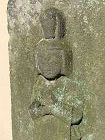
sold Bato Kannon Ca. 1870 (horse-headed Kannon, also called Mezu Kannon), hayagriiva in Sanskrit, is one shape of Bosatsu (Bodhisattva) worshipped in Buddhism. It is one of the transformations of Kannon Bosatsu (Kannon Bodhisattva) and is also included in Roku Kannon (six deities of mercy). It has fierce expression, which is rare for Kannon. Granite stone, age wear, hands in gassho prayer mudra. Ask for shipping quote.
Global Ceramics
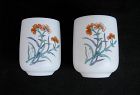
$100.00 Japanese Yunomi pair of beakers, one a little smaller than the other, husband and wife cups. Decoration of enameled / iroe carnation flowers in Kakiemon style and colours on a matted ground. Arita Nabeshima, Tsuji production signed Mayama Akira. Between the leaves to the left of each beaker there is further writing in Japanese. Height "3 ¼ / 8 and "3 ½ / 8.5 cm respectively. Condition: fine.
Kodo Arts
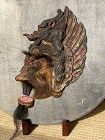
$800.00 Magnificent, very rare wood Bugaku dance mask depicting the Dragon King, Ryo-o. Mounted on a round frame covered on silver leaf paper. Ca. 1820. The mask has a bristling moustache and beard, 4 teeth and a hanging moveable chin piece. The top has a dragon carved. All was lacquered. A similar mask is on exhibit at the British Museum.
Bugaku is a courtly ritual dance which has survived in Japan since the Heian Period, Ca. 794-1185...
Zentner Collection
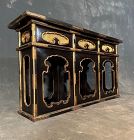
$2,450.00 A large antique Japanese Buddhist altar table decorated with black and gold lacquer on wood. Divided into three visual sections, each one held a Buddhist item such as a Sutra, an incense burner, a temple bell, a Mokugyo, etc. Inscription on the back appears to read "Dedicated by Tokuto Eizo."
Age: Meiji Period (1868-1912) Dimensions: 45 1/2" Wide by 24 3/4" High by 12" Deep |