| Home | | | Items For Sale | | | Shops | | | Current Auctions | | | Auction Information | | | Auction Schedule | | | My Vervendi | | | Seller Registration | | | Bidder Registration (free) |
| Directory: Japanese (12518) |
|
Auctions MAIN CATEGORIES
|
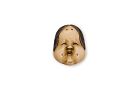
Ivory Netsuke of Okame Noh mask, signed Hikari (光) on the back.
Okame, also known as Otakufu, is a popular figure in Japanese folklore. She is often
depicted as a cheerful, jovial woman with a round, smiling face, plump cheeks and
small, squinty eyes. Okame is considered a symbol of good fortune and happiness...
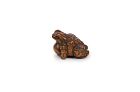
Netsuke of a wooden toad with its throat swollen. Made entirely in boxwood, the skin
is treated with detail, the naturalistic pause suggests that the toad is croaking, the
smooth texture of the goiter contrasts with the uneven sensation on the rest of the skin.
The facial expression is very amusing and mimics the one of a real toad.
The toad or frog (kaeru) is associated with good luck and wealth. Kaeru means both
"toad" or "frog" and "to come home" in Japanese...
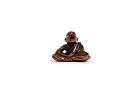
Boxwood netsuke of a seated professional sneezer depicted as an old man with his
right hand raised, holding an ivory stick to tickle himself. His head is slightly raised,
his eyes practically closed and his mouth wide open, signs that he is about to sneeze.
Himotôshi underneath, one hole larger than the other...
Dragon's Pearl
$1,000.00 An elegant and impressive charger of stoneware decorated in the mirror with a scale-like pattern in iron covered with a translucent ash glaze surrounding the centre, which is covered by a toned green glaze. The underside with the same semi-clear ash glaze. The shape of the charger is slightly convex. Fully marked in the bottom with the sign for Shimaoka Tatsuzo (1919–2007), the primary student among Hamada Shoji’s followers in Mashiko. No box...
DEVAGATI
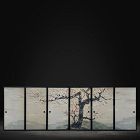
Price on Request Showa Period Plum Blossoms Fusuma
This exquisite 6-panel fusuma screen, hailing from the Showa period, captures the serene beauty of Japan's beloved plum blossoms. Each panel is meticulously crafted with high-quality Japanese paper, providing a delicate backdrop for the elegantly hand-painted plum tree that spans across the panels. The artwork vividly portrays the fleeting beauty of early spring, where plum blossoms emerge in a burst of life against tranquil landscapes...
DEVAGATI
USD $1,000 Late 19th Century Meiji Temple Dragon Panels
Magnificent Meiji-era temple panel is traditionally placed above the entrance, gracing the space with spiritual protection and aesthetic beauty. Each panel vividly depicts a dragon, a symbol of power, strength, and good luck in Japanese culture, intricately crafted with vibrant colors and dynamic movement. The dragons are set against a backdrop of stylized clouds and floral motifs, accentuated with gold, which highlights their divine nature...
Haruko Watanabe
$120.00 A role of cloth (tanmono) for a cotton kimono (yukata) with shibori. Shibori technique is one kind of Chidori shibori (plovers) which was invented in 1920s. Mostly in good condition but has a slightly indigo faded part in the selvedge. 1920s to 1980. W:30.5cm, L: about 7m40cm (before ironing with steam)
Zentner Collection
$6,000.00 Edo Japanese Fukusa Embroidery pair minogame turtle turstles amounst the Sea and surf. Dtails in gold in silver on a deep purple silk base. Backed in original orange material.
Edo Japanese fudog fukusa embroidery. The silk panel is embroidered in gold with detailed pair of minogames. Japanese mythical turtle that is said to live 1,000 years.
Zentner Collection
$8,250.00 Rare Edo Japanese fudog fukusa embroidery. The silk panel is embroidered in gold with detailed fu dog climbing the mountainous terrain. Backed on its original green velvet organic material.
In the 17th–19th centuries, fukusa were used to wrap gifts in a ceremonial setting...
Zentner Collection
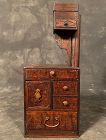
SOLD An antique Japanese sewing box called Haribako in the traditional form made of Toneriko (Ash) and Kurinoki (Walnut). The main body features 5 drawers of varying sizes where sewing accoutrements were stored. The neck supports a storage box with hinged top hiding a pin cushion and a small drawer for additional storage...
Kodo Arts
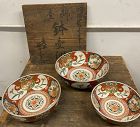
$550.00 Lovely set of 3 nesting Meiji Period Ca. 1900 Imari bowls with original wood box. Very good condition. Ask for shipping quote.
t a t a m i
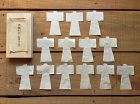
$200.00 OHARAE KATASHIRO Traditional Japanese Shinto paper doll as the substitute for a person, used as the target for a prayer or curse called 'Katashiro', used in the great purification rituals called 'Oharae' (ref. https://www.kamigamojinja.jp/en/rituals/nagoshi-no-oharae-purification-ritual/). This is an old dead stock set with no written name or age as unused. Showa period, 20th century. Katashiro - 12.2 x 8 cm (4.80 x 3.14in) each...
The Kura
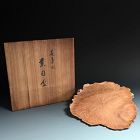
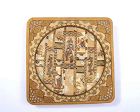
sold A wooden tray carved in the shape of a lotus leaf which seems to be almost as thin as the real thing, and amazing feat for the artist. It is 31 x 30 x 1 cm (roughly 12 inches diameter) and in excellent condition dating from the early 20th century and enclosed in a period wooden storage box titled Hasunoha-gata Kashibon.
2ezr
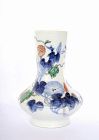
Inquire for Price 1930's Japanese Imari Arita Studio Porcelain Vase Marked Genroku Tominaga 富永源六
It is 7.5 inches (19 cm) tall by 5.3 inches (13.5 cm) wide...
2ezr
Inquire for Price 1920's Japanese Satsuma Earthenware Plate with Samurai and Geisha Figures Signed Seikozan
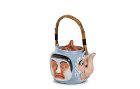
It is 0.78 inch (2 cm) by 5.9 inches (15 cm). It is 0.7 Lb. It has mild rubbing gold, surface wears and scratches (as seen in the photos). 168799 111719624eth Our Guarantee: We stand behind all of the items that we sell. That is to say, if you purchase an item from us and are unhappy with it for any reason, return it for a 100% refund of the amount you originally paid. All yo... Banko polychrome enamelled terracotta teapot, representing on each side masks from
the Japanese folklore. Handle in wicker work.
On the spout, Hyottoko, a comical and childlike character. He is recognizable by the
shape of his elongated mouth with two red dots (he blows fire with a bamboo pipe),
his white scarf with blue dots around his face and his eyes of different sizes. During
local festivals like in Miyazaki, he appears in traditional dengaku dances and plays the
role of a clown
...
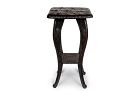
The Liberty and Co. was established in 1875 by Arthur Lisenby Liberty with the
intention of selling goods and furniture from all around the British empire. By the end
of the XIX th century, and with the growth in popularity of the arts and crafts
movement, the well implanted business diversifies. Most of the items sold were now
custom made for Liberty and are sold in the numerous shop of the firm. This specific
line occurred by the year 1905 and was fully made of hardwood in Japan. Wit...
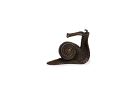
Bronze with a brown patina representing a snail with a very interesting pose. Its angular pose suggests that it could be exposed in such a way that he would mimic a
real snail going up or down a wall. The texture of the shell and the skin are rather
realistic and emphasize the expression of snail’s long globular eyes. A hole in its mouth
could be used to turn the whole sculpture into an incense burner.
Foundry stamp at the base of the tail
Japan – Meiji era (1868-1912)
Length: 7.5 ...
|