| Home | | | Items For Sale | | | Shops | | | Current Auctions | | | Auction Information | | | Auction Schedule | | | My Vervendi | | | Seller Registration | | | Bidder Registration (free) |
| Directory: Japanese (12525) |
|
Auctions MAIN CATEGORIES
|
Japanese : Woodblock Prints : Pre 1970
item #1499326
(stock #Hasui692)
Era Woodblock Prints
$275 Kawase Hasui
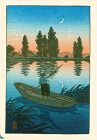
Fisherman at Sunset Date: 1930s. This edition 1950s-60s. Approximately 5.625 x 3.75 inches. Publisher: Watanabe Shozaburo. Artist's oval seal at lower left. Medium: Japanese woodblock print attached along its top edge only to blank, original 7 x 4.625-inch card. Condition: Excellent.
Haruko Watanabe
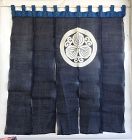
Sold, Thank you. Noren made of asa (probably choma, ramie), both wefts and warps are hand plied and vegetable indigo dye. It has family crest "Maru-ni-kazura Kashiwa Mon" (creeping plant and oak leaf in circle crest). One of the panels is missing. Cotton cloth of the top and belts are handspun and vegetable indigo dye. In good condition but has a few small holes. 19th century. W:157cm, L:171cm
Kodo Arts
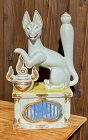
$380.00 1950's very large ceramic Shinto Shrine Inari Fox. 45cm tall x 28cm wide. excellent condition. Ask for shipping quote.
Petrie-Rogers Gallery
$450.00 Early edition Japanese shin hanga woodblock print by Toshi Yoshida (1911-1995) titled "Heirinji Temple Bell" dated in the left margin 1951. The print is pencil-signed in the lower right margin with the artist's red seal above. Paper size: 15 7/8" x 10 5/8" (image: 14 1/2" x 9 1/2"). Very good overall condition. There is an extremely faint sunstruck line in the margin and there is a tiny pencil notation on the back corner with the original yen price of 14,000.
Kodo Arts
$850.00 Wonderful Ca. 1910 old Shigaraki wood fired sembei style jar. Fired in a climbing kiln. 22cm tall x 17cm in diameter. great condition. Ask for shipping quote.
Japanese : Woodblock Prints : Pre 1960
item #1499299
(stock #Ohno027)
Era Woodblock Prints
$575 Ohno Bakufu
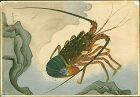
Spiny Lobster Great Japanese Fish Picture Collection (Dai Nihon Gyorui Gashu), Volume 1. Date: 1937-38. Size: Approximately 15.875 x 10.875 inches. Artist's signature and seal upper left. Publisher: Nishinomiya Shoin. This edition with the red circular seal in the lower corner was likely published by Kyoto Hanga-in in the 1950s. Medium: Japanese woodblock print. Condition: Toning...
2ezr
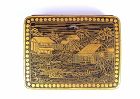
Inquire for Price 1910's Japanese Iron Mixed Metal Rectangular Shaped Box with Village Scene
It is 0.82 inch (2.1 cm) tall by 2.4 inches (6 cm) wide by 1.8 inches (4.5 cm) long . It is 105 gram. It is tarnished and has rust, loss of gilding, surface wears, and scratches (as seen in the photos).Our Guarantee: We stand behind all of the items that we sell...
2ezr
Inquire for Price Japanese Studio Peachbloom Porcelain Mini Vase by Makuzu Kozan 香山
It is 3.15 inches (8 cm) tall by 2.08 inches (5.3 cm) wide. It is 80.3 gram. It has mild skip glazes, surface wears and scratches (as seen in the photos). 16443908062024oby Our Guarantee: We stand behind all of the items that we sell. That is to say, if you purchase an item from us and are unhappy with it for any reason, return it for a 100% refund of the amount you originally paid...
t a t a m i
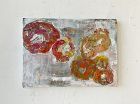
$180.00 UNTITLED Oil painting on canvas, with unidentified painter's sign, 33.5 x 24.5 x 2 cm (13.18 x 9.64 x 0.78in). selected by hotoke * Please understand that EMS shipping fee is additionally charged, and also confirm our Sales Policy before purchase, since your order will be assumed to have fully acknowledged our Sales Policy under any circumstances. Thank you.
t a t a m i
$250.00 TIGER OF BEADS Anonymous beading picture attached with frame, Showa period, 20th century, Japan, 48.5 x 41 x 4.4 cm (19.09 x 16.14 x 1.73in)...
GALERIE TIAGO
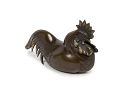
SOLD Okimono bronze sculpture of a reclining rooster.
In the Kojiki (lit. “Records of Ancient Matters”), a collection of myths about the origins
of Japan, the rooster manages to lure the solar deity Amaterasu out of her cave by
using his song and a magic mirror.
Japan – Meiji era (1868-1912)
Width: 3.1 in (8 cm) – depth: 7.9 in (20 cm) – height: 4.3 in (11.8 cm)
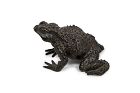
Okimono bronze sculpture of a toad.
The toad or the frog (kaeru) is associated with good luck and wealth. Kaeru means both
“toad” or “frog” and “to return home” in Japanese. This meaning is due to the toad’s
ability to return each year to the pond of its birth. A gong in the shape of a toad can
sometimes be used as a door hammer or to protect house.
Japan – Meiji era (1868-1912)
Width: 4.3 in (11.5 cm) – depth : 4.7 in (12.5 cm) – height: 2.4 in (6.8 cm)
GALERIE TIAGO
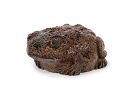
sold Sculpture in varnished bamboo representing a toad.
The wood, before being carved, was attacked by xylophagous insects, which hollowed it out
by forming cavities. After treating and stabilizing the wood, the sculptor was able to use this
appearance to depict the toad's grainy skin: its skin is pustular.
In the Japanese bestiary, the toad occupies a special place, carrying positive values...
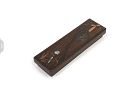
Brush box (fudebako) made of wood and lacquer. On the lid, lacquer decoration
representing sagittarius, a flower inlaid with ceramic and a leaf inlaid with mother-of-
pearl (raden).
Interior and base of the box in nashi-ji lacquer.
Japan - Taisho Era (1912-1926)
Height: 1.4 in / 3.5 cm - width: 2.8 in / 7.2 cm - depth: 9.4 in / 23.9 cm
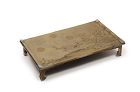
Rectangular bundai writing table on four legs in gold lacquer with black highlights on
a nashi-ji background...
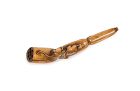
Curious netsuke or Okimono repurposed as netsuke made of dear antler. It represents a bag,
probably full of rice that is held closed by three stings. On the top of the curve are two mouse
or dormice. Their fur and tails are detailed, and eyes made of buffalo horn.
Unidentified signature
Japon – Meiji era (1868-1912)
Length: 7 cm – width: 3 cm
GALERIE TIAGO
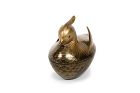
sold Gold lacquer kogo incense box in the shape of a mandarin duck. Its feathers are
delicately rendered in takamaki-e on the back and hiramaki-e on the belly. Gold, silver
and copper nashi-ji lacquer interior.
Inlaid horn eyes.
Japan – Edo period (1603-1868)
Height: 3.5 in / 9.5 cm – width: 2.7 in / 7 cm – depth: 4.7 in / 12 cm
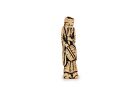
Netsuke representing Jurôjin standing, he is holding his long beard his left hand and
in his right hand he holds a fan. He is wearing a long robe decorated with cloud
motives and a traditional hat
Jurôjin is a god of longevity and among the Seven Gods of Happiness, according to the
Taoist beliefs. He is depicted as an old man with a long white beard, wearing a high
hat and a long robe. His attributes are the fan and the pilgrim stick...
|