| Home | | | Items For Sale | | | Shops | | | Current Auctions | | | Auction Information | | | Auction Schedule | | | My Vervendi | | | Seller Registration | | | Bidder Registration (free) |
| Directory: Japanese (12506) |
|
Auctions MAIN CATEGORIES
|
Asian Art By Kyoko
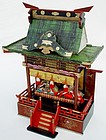
Inquire for Price This is a Hina Goten (Palace) doll house for the Girl's day in Japan, also known as Hina-matsuri or Sekku. Traditionally it is the day to celebrate and honor the young girls in the family. I remember my days playing with our antique hina dolls. Unfortunately, ours were all destroyed over the years. I guess that our temptation was a little too strong to play around with these attractive removable attachments, including the swords...
Asian Art By Kyoko
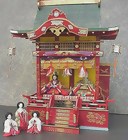
Inquire for Price The Hina dolls palace is for the Japanese Girl's Day, Hina Matsuri festival. The Hina doll set that I grew up with was displayed in the steps style, which is a common way of displaying 15 dolls with furniture. I have never seen this type of Hina Goten (Palace) until I found several of these recently. It tells us how different things used to be (and still is to some extent) according to regions. The hina dolls were modeled after the Imperial Court from the Heian period (794-1192)...
Asian Art By Kyoko
sold
Asian Art By Kyoko
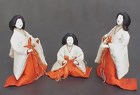
Inquire for Price These dolls are a part of the Hina doll set displayed for the Japanese Girls Day, Hina Matsuri (Festival) in March. The day is also called Peach Festival. When the peach blossoms open in February to March by breaking through the snow, it is an announcement of the beginning of spring in Japan. The blossoms are very much associated with women’s strength and for this reason, along with their beauty, daintiness and softness, these are all desirable characters for women...
Asian Art By Kyoko
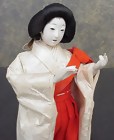
Inquire for Price This standing Court lady is in extremely in good quality. She is probably from the Taisho Period (1912
Asian Art By Kyoko
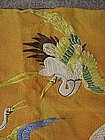
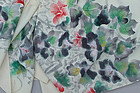
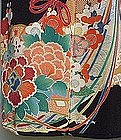
Price on Request Hand painted (dyed) long silk roll, long enough to make one full kimono; 14 1/4" wide x 44' long. The designs do not repeat, some are to be matched for the width. The base color is a soft creamy color with a slight color change on the edge. 100 percent pure silk...
Asian Art By Kyoko
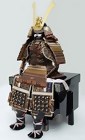
Sold. Thank you! Japanese Boy's Day samurai Yoroi and Kabuto (armor,helmet) set. Musha ningyo (Samurai dolls), Yoroi and Kabuto (helmet), swords, banners and carps are a part of the display used for the Boy's Day in Japan.
Culturally, the Japanese emphasize anything to do with children. The Girl's day with hina dolls is in March. The warrior's set like this will inspire boys in their manliness and hopefully bravery, discipline and honor codes come with it.
All the fabric used marked as pure silk...
The Kura
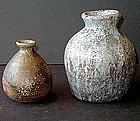
Sold, Thank you A Stunning combination of works by mother and son Koyama Kiyoko (1936-present) and Koyama Kenichi (1961-1992), both in the original signed wooden boxes. The Tokkuri, by Kiyoko, is of bulbous form decorated with slips of green glaze used sparingly around the neck. The terracotta body is fired to a deep amber on one side, the bright orange clay indicative of Shigaraki showing through on the other...
Asian Art By Kyoko
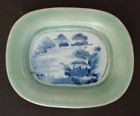
Price on Request The shape of this oval Japanese Arita dish derives from European forms. The
combination of colors (Celadon and blue & white) is known to be produced from 1780 – 1820, a late Edo example. The dimensions: 7 1/2" x 6"
Asian Art By Kyoko
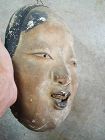
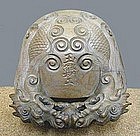
$340.00 Japanese female mask in the style of a Noh mask. This face may have been considered beautyiful many years back, but now it carries a heavy-duty insult to any ladies if they were to be called Otafuku-chan or Okame-san in Japanese. Otafuku-kaze is the mumps and there are popular snack beans called Otafuku-mame, shaped exactly like this face.
Otafuku simply means “much happiness”. Also known as Okame or Uzume, this face has been the symbol of good wishes for health and happiness...
Asian Art By Kyoko
sold
Asian Art By Kyoko
sold
Japanese : Pre 1960
item #47190
Asian Art By Kyoko
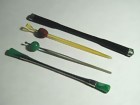
Sold Included in this Japanese kanzashi set are jade kanzashi, jade and red kougai and genuine black lacquer kanzashi with jade at the ends. One of the jade has scratches as shown.
Asian Art By Kyoko
sold
Asian Art By Kyoko
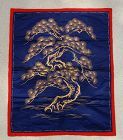
Price on Request This is an old silk fukusa from Meiji period (1868-1912). This type of fukusa is a covering placed over a gift at the time of a gift-giving ceremony. Lined with a deep red crepe silk, this fukusa is almost in perfect condition.
Pine trees are considered as sacred in Japan. Here, an ancient pine tree is mostly done with the gold couching, overlaying of threads (wrapped in gold) rather than going in and out of the base fabric...
Asian Art By Kyoko
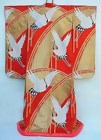
Price on Request Taiko bashi (arched bridge) in very beautiful red! The condition of this Japanese wedding gown is very new. The measurements are: 51"w x 71"long
Please see my other Japanese wedding gowns.
Asian Art By Kyoko
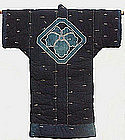
sold This is an old Yogi, a futon/blanket for the colder parts of Japan. It is a thick cotton dyed in the "Japanese blue", ai/indigo with a tsutsugaki (freehand painted rice paste resist) family crest on the back and stuffed with a cotton inside. The whitle little spots that you see are cutton balls from inside. The condition is excellent; some faint brown stains on the right side bottom and the lower left side bottom of the inside which is giving a charactor to this beautiful piece...
Asian Art By Kyoko
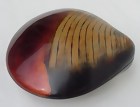
$280.00 Shell shaped Japanese lacquer container. This is not something that was made quickly or should I say, "well layered". It comes with a beautiful luster, indescribable. It is beautiful.
The measurements: 8 2/3" x 8 1/4" x 3 2/3"H |