| Home | | | Items For Sale | | | Shops | | | Current Auctions | | | Auction Information | | | Auction Schedule | | | My Vervendi | | | Seller Registration | | | Bidder Registration (free) |
| Directory: Japanese (12509) |
|
Auctions MAIN CATEGORIES
|
The Kura
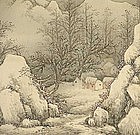
Sold, Thank you A collection of huts glow softly huddled in the protection of towering rocks in this lovely winter landscape by Akamatsu Unrei (1893-1958) enclosed in the original signed wooden box dated 1928, which itself is in turn enclosed in a protective red lacquered wooden box (nijubako). A true master of the genre, Unrei was born in Osaka, and apprenticed under Koyama and later the famous Nanga-ka Himejima Chikugai...
The Kura
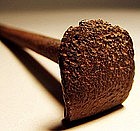
Sold, Thank you A pair of ancient iron tongs for working charcoal within the furo during the Japanese Tea Ceremony enclosed in an ancient wooden box titled HiBashi, Todaiji Kawara-Kugi, or charcoal tongs, Todaiji, Roof Tile Nails. One of the nails shows deterioration in the center where it rusted on the surface between the tile and the roof. The hand forged nails are just over 9 inches (23.5 cm) long, folded over on the flattened ends to form the head...
The Kura
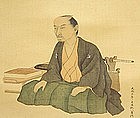
Sold, Thank you A fine Edo period portrait of a sinewy middle aged samurai proudly seated before a pair of swords, a table upon which rests an ink stone and book at his right elbow. Exquisite detail in the figures face and fine lines and shadows in the clothing are reminiscent of portraits by the great artist Watanabe Kazan. The portrait is signed Higashiyama Giryo and dated Tenpo 3 (1832) and the epitaph is signed Raijo. The portrait appears to be of a samurai named Kanda Hojo...
The Kura
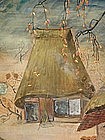
Sold, Thank you A noborigama (multiple chamber climbing kiln) ascends the right side of this wildly brushed Autumnal Nihonga screen signed Takuji, which dates from the late 1920s or 1930s. Drastically contorted thatched buildings are shaded by a massive leafless tree which dominates the center of the scene. A few remaining leaves dangling after winters first frosts, shine with gold about the edges...
The Kura
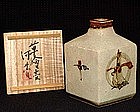
Sold, Thank you A square bottle vase by one of the most sought after and influential of all Japanese ceramic artists, Kawai Kanjiro (b. 1890), enclosed in the original kiri box signed by the master, which we have had authenticated at the Kawai Kanjiro Memorial Museum (now endorsed on the top by his daughter, Kyoha). The pale crackle glazed vase dates circa 1935, and is decorated with flower like dabs of rust and cobalt typical of this period, with dark iron fading out from the square mouth and base...
Welcome To Another Century
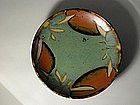
$120.00 Serving plate. Over a grayish brown stoneware a geometrical design in blue, brown and green glazes, partly with fine crackle.
Unsigned, Mashiko ware. Japan, 2nd half 20th century. Diameter 10 ¼ inches, height 2 inches. Slight traces of usage, otherwise very good condition.
The Kura
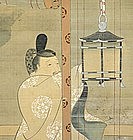
Sold, Thank you A gentleman standing in courtly robes takes advantage of a warm spring night to get in some reading. Standing on the balcony he puts light to a hanging lantern, illuminating cherry blossoms wrapped in evenings misty veil beyond the rail. This is an excellent example of Meiji period Yamato-e signed Saiho which has been fully re-mounted in quality patterned brocade, and retaining the original bone rollers...
The Kura
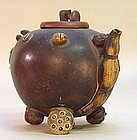
Sold, Thank you A very unusual unglazed small tea pot decorated with various nuts and seeds all in three dimensional relief, featuring a mushroom shaped lid dating from the later 19th to early 20th century. Known as Banko in Japan, the kilns which produced these items were also responsible for the Sumidagawa pottery so popular in the west. This piece has 8 seeds about the shoulder, including peanut, pumpkin and sunflower...
Welcome To Another Century
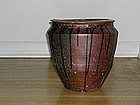
$1,300.00 Storage jar with beautiful dark brown glaze drippings from the neck and shoulder down, over a dark brown stone ware with countless inclusions. Around the neck engraved with cross pattern. Shape somewhat distorted. Height 11 inches, width 10 inches. Two short cracks at the rim, one small chip at the rim, glaze partly rubbed due to extensive usage. Overall condition good. Japan 18/19th century.
The Kura
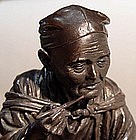
Sold, Thank you There is incredible detail in all aspects of this huge bronze sculpture of a jacketed monkey and his elder handler resting on a bronze base signed Shojun (also read Katsunori), dating from the mid 20th century (1935-1965). Taking a break between performances, the aged man pulls out his pipe and tobacco pouch, his wizened countenance seeming as if speaking some soothing words to the creature, perhaps otsukare-sama. A chain runs from his wrist to a collar around the animals neck...
Welcome To Another Century
$900.00 Stoneware bottle with a short neck with rolled lip used for storing sake or other liquids on board of ships. Body and neck ribbed, decorated with a yellowish brown slip-like patch of glaze on the shoulder.
Height 12 inches. Japan, early Edo period. Some irregularities due to firing, excellent condition. Provenance: from the collection of CC Wang.
The Kura
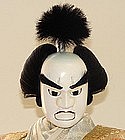
Sold, Thank you This is a superb Bunraku puppet of the historical figure Minamoto Yoshitsune, one of the lead characters from the Tale of the Heikei and legendary fighter in Japan. The doll is incredibly mobile. Head moving up and down, his eyes open and close and move left to right. His eyebrows can be raised and lowered, and mouth opened or closed, all from toggles inside his kimono on the extended neck piece...
Welcome To Another Century
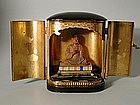
$750.00 Travel shrine, or zushi, with sitting figure of Kukai, carved in wood. The founder of the Shingon sect sits on a low pedestal, his shoes put underneath. In his left hand he holds the rosary, in the right he formerly held a vajra. Figure carved in plain wood, the pedestal decorated in gold and the typical red, white, green and blue. The inside of the doors decorated with lotus flowers in dull gold lacquer on shining gold lacquer...
The Kura
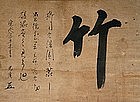
Sold, Thank you The character Take (bamboo) is struck with six brisk strokes of dark ink on this Chagake tea scroll signed Mitsuhiro (Karasuma Mitsuhiro, 1578-1638) and dated 1631. The calligraphy is exquisite. Mitsuhiro was born the son of Karasuma Mitsunobu (1543-1606) and, like his auspicious father, was a well known poet and songwriter accomplished in calligraphy...
The Kura
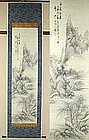
Sold, Thank you A surreal ink on cloth landscape by Kyoto artist Nakanishi Koseki (1807-1884) bordered in rich blue patterned silk and featuring radical flaring rosewood rollers. Soft ink tones and heavy washes of gray clash with the brisk strokes and jagged lines of the painting, creating a vivacious scene...
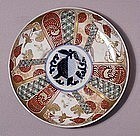
The size of Plate: 7 1/4" Dia x 1 1/8". Pretty Japanese Ko Imari Plate. The plate has blue underglaze design with red, gold design in the center. There is two design around with total three windows and three strip decoration. One with Crane and Pine tree with gold karakusa design. Other stripe design with red Karakusa and green geometric design. All of design are done with very good detail work. The condiiton of plate very good, no chip, no crack and no hairline. The some of gold has wear on pin...
Welcome To Another Century
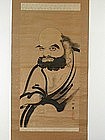
$350.00 Half portrait of Daruma in bold strokes of gray and black. Lower right signature Isshin hitsu and two seals. Black and gray ink on paper. Painted area 36 ½ x 8 ½ inches. Toned, some horizontal creases, repaired missing area at lower middle. Celluloid scroll ends.
Feel free to ask for more pictures.
Welcome To Another Century
$300.00 Ebisu sits on a rock, a bamboo stalk in the hand, as if holding a fishing rod, a giant red carp stuck under his arm. Daikoku stands on rice bales and holds his hammer in the hand. Around them a split daikon and the coat and hat of invisibility. On the lower right two seals: Kachutei Ninsei (or Jinsei). Ink and colors on paper (black outlines are hand painted, NOT printed). Painted area 11 ¾ x 18 1/8 inches. Toned, several horizontal creases, some of them backed, few vertical creases restored, f...
|