| Home | | | Items For Sale | | | Shops | | | Current Auctions | | | Auction Information | | | Auction Schedule | | | My Vervendi | | | Seller Registration | | | Bidder Registration (free) |
| Directory: Japanese (12525) |
|
Auctions MAIN CATEGORIES
|
JJ Oriental
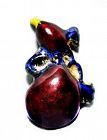
$575.00 An elegantly hand-crafted cloisonne obidome of a double-gourd form. The burgundy-colored glass enamelling of the gourd is thickly applied and translucent. The cobalt blue "rope" around gourd has pure gold highlights. Can be used as a pendant.
Size: L. 5cm. W. 3cm. Condition: No repairs.
Momoyama Gallery
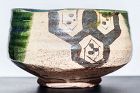
sold Beautiful half cylinder shaped (hanzutsu) tea bowl from the early stage of the Edo Period (1603 - 1868) with a rounded brim, made of iron bearing, coarse, unrefined Narumi Mino clay. The expertly thrown body was trimmed with a potter's knife in its lower part. The unglazed foot is relatively large...
Zentner Collection
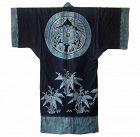
SOLD Antique Japanese large indigo Tsutsugaki yogi robe made out of a futon cover, with a paste-resist Kikumon, or Chrysanthemum crest on its back, also called the Imperial Seal of Japan. Tsutsugaki is a technique in which bindings are applied to the cotton threads in any desired pattern and dye is applied over them. The bindings resist the dye, leaving behind patterns in the original color of the threads. The edges of fabric are sewn together using white sashiko stichwork...
Zentner Collection
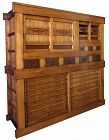
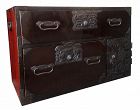
SOLD Antique Japanese two section 6ft Mizuya (kitchen tansu) make with Hinoki (cedar) wood, with Keyaki (elm) burl panels.
The top section has two sets of sliding doors, one with mesh, all with ornately carved panels across, the lower portion has eight small drawers with beautiful Keyaki burl.
The bottom section houses a single shelf behind two large sliding door panels. Its sides are reinforced with horizontal braces. Meiji period (1868-1912)
Size: 71.5" L x 20" W x 67.5" H
Zentner Collection
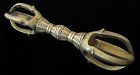
$1,600.00 Antique Japanese bronze vajra, an important symbol in Vajrayana Buddhism, Hinduism, and Tantra religions. The name vajra means both thunderbolt and diamond, as it is a symbol of brute strength and indestructibility. Its center piece represents the center of the universe with lotus pods blooming outwards to extend the five pronged weapons. The five prongs represent the "Five Poisons" which prevent humanity from reaching enlightenment...
EastWest Gallery
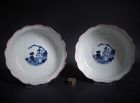
Sold A pair of Namasu or small serving bowls in revived Kakiemon style decorated with a depiction of the Seven Sages of the Bamboo Grove in low moulded relief; here represented by just two of them. The Sages were synominous with a hedonistic lifestyle of drinking and poetry. The foliate rims of the dishes are painted with a fuchi beni, iron brown glaze...
Japanese : Woodblock Prints : Pre 1940
item #1356368
(stock #Ohara152)
Era Woodblock Prints
SOLD Ohara Koson (Shoson)
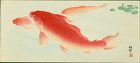
Three Red Carp, water plant above Size: Yoko o-tanzaku. Approximately 15.25 x 6.75 inches. Date: ca. 1920s-1930s. "Paris, August 1939" noted in pencil on the verso in French. Publisher: Watanabe Shozaburo. Medium: Japanese woodblock print. Reference: S39.3 and Watanabe W36-571 in Crows, Cranes and Camellias: The Natural World of Ohara Koson (Reigle Newland). Condition: Excellent.
Kyoto Ceramics and Fine Art
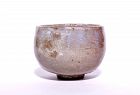
Sold, Thank You! This piece features a warm golden crackled glaze with several patches of lighter pigmentation and a number of gold and silver repairs. The inside of the bowl is especially inviting, showing a magnificent patina developed over many decades of use...
Japanese : Tea Articles : Pre 1900
item #1356259
(stock #TRC1661)
Kyoto Ceramics and Fine Art
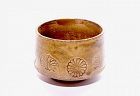
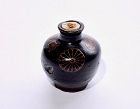
Sold, Thank You! The jet-black glaze of this cha-ire (tea caddy) nicely highlights the Chrysanthemum flowers (Kiku) adorning the upper surface—long considered auspicious symbols of longevity and rejuvenation in Japan. When first introduced to the island nation during the Nara period (710 – 793 AC), the Japanese Royal Family was fascinated with the Chrysanthemum. Over time, it became the Imperial Family Emblem and during certain eras was generally forbidden to be used by the general public...
Zentner Collection
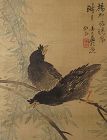
$4,000.00 Antique Japanese painting on silk, of a pair of black birds pierced on the branch of a tree. With calligraphy and red chop signature.
Size: 12.5" W x 52" H (entire scroll) 7.75" W x 18.75" H (painting only)
Zentner Collection
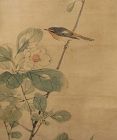
SOLD Antique Japanese scroll painting of a small bird, perching on the branch of a tall growth of flowers. Signed with red chop.
Size: 16" W 9 69" H (entire scroll) 10.25" W x 38" H (painting only)
Zentner Collection
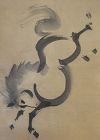
SOLD Antique Japanese scroll painting of a horse, done in sumi ink, its legs kicked up into the air. Very disciplined calligraphy brush work is used, and may have been executed by a Zen Buddhist monk. This horse painting was possibly cut down from a larger screen and mounted as a scroll.
18th century Edo period (1603-1868) Size: 17.5" W x 52" H (entire scroll) 14.25" W x 20.75" H
Zentner Collection
SOLD Antique Japanese small Kiri tansu from the Sakata region, with red lacquer top and sides and black lacquer front. Motifs of bamboo, pine, kiri leaves, and other floral imagery can be seen in the iron plates of each drawer. The bottom right corner houses an ornate lockbox with two small drawers inside. Meiji period (1868-1912)
Size: 33.25" L x 16" W x 21.5" H
Japanese : Other Prints : Pre 1980
item #1356206
Zentner Collection
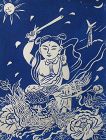
SOLD Original Japanese print by well known artist Mayumi Oda (1941-present), titled "Let Wisdom Arise Within Us" (Blue) , number 23/100, and signed in pencil along the bottom. Wonderful depiction of a goddess wielding a sword while riding on the back of a growling fu lion, surrounded by large bouquets of peonies, the flower petals blown around her by mystic winds.
Size: 19" W x 26" H
Kyoto Ceramics and Fine Art
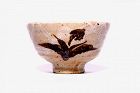
Sold, Thank You! The name “Tobe-ware” first appeared in historical documents in the mid-18th century, though the tradition itself dates back well over 1,000 years. Within this style can be found an abundance of fine porcelain and celadon works as well as works painted with dark ferrous glazes—such as the piece featured here.
The creator of this fine work Sakai Yoshito (b. 1931) has been the main figure in maintaining the Tobe-ware tradition in modern times...
Japanese : Tea Articles : Pre 1900
item #1356081
(stock #TRC18331)
Kyoto Ceramics and Fine Art
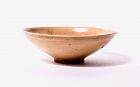
Sold, Thank You! This remarkable hira tea bowl displays a subtle grace and refined elegance grounded in classic form, masterfully applied glazing, and a delightful rustic feel bestowed by the hand of time. Though the glazing is described as shiro-yu, or white glazing, it appears more of a creamy shade of beige...
Japanese : Tea Articles : Pre 2000
item #1356057
(stock #TRC1657)
Kyoto Ceramics and Fine Art
Sold, Thank You! One of my personal favorite shapes for a chawan, the wa-nari (sometimes pronounced rin-nari) appears firmly grounded and balanced at all times. With round curving surfaces so natural in the hand—they conjure images of ripe fruit waiting to be devoured.
This piece was produced by Koizumi kiln in Aichi Prefecture, most likely by the head potter Kato Shineda—though it only bears the seal of the kiln and not the potter...
Japanese : Tea Articles : Pre 1900
item #1355987
(stock #TRC1655)
Kyoto Ceramics and Fine Art
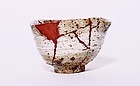
Sold, Thank You! Surely an extraordinary confluence of circumstances must have come into alignment in order to bring this remarkable composition into existence. Done in the Korai style—referring to the heavy influence from Korean forms and glazing—this exquisite Edo period Karatsu-ware tea bowl features a white stripe running horizontally along the outer surface of the bowl known as Hakeme...
|