| Home | | | Items For Sale | | | Shops | | | Current Auctions | | | Auction Information | | | Auction Schedule | | | My Vervendi | | | Seller Registration | | | Bidder Registration (free) |
| Directory: Japanese (12525) |
|
Auctions MAIN CATEGORIES
|
Zentner Collection
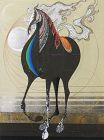
$8,500.00 Large Japanese woodblock print of a horse by the artist Nakayama, Tadashi (born 1927). Titled, "Cyclone". This image of a horse stands with it's mane billowing with bits of color and metalic leaf. The head of the horse is patterned with colors while most of the body remains a dapple of charcoal and white. In the background, a series of thin circular lines accent a metalic leaf sun or moon. Signed in pencil and numbered 85 of 85...
Zentner Collection
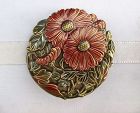
$450.00 Japanese Satsuma ware obidome (obi broach) made of ceramic and decorated with orange blossoming chrysanthemums. This three dimensional obidome is painted with gold details and has a slot in the back through which an obijime cord can be strung. With signed kiri wood tomobako.
Taisho Period (circa 1920) Dimensions: 1 3/4" diameter
Zentner Collection
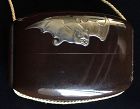
sold Japanese antique inro with one compartment, carved of wood and lacquered a very dark brown. On one side, a silvery bat flies through the air. On the other side, a fishing net hangs to dry on a fence. The fishing net is done in gold lacquer and the fence is made of shell inlay. The inside of the inro case is lacquered a deep red with gold edging.
Late Meiji Period (1868-1912) Dimensions: 2 1/8" high x 3" wide
Zentner Collection
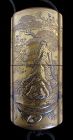
$3,000.00 Antique Japanese inro with three compartments, made of wood with gold lacquer and inlaid with gold flecks. One side is decorated with a pair of cranes and sprouting pines. The other side of the inro depicts an ancient turtle who carries, on his back, a large rock formation. Out of the rock sprouts a plum tree, a pine tree and bamboo - together called Sho chiku bai or "The Three Friends of Winter". The inside of each compartment is cover with dense nishji lacquer (fine gold flecks)...
Japanese : Woodblock Prints : Pre 1900
item #1383579
(stock #Hokusai008)
Era Woodblock Prints
SOLD Katsushika Hokusai (1760-1849)
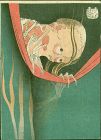
The Ghost of Kohada Koheiji From Hyaku Monogatari (One Hundred (Ghost) Stories) Published by Tsuruya Kiemon ca. 1833. This edition Meiji 19th century. Size: Chuban. Approximately 10 x 7.25 inches. Condition: Very light creasing. Medium: Japanese woodblock print. This rare print depicts the murdered Kohada pulling back a mosquito net as he returns to haunt his wife and her lover.
EastWest Gallery
$160.00
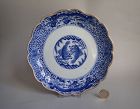
A very fine sometsuke dish of scalloped octalobed form painted with a mon form central motif of a symmetrically arranged pair of leaping carp. Framed by a continuous band of botan karakusa, Peonie lotus scroll, within which are reserves containing, dragons, Ryu, in clouds and a gilt rim, kin-beni. The reverse decorated with hagi-karakusa, vine pattern and a six character mark for the Chinese Emperor Jiajing. The quality of the painting is of the highest quality...
EastWest Gallery
Sold A very fine sometsuke dish of scalloped octalobed form painted with a mon form central motif of a symmetrically arranged pair of leaping carp. Framed by a continuous band of botan karakusa, Peonie lotus scroll, within which are reserves containing, dragons, Ryu, in clouds and a gilt rim, kin-beni. The reverse decorated with hagi-karakusa, vine pattern and a six character mark for the Chinese Emperor Jiajing. The quality of the painting is of the highest quality...
Momoyama Gallery
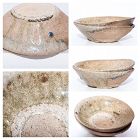
sold A historic-cultural highlight: we proudly present a more than 1000 year old Yama Chawan with a strong kai-yu glaze. Once in a while you can find a traditional unglazed yama chawan on the antique market, but a Yama Chawan with a strong and vivid kai-yu glaze is very very rare...
Zentner Collection
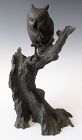
SOLD The Japanese bronze maker is known for its high quality and attention to detail rendered in bronze, silver, and other precious materials. The exposure to the world's fair has showcased the Japanese skilled artisan in many different styles and categories. Naturalism and realism was the template to the Western taste during the Meiji period.
This is a fine example of a great horned owl in bronze depicted in naturalism. The okimono owl is perched on a gnarled branch preening itself...
EastWest Gallery
$115.00
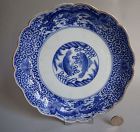
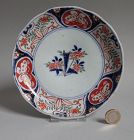
A dish of scalloped rim form of six-sun size decorated with a central motif of a bouquet of Cherry blossom wrapped in the traditional manner for formal presentation with a sheath of washi paper, tsutsumi, shaped into a horn and tied with cord. The rim of the dish decorated with auspicious motifs of gobenka and cho butterflies in the typical Imari three colour palette dating to the Kyoho period circa 1710-40.
The reverse decorated with ribbon ties and trailing flowers...
EastWest Gallery
$115.00
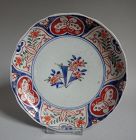
A dish of scalloped rim form of six-sun size decorated with a central motif of a bouquet of Cherry blossom wrapped in the traditional manner for formal presentation with a sheath of washi paper, tsutsumi, shaped into a horn and tied with cord. The rim of the dish decorated with auspicious motifs of gobenka and cho butterflies in the typical Imari three colour palette dating to the Kyoho period circa 1710-40.
The reverse decorated with ribbon ties and trailing flowers...
Modern Japanese Ceramics
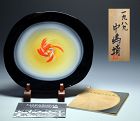
sold, thank you Crimson petals seem to swirl about a vortex of yellow fading to white on the overall black glass surface of this plate by Nakashima Yasushi enclosed in the original signed wooden box and exhibited at the 19th Nihon Dento Kogeiten exhibition (catalog included). It is 14 x 16 inches (35.5 x 41.5 cm) and is in excellent condition. It is titled Anba Unmo Nami-Uchi Sara, Roran no Hana. (I believe he is using the first two characters as “ateji” meaning Amber Mica Waved Dish, Orchid Flowers)...
Japanese : Tea Articles : Pre 1940
item #1383208
(stock #AOR6778)
The Kura
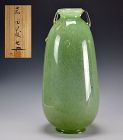
sold, thank you A large glass vase of emerald green reflecting the ancient glass works found in the Shosoin Imperial repository by 20th century pioneering glass artist Iwata Toshichi enclosed in the original signed wooden box. Flecks of various colors and air permeate the glass, accentuating the fact he is duplicating the ancient glass works, long before techniques had been perfected and material purified. It is quite large at 15-/2 inches (40 cm) tall and in excellent condition...
Hawkes, Asian Art
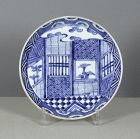
£275.00 A Japanese porcelain steep-sided dish depicting a traditional zashiki room or perhaps a temple interior. The plants seen through the windows are banana and cycad, both common in warmer climates as experienced in Kyushu or Okinawa...
Hawkes, Asian Art
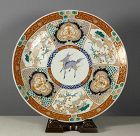
£330.00 A very large plate decorated with a kylin surrounded by panels of cranes among pine and prunus trees, separated by formal lotus flowers.
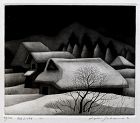
Just a tad under 41 cm diameter. No cracks, chips or restoration. Some light wear from use. Stand not included. Please study the photographs. For new customers resident in China sadly I have to state that I am no longer prepared to accept payment by PayPal. I will accept payment only by bank to bank transfer in British P... Japanese limited-edition mezzotint depicting a traditional village in snow by Koichi Sakamoto (b. 1932) titled “Enduring Village No. 1.” The print is pencil-signed, titled in English and kanji, and numbered 68/100 in the lower margin. Dates circa 1982. The artist’s watermark is in the lower right margin. Paper size: 9” x 11” (plate about 5 1/2” x 6 1/2”). The white archival mat folder measures about 12 1/2” x 13 1/2.” Excellent overall condition. The print is attached to...
Japanese : Other Prints : Contemporary
item #1383011
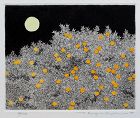
Japanese limited-edition copperplate etching and aquatint by Tanaka Ryohei (b. 1933) titled “Tree of Mandarin” dated ‘08. Pencil-signed, dated ’08, and numbered 20/100 in the lower margin. Paper size: 10 1/2” x 11 3/4” (image: 6 1/2” x 8”). Never framed. Excellent original condition.
Zentner Collection
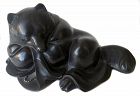
$7,000.00 Antique Japanese bronze okimono, animated in a recumbent pose. The tanuki clothed in Buddhist monk robes, curled and withdrawn for rest. A strand of prayer beads is visible out from underneath his crossed front legs.
The sculpture is skillfully cast with a bronze dark russet patina, essentiated by the chasing of the hair and the smooth surface of the folds. The artist has also rendered in detail of the tanuki's paws, which is the underside of the sculpture signed "Yoshiyama".
Me... |