| Home | | | Items For Sale | | | Shops | | | Current Auctions | | | Auction Information | | | Auction Schedule | | | My Vervendi | | | Seller Registration | | | Bidder Registration (free) |
| Directory: Japanese (12513) |
|
Auctions MAIN CATEGORIES
|
Japanese : Tea Articles : Contemporary
item #1383814
(stock #TRC2205711)
Kyoto Ceramics and Fine Art
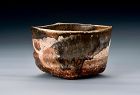
Sold, Thank You! This piece is described on the box as a Hikidashi Kuro Chawan. In Japanese hikidashi means “a pull-out drawer” and the term first came into use at Mino kilns in the 16th century to describe individual pieces that were pulled out of the wood kiln at the peak of firing to gauge if the batch was ready. The rapid cooling of such pieces often creates dramatic effects, with the most noted being rich varieties of deep black...
Zentner Collection
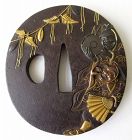
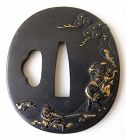
$4,200.00 Japanese hand-forged iron tsuba, used to protect a swordsman's hand from sliding up the blade during use as well as to provide balance. The front depicts two joyful festival performers, one holding a drum and the other holding a fan, the figures in relief with gilt accenting throughout. The backside of the tsuba shows a large mallet and mortar traditionally used for pounding rice into mochi.
Dimensions: 2 3/4" x 3"
Zentner Collection
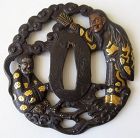
SOLD Japanese hand-forged iron tsuba, used to protect a swordsman's hand from sliding up the blade during use as well as to provide balance. The openwork tsuba depicting two sages, their robes accented in gilt, one sage with a face of silver and the other with a face of copper. The front image is signed 'Soheishi Nyudo Soten' , the other side reads 'Goshu Hikone ju' (resides in Goshu-current Shiga prefecture).
Dimensions: 3 1/8" x 3 1/4"
Petrie-Rogers Gallery
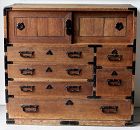
$500.00 Japanese ko tansu (personal chest) with two sliding doors opening to a compartment on top, five smaller drawers, and a sixth drawer extending along the bottom. Two side carrying handles. Pawlonia (kiri) wood with black iron hardware. Late Meiji to early Taisho Period (circa 1900 - 1920). 26 1/8" wide x 24 3/8" high x 13" deep. Very good solid overall condition. There are a few old repairs to the right sliding door, which is a bit difficult to slide open...
Zentner Collection
SOLD Japanese tsuba, a sword fitting to protect a swordsman's hand from sliding up the blade during use as well as to provide balance. The tsuba depicts a scene of hunters, one on horseback and the other on foot wielding a staff, in pursuit of a leaping rabbit, in gilt and silver. The backside of the tsuba depicts a running fox in gilt and copper.
Dimensions: 2 1/2" x 2 1/8"
Intandane ltd
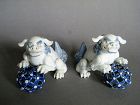
**Sold** to USA, January 2021 A rare pair of heavy (solid) underglaze cobalt blue decorated porcelain Shishi Lions (koma inu 狛犬) made in the Hirado kilns, Mikawachi, Japan during the later years of the Edo period...
Zentner Collection
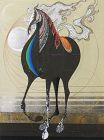
$8,500.00 Large Japanese woodblock print of a horse by the artist Nakayama, Tadashi (born 1927). Titled, "Cyclone". This image of a horse stands with it's mane billowing with bits of color and metalic leaf. The head of the horse is patterned with colors while most of the body remains a dapple of charcoal and white. In the background, a series of thin circular lines accent a metalic leaf sun or moon. Signed in pencil and numbered 85 of 85...
Zentner Collection
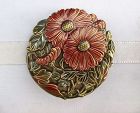
$450.00 Japanese Satsuma ware obidome (obi broach) made of ceramic and decorated with orange blossoming chrysanthemums. This three dimensional obidome is painted with gold details and has a slot in the back through which an obijime cord can be strung. With signed kiri wood tomobako.
Taisho Period (circa 1920) Dimensions: 1 3/4" diameter
Zentner Collection
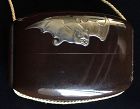
sold Japanese antique inro with one compartment, carved of wood and lacquered a very dark brown. On one side, a silvery bat flies through the air. On the other side, a fishing net hangs to dry on a fence. The fishing net is done in gold lacquer and the fence is made of shell inlay. The inside of the inro case is lacquered a deep red with gold edging.
Late Meiji Period (1868-1912) Dimensions: 2 1/8" high x 3" wide
Zentner Collection
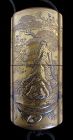
$3,000.00 Antique Japanese inro with three compartments, made of wood with gold lacquer and inlaid with gold flecks. One side is decorated with a pair of cranes and sprouting pines. The other side of the inro depicts an ancient turtle who carries, on his back, a large rock formation. Out of the rock sprouts a plum tree, a pine tree and bamboo - together called Sho chiku bai or "The Three Friends of Winter". The inside of each compartment is cover with dense nishji lacquer (fine gold flecks)...
Japanese : Woodblock Prints : Pre 1900
item #1383579
(stock #Hokusai008)
Era Woodblock Prints
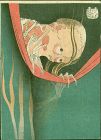
SOLD Katsushika Hokusai (1760-1849)
The Ghost of Kohada Koheiji From Hyaku Monogatari (One Hundred (Ghost) Stories) Published by Tsuruya Kiemon ca. 1833. This edition Meiji 19th century. Size: Chuban. Approximately 10 x 7.25 inches. Condition: Very light creasing. Medium: Japanese woodblock print. This rare print depicts the murdered Kohada pulling back a mosquito net as he returns to haunt his wife and her lover.
EastWest Gallery
$160.00
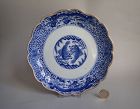
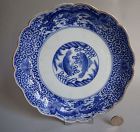
A very fine sometsuke dish of scalloped octalobed form painted with a mon form central motif of a symmetrically arranged pair of leaping carp. Framed by a continuous band of botan karakusa, Peonie lotus scroll, within which are reserves containing, dragons, Ryu, in clouds and a gilt rim, kin-beni. The reverse decorated with hagi-karakusa, vine pattern and a six character mark for the Chinese Emperor Jiajing. The quality of the painting is of the highest quality...
EastWest Gallery
Sold A very fine sometsuke dish of scalloped octalobed form painted with a mon form central motif of a symmetrically arranged pair of leaping carp. Framed by a continuous band of botan karakusa, Peonie lotus scroll, within which are reserves containing, dragons, Ryu, in clouds and a gilt rim, kin-beni. The reverse decorated with hagi-karakusa, vine pattern and a six character mark for the Chinese Emperor Jiajing. The quality of the painting is of the highest quality...
Momoyama Gallery
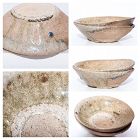
sold A historic-cultural highlight: we proudly present a more than 1000 year old Yama Chawan with a strong kai-yu glaze. Once in a while you can find a traditional unglazed yama chawan on the antique market, but a Yama Chawan with a strong and vivid kai-yu glaze is very very rare...
Zentner Collection
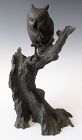
SOLD The Japanese bronze maker is known for its high quality and attention to detail rendered in bronze, silver, and other precious materials. The exposure to the world's fair has showcased the Japanese skilled artisan in many different styles and categories. Naturalism and realism was the template to the Western taste during the Meiji period.
This is a fine example of a great horned owl in bronze depicted in naturalism. The okimono owl is perched on a gnarled branch preening itself...
EastWest Gallery
$115.00
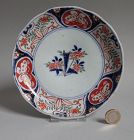
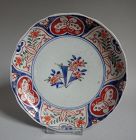
A dish of scalloped rim form of six-sun size decorated with a central motif of a bouquet of Cherry blossom wrapped in the traditional manner for formal presentation with a sheath of washi paper, tsutsumi, shaped into a horn and tied with cord. The rim of the dish decorated with auspicious motifs of gobenka and cho butterflies in the typical Imari three colour palette dating to the Kyoho period circa 1710-40.
The reverse decorated with ribbon ties and trailing flowers...
EastWest Gallery
$115.00
A dish of scalloped rim form of six-sun size decorated with a central motif of a bouquet of Cherry blossom wrapped in the traditional manner for formal presentation with a sheath of washi paper, tsutsumi, shaped into a horn and tied with cord. The rim of the dish decorated with auspicious motifs of gobenka and cho butterflies in the typical Imari three colour palette dating to the Kyoho period circa 1710-40.
The reverse decorated with ribbon ties and trailing flowers. The dish is in good cond...
Modern Japanese Ceramics
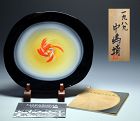
sold, thank you Crimson petals seem to swirl about a vortex of yellow fading to white on the overall black glass surface of this plate by Nakashima Yasushi enclosed in the original signed wooden box and exhibited at the 19th Nihon Dento Kogeiten exhibition (catalog included). It is 14 x 16 inches (35.5 x 41.5 cm) and is in excellent condition. It is titled Anba Unmo Nami-Uchi Sara, Roran no Hana. (I believe he is using the first two characters as “ateji” meaning Amber Mica Waved Dish, Orchid Flowers). <...
|