| Home | | | Items For Sale | | | Shops | | | Current Auctions | | | Auction Information | | | Auction Schedule | | | My Vervendi | | | Seller Registration | | | Bidder Registration (free) |
| Directory: Japanese (12509) |
|
Auctions MAIN CATEGORIES
|
Zentner Collection
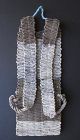
$875.00 Antique Japanese bandori, peasant's woven back pad for carrying heavy loads. Woven of re purposed cotton cloth, this bandori is outfitted with shoulder straps and is folded on the bottom for extra padding. The back pad is made of cotton from two different textile: a brown striped cotton and light blue and white pattern on cotton. A bandori is made specially for the person carrying the load so it is beautifully unique in it's materials and construction...
Zentner Collection
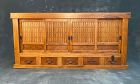
SOLD Single section Mizuya (kitchen buffet tansu) with set of four sliding Keyaki panels opening to a open space with a single removable shelf inside.
Lined along the bottom are a set of 5 pull out drawers with beautifully finished quartered sawn keyaki drawers.
Hand forged iron hardware. Natural blond finished with fine carpentry details. Overall in very good condition. Ready to go! Age: Meiji Period (1868 - 1912) Dimensions: 71" long x 34 high x 20 1/4" deep
Zentner Collection
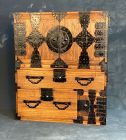
SOLD A Meiji Period (1868 - 1912) Japanese Kannon Biraki Tansu (Wedding Kimono Chest) made of beautiful aged Kiri (Paulownia) and Suginoki (Cryptomeria) wood. The top section has two hinged doors with a special lock from the inside that secures the inside of the door.
When open the doors reveal two large drawers where the bride's kimono were stored...
Zentner Collection
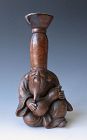
SOLD Antique Japanese small Bizen ware oil lamp in the form of Fukurokuju, one of the 7 Lucky Gods. Easily identified by his elongated head on top of which is a small bowl for oil. His expression is kind and he sits holding a large gourd (hyotan) in both hands. Fukurokuju is believed to be a sennin, a philosopher who can exist without eating food. His name literally means "happiness" (fuku), "wealth" (roku) and "longevity" (ju)...
Modern Japanese Ceramics
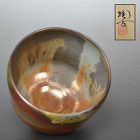
sold, with thanks! Although I love Bizen pottery for myself, I rarely offer it on the website as the colors are so subtle and designs often so very Japanese. This Chawan by (certainly for her era) the rare female potter Konishi Toko II is a striking exception. It stands out in a room of Bizen as if ringing a bell...
The Kura
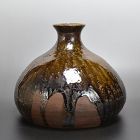
sold, with thanks! A large and rare mid Edo period Tamba Funa-dokkuri Ship Bottle made with flaring mouth and wide flat bottom for use on Ships. Down the side is inscribed the date Kyoho Gannen (First year of Kyoho, 1716). The Akadobe clay is covered in rich green glaze cascading in rivulets all about, with a few scattered windows of raw clay exposed. The base is slightly concave, impressed with a fern leaf...
Kodo Arts
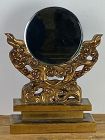
$450.00 Elegant gold gilt Meiji Period c.1900 Zen Buddhist Altar Inner Mirror meant to reflect the soul. Beautifully carved buddhist clouds and waves. Holds a bevelled round mirror. Back is thick black lacquer. Ecellant condition. 11" by 11". Ask for shipping quote from California warehouse.
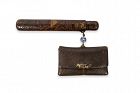
Leather tobacco pouch (tabaco-ire), its lacquered wood pipe case decorated with a landscape and a pipe in wood, copper and silver.
The pouch still contains tobacco.
Ojime in white and blue porcelain, decorated with a dragon.
Japan, Meiji period (1868-1912)
Pipe case : 8,3 in – 21 cm
Pipe : 7 in – 18 cm
Pouch: Height : 3,1in (8 cm) - Width : 5,1in (13cm)
Lilly Parker Antiques, Inc.
$30.00 Japanese Kiri Wood Scroll Storage Box, 24 1/2 long, 3 1/2 high, 3" wide, in old used condition.
Lilly Parker Antiques, Inc.
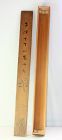
$25.00 Japanese Kiri Wood Scroll Storage Box, 32" long, 3 1/2" high, 3" wide, in old used condition, some old writing on top of the box.
GALERIE TIAGO
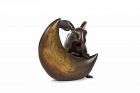
SOLD Japanese bronze brown patinated representing a hare laying on a crescent moon.
Japan – Showa (1912-1926)
Height: 11 cm – 4,3 inches
The Hare is a very beloved animal in Japan. Each year, on the 15th day of the 8th month of the moon calendar, Japanese are celebrating “Tskukumi”, a party paying tribute to the hare of a tale.
A God decided to get down on earth as a starved man...
Zentner Collection
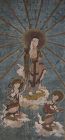
Price on Request Antique Japanese scroll painting of Buddha Amitābha also known simply as Amida Buddha and two Bodhisattva attendants: Sanzon Bosatsu (with both hands holding a lotus blossom) and Seishi Raigo Bosatsu (with hands in gassho adoration mudra). The central figure, Amida Nyorai stands with each foot on a lotus blossom, floating on swirling clouds as he descents. His hands are in vitarka mudra, also known as Raikō gesture of welcoming souls to Paradise (Jōdō or Sukhavati in Sanskrit)...
Zentner Collection
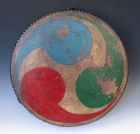
$850.00 Antique Japanese taiko Buddhist temple drum. Made of keyaki (zelkova elm) wood. Painted with mitsu domoe design, the three comma motif also used as a popular family crest. The design is painted in bold red, blue and green colors. Tightly stretched on both sides with bronze and iron hardware. Taiko (literally meaning "drum" in Japanese) first came about as a way to frighten away evil spirits and crop-threatening pests as well as to call the rain spirit to nourish the fields...
Zentner Collection
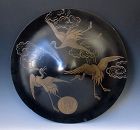
Sold Antique Japanese lacquer jingasa, samurai's hat. Round rim with a gradually pointed top. Lacquered black and decorated with a design of 3 flying cranes in swirling clouds and with a Narabi-ya (double arrows) mon in raised gold lacquer.
The samurai class in feudal Japan, as well as their retainers and footsoldiers (ashigaru), used several types of jingasa made from iron, copper, wood, paper, bamboo, or leather...
Zentner Collection
SOLD Antique Japanese ko tansu (personal storage chest) made with kiri (paulownia) wood drawer fronts and sugi (cryptomeria) wood body and drawer interiors. 5 drawers of various sizes. Finished with red and black negoro lacquer finish. Hand forged iron hardware including hirute drawer pulls and round lock plates.
Age: Meiji Period (1868-1912) Dimensions: 16" high x 22" wide x 13 1/4" deep
Zentner Collection
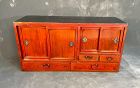
SOLD Antique Japanese low tansu with a mix of sliding doors and pull out drawers.
Quartered sawn keyaki hardwood front with beautiful natural graining. Original finish with warm red lacquer tones. Hand forged iron hardware pulls. Dark black lacquer top and sides.
Age: Meiji period (1868 - 1912) Dimensions: 45" long x 16" deep x 23" high
Zentner Collection
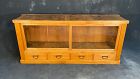
Sold Antique Japanese single section tansu with pair of sliding glass doors. Four uniform drawers sit symmetrically at the bottom of the chest. Overall simple modern design with functional use. Natural finish, over hinoki (Japanese cypress) wood.
Would make for a great low media cabinet. Age: Meiji Period (1868 - 1912) Dimensions: 59 1/2" long x 14 1/2" deep x 26 1/2" high
Zentner Collection
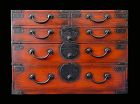
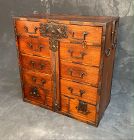
Price on Request A rare edo period Japanese choba (merchants) tansu from the Niigata perfection in Japan. Made of solid keyaki hardwood (including the back). Finely detailed hand forged iron of a flying crane and longevity turtle seen amongst the pine and bamboo. The lower two drawers depict a lock and drum. Stunning original finish with warm tones. 8 drawers in total each of there own size...
|