| Home | | | Items For Sale | | | Shops | | | Current Auctions | | | Auction Information | | | Auction Schedule | | | My Vervendi | | | Seller Registration | | | Bidder Registration (free) |
| Directory: Japanese (12515) |
|
Auctions MAIN CATEGORIES
|
The Kura
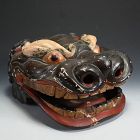
sold, thank you An unusual mask with gaping jaws and flattened features covered in red and black lacquer with golden teeth and eyes dated a lucky day in the 6th month of Tenmei 2 (1782). The mask is of carved wood covered in cloth over which has been applied layers of colored lacquer, gold and gofun (powdered shell) to form the white eyebrows. It is quite unusual in configuration. Most masks are open at the back, however this is carved with curling hair all the way down to the neck...
EastWest Gallery
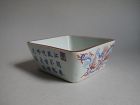
$450.00 A square shallow bowl in the form of a Japanese rice measure, masu, which was considered to be an auspicious form decorated to the exterior with two Dragons in different stances with two eight character poems with seals. Presumably the shape was intended as a play on the word, namasu, a term used to traditionally describe a serving of pickled vegetables and the related bowl...
EastWest Gallery
$450.00
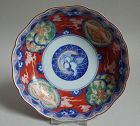
An exceptionally fine porcelain bowl made for presentation, kenjo-te. The centre of the dish is decorated with an unusual version of a Karashishi which would seem to be floating upon a feather set against a net like blue ground which has been produced using the shiranaku technique. It is strikingly similar to the karashishi and feather compositions that appear on Chinese porcelain of the Wanli era...
AfricAsia Primitive and Antiques
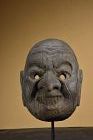
€325.00 Wood mask of the Gigaku theater representing Konju, a figure in ancient Gigaku dance. The finely carved mask shows a very strong expression. Japan, early Edo period. Height: 18 cm. Beautiful age patina. Some abrasion, otherwise very good condition. The mask is nicely mounted on a custom stand.
NOTE: Gigaku theater is one of the most ancient dramatic arts in Japan, performing ritual dance, mime and music, and taking place inside Buddhist temples...
Modern Japanese Ceramics
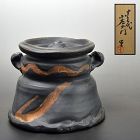
sold, thank you A stellar Black water jar by Yamaguchi Shozaemon XIII enclosed in the original signed wooden box titled Kamakura Nioi Mizusashi. Scraped cut and beat out of form with looping ribbons of clay for handles creating a bold, lively experience. Here is a Mizusashi which certainly does not let down. It is 21 cm (just over 8 inches) diameter at the base, 16.5 cm (6-1/2 inches) tall and in excellent condition...
2ezr
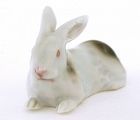
Inquire for Price 1930's Japanese Kutani Porcelain Miniature Rabbit Okimono Marked "Japan"
It is 1.25 inches (3.17 cm) tall by 2.25 inches (5.71 cm) in length. It is 25.5 gram. It has a flea bite chip at one ear, writing on the bottom, and surface wears and scratches (as seen in the photos). Our Guarantee: We stand behind all of the items that we sell...
Zentner Collection
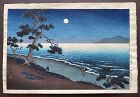
$2,000.00 Antique Japanese woodblock print by Koitsu Tsuchiya (1870-1949) entitled Moon at Sumanoura Beach. A lone villager walks on the beach lit by the full moon. In the foreground are gnarled pines.
Koitsu Tsuchiya began studying the art of woodblock printing at the early age of 15. He studied for 19 years under the ukiyo-e master, Kiyochika Kobayashi...
Zentner Collection
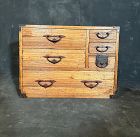
$1,250.00 An antique Japanese Tansu chest called a Fukushima Kotansu made of Kiri (Paulownia) and Hinoki (Cypress) wood. All original hand forged iron hardware and hardened wooden nail construction. Used as a merchant accounting chest where papers, inkstones, brushes, and ink sticks were stored. 6 drawers of varying sizes.
Age: Meiji Era (1880-1890) Dimensions: 24" Wide by 17 3/4" High by15 1/4" Deep
Zentner Collection
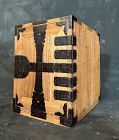
$1,850.00 An antique Japanese Tansu chest made of Kiri (Paulownia) wood. Used as a merchant safe box to store money and valuables. All original hand forged iron hardware with straight dovetail joinery and hardened wooden nails. Hinged door opens to 7 drawers.
Age: Meiji Era (1880-1890) Dimensions: 13" Wide by 17" High 16 1/2" Deep
Zentner Collection
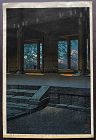
$1,600.00 Antique Japanese woodblock print by Hasui Kawase (1883-1957) entitled Chionin Temple, Kyoto. Looking out through the darkened interior towards bright sky and pines. In the background, heavy temple doors frame a woman and child.
The artist, Hasui Kawase is considered one of the major landscape artists of Japan. He was born the son of a silk merchant and studied both Japanese and Western style painting. He showed at the Tatsumi Exhibition of Painting at the age of 19...
Zentner Collection
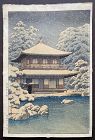
SOLD Antique Japanese woodblock print by Hasui Kawase (1883-1957) entitled Snow at Ginkakuji Temple. Snow falls quietly on a two story building. The rocks and trees around the pond are capped with snow and figures stroll by with umbrellas.
The artist, Hasui Kawase is considered one of the major landscape artists of Japan. He was born the son of a silk merchant and studied both Japanese and Western style painting. He showed at the Tatsumi Exhibition of Painting at the age of 19...
Zentner Collection
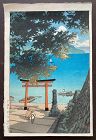
$1,850.00 Antique Japanese woodblock print by the artist Hasui Kawase (1883-1957) entitled Chuzenji Lake, Utagahama. Depicting figures, most likely pilgrims, walking near a red torii gate at water's edge. The sun shines on boaters on the lake and tall trees give shade on the shore.
The artist, Hasui Kawase is considered one of the major landscape artists of Japan. He was born the son of a silk merchant and studied both Japanese and Western style painting. He showed at the Tatsumi Exhibition of ...
Petrie-Rogers Gallery
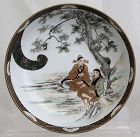
$150.00 Japanese Kutani porcelain bowl decorated in gilt and overglaze polychrome enamels with a scene depicting two figures seated outdoors conversing under a tree. A geometric band interspersed with white flowers decorates the interior rim. There are fine "ao tsubu" (green dot) accents. The exterior is decorated on opposing sides with a prominent yellow flower and ribbon pattern. The base is signed in red "Kutani made." Believed to date from the early Showa Period (circa 1926 - 1935). Measures 9 ...
Petrie-Rogers Gallery
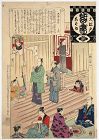
$100.00 First edition Japanese Meiji Period woodblock print titled "Otsu Inari" from the series "The Calendar of Events in Edo Theater" by Adachi Ginko (1874-1897). Three editions of this series are known. This print is from the first edition and contains the publisher's information and date of Meiji 30 (1897) 7th month 10th day in the left margin and the artist's red seal at the lower right. This series is unusual in that it depicts various events backstage with the actors, views including the specta...
Conservatoire Sakura
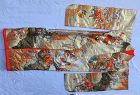
$3,800.00 Wedding Kimono (Uchikake) Silk embroidery and gold and silver metallic ribbons. Some metal ribbon details are iridescent. This Uchikake is a unique model created in a single copy, in fact the decoration is not composed of assembling pieces of fabric with repetitive decoration as most often, but the scene takes place without interruption. The elements represented are highly symbolic , we can admire the pairs of mandarin ducks (marital happiness), the cranes and peonies (immortality) the 8 treasur...
AfricAsia Primitive and Antiques
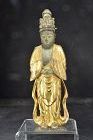
€490.00 Partly gilt wood statue of Buddhist goddess Sho Kannon Bosatsu (one of the many forms of Bodhisattva Avalokiteshvara), wearing formal robes, and a diadem with a small stylised Amithaba on the front, standing, her hands joined to hold a bowl. The goddess face reflects a profound meditation. Fine age patina. Japan, Edo period, early 19th century, maybe earlier. Height: 24.2 cm. Old insect attack on the right side (no more danger), otherwise very good condition.
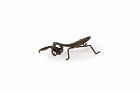
Dark brown patina bronze sculpture of a praying mantis.
The praying mantis (in Japanese, kamakiri) is considered an auspicious symbol.
Japan – Meiji era (1868-1912)
Height: 0.79 in / 2.3 cm – width: 1.18 in / 3.5 cm – depth: 3.15 in / 8.8 cm
GALERIE TIAGO
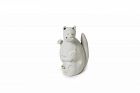
Sold Ceramic sculpture of the white fox, messenger of Inari – the Shinto and Buddhist deity of harvest, rice and abundance.
The Inari fox (kitsune) is a benevolent animal, a sign of prosperity and wealth. This proximity to the kami Inari leads to the two figures being mixed and substituted in the imagination, with the animal becoming a fox-god. Inari’s fox is depicted holding a variety of objects in its mouth with different symbolic meaning: a wheat ear, a scroll, a ball or a key. In...
|