| Home | | | Items For Sale | | | Shops | | | Current Auctions | | | Auction Information | | | Auction Schedule | | | My Vervendi | | | Seller Registration | | | Bidder Registration (free) |
| Directory: Japanese (12525) |
|
Auctions MAIN CATEGORIES
|
Zentner Collection
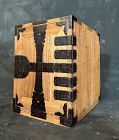
$1,850.00 An antique Japanese Tansu chest made of Kiri (Paulownia) wood. Used as a merchant safe box to store money and valuables. All original hand forged iron hardware with straight dovetail joinery and hardened wooden nails. Hinged door opens to 7 drawers.
Age: Meiji Era (1880-1890) Dimensions: 13" Wide by 17" High 16 1/2" Deep
Zentner Collection
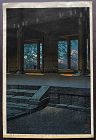
$1,600.00 Antique Japanese woodblock print by Hasui Kawase (1883-1957) entitled Chionin Temple, Kyoto. Looking out through the darkened interior towards bright sky and pines. In the background, heavy temple doors frame a woman and child.
The artist, Hasui Kawase is considered one of the major landscape artists of Japan. He was born the son of a silk merchant and studied both Japanese and Western style painting. He showed at the Tatsumi Exhibition of Painting at the age of 19...
Zentner Collection
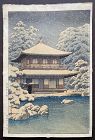
SOLD Antique Japanese woodblock print by Hasui Kawase (1883-1957) entitled Snow at Ginkakuji Temple. Snow falls quietly on a two story building. The rocks and trees around the pond are capped with snow and figures stroll by with umbrellas.
The artist, Hasui Kawase is considered one of the major landscape artists of Japan. He was born the son of a silk merchant and studied both Japanese and Western style painting. He showed at the Tatsumi Exhibition of Painting at the age of 19...
Zentner Collection
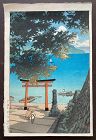
$1,850.00 Antique Japanese woodblock print by the artist Hasui Kawase (1883-1957) entitled Chuzenji Lake, Utagahama. Depicting figures, most likely pilgrims, walking near a red torii gate at water's edge. The sun shines on boaters on the lake and tall trees give shade on the shore.
The artist, Hasui Kawase is considered one of the major landscape artists of Japan. He was born the son of a silk merchant and studied both Japanese and Western style painting...
Petrie-Rogers Gallery
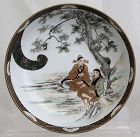
$150.00 Japanese Kutani porcelain bowl decorated in gilt and overglaze polychrome enamels with a scene depicting two figures seated outdoors conversing under a tree. A geometric band interspersed with white flowers decorates the interior rim. There are fine "ao tsubu" (green dot) accents. The exterior is decorated on opposing sides with a prominent yellow flower and ribbon pattern. The base is signed in red "Kutani made." Believed to date from the early Showa Period (circa 1926 - 1935)...
Petrie-Rogers Gallery
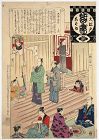
$100.00 First edition Japanese Meiji Period woodblock print titled "Otsu Inari" from the series "The Calendar of Events in Edo Theater" by Adachi Ginko (1874-1897). Three editions of this series are known. This print is from the first edition and contains the publisher's information and date of Meiji 30 (1897) 7th month 10th day in the left margin and the artist's red seal at the lower right...
Conservatoire Sakura
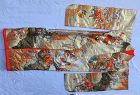
$3,800.00 Wedding Kimono (Uchikake) Silk embroidery and gold and silver metallic ribbons. Some metal ribbon details are iridescent. This Uchikake is a unique model created in a single copy, in fact the decoration is not composed of assembling pieces of fabric with repetitive decoration as most often, but the scene takes place without interruption...
AfricAsia Primitive and Antiques
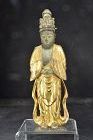
€490.00 Partly gilt wood statue of Buddhist goddess Sho Kannon Bosatsu (one of the many forms of Bodhisattva Avalokiteshvara), wearing formal robes, and a diadem with a small stylised Amithaba on the front, standing, her hands joined to hold a bowl. The goddess face reflects a profound meditation. Fine age patina. Japan, Edo period, early 19th century, maybe earlier. Height: 24.2 cm. Old insect attack on the right side (no more danger), otherwise very good condition.
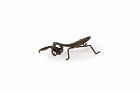
Dark brown patina bronze sculpture of a praying mantis.
The praying mantis (in Japanese, kamakiri) is considered an auspicious symbol.
Japan – Meiji era (1868-1912)
Height: 0.79 in / 2.3 cm – width: 1.18 in / 3.5 cm – depth: 3.15 in / 8.8 cm
GALERIE TIAGO
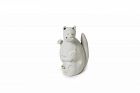
Sold Ceramic sculpture of the white fox, messenger of Inari – the Shinto and Buddhist deity of harvest, rice and abundance.
The Inari fox (kitsune) is a benevolent animal, a sign of prosperity and wealth. This proximity to the kami Inari leads to the two figures being mixed and substituted in the imagination, with the animal becoming a fox-god. Inari’s fox is depicted holding a variety of objects in its mouth with different symbolic meaning: a wheat ear, a scroll, a ball or a key...
GALERIE TIAGO
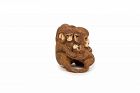
Sold Ivory netsuke of a group of three compactly intertwined monkeys, the smallest holding a longevity peach against him. Their eyes are inlaid horn. Their coats are carefully incised and their fingers are finely sculpted. Natural himotoshi through one of the legs.
Signature on the right flank of the largest monkey, in an unidentified rectangular reserve.
Japan - Meiji Era (1868-1912)
Width: 0.8 in (2.5 cm) - Depth: 1.6 (4 cm) - Height: 1.6 in (4.5 cm)
GALERIE TIAGO
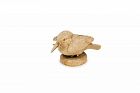
Sold Ivory sculpture okimono of a kingfisher on its base, with a fish in its beak. Its eyes are in hard stone.
Japan - Meiji Era (1868-1912)
Width: 1.6 in (4 cm) - depth: 2.8 in (7.2 cm) - height: 1.6 in (4.3 cm)
Japanese : Woodblock Prints : Pre 1940
item #1492276
(stock #Unidentif209)
Era Woodblock Prints
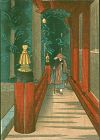
SOLD Enryakuji Temple, Hiyeizan (Hieizan), Kyoto.
Artist not identified. Dated August 21st, 1937. Size: 7.5 x 5375 inches (19 x 13.6 cm). A cover of a dinner menu of the Nippon Yusen Line passenger ship, Chichibu Maru. Publisher: Likely Nippon Mokuhan Co. Tokio (Japan Woodblock Co. Tokyo), who produced another of our ship menu woodblock prints. Medium: Shin-hanga Japanese woodblock print...
t a t a m i
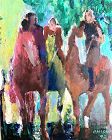
$280.00 HORSES Japanese oil painting on canvas board, with the painter's sign of 'OHISHI '92', attached with wooden frame. Frame: 37 x 45 x 2.5 cm (14.56 x 17.71 x 0.98in). Brief biography notes (Years of prize winning by the works of 'Horse') at the backside...
Haruko Watanabe
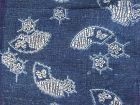
Sold. Thank you. Cotton cloth with katazome pattern which is called "Narumi-Kongata", imitating Arimatsu-Narumi shibori pattern. It is called "Urumi-zome among craftspeople. It uses plural stencils and requires high dyeing technique. In good condition but has two mending patches for the cut which used to be the neck part and in one side of selvedges. The Meiji period (1868 to 1912). W:33cm, L:180cm
The Kura
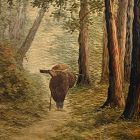
sold, thank you A striking image of an itinerant monk carrying his few earthly possessions though the cedar forest in draped in a mino straw-raincoat and hat, all performed with colored thread in silk embroidery. Behind glass, it has been well protected over the last 100 plus years. The wide dark frame is stained Nara (a form of oak) emulating the arts and crafts style...
Haruko Watanabe
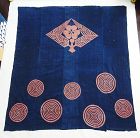
$450.00 Cotton futonji with katazome (stencil-resist dye), which is remade from yogi (one kind of futon in the shape of kimono). It is made of hand spun cotton and dyed with vegetable indigo. The reddish-brown color is bengara (iron oxide red pigment). 19th century. In good condition except for three mending patches. one snag and some small holes. W:153cm, L:165cm
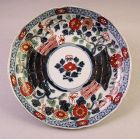
The size of Plate: 5 7/8" Dia x 1 1/8" High. This is beautiful Japanese Ko Imari Porcelain plate with polychrome colors with Fence Design and flowers. All flowers and fence design has gold works around. All designs are intricately hand painted. Backside plate with Karakusa design around the border. Inside foot rim has "Taimin Seika Nensei" (Great Ming Chenghua Nian Zhi) in Japanese; Kanji letters. The condition of plate as following, three hairlines as photo showing (two are in glaze, one can fe...
|