| Home | | | Items For Sale | | | Shops | | | Current Auctions | | | Auction Information | | | Auction Schedule | | | My Vervendi | | | Seller Registration | | | Bidder Registration (free) |
| Directory: Japanese (7390) |
|
Auctions MAIN CATEGORIES
|
Lilly Parker Antiques, Inc.
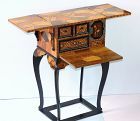
$3,500.00 Japanese Marquetry inlaid Table, mid 1800's, beautifully detailed various design and color of wood Marquetry works are displayed in this three(3) functional table, all in one(1) table as a Book Stand, a Chess table and a Sewing or Work Table, 33 1/2" high, 13" deep, 35 1/2" wide when it is open, 17 1/2" wide when two(2) leaves are closed, with inlaid 4 side brackets support leaves on both sides...
GALERIE TIAGO
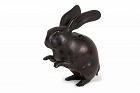
sold Round hare in bronze with a dark brown patina, standing on two legs.
In Japanese, the hare and the rabbit are referred to by a single word: usagi. The animal is one of the twelve animals of the zodiac in Sino-Japanese astrology. It also plays a role in many folk tales and legends...
Japanese : Tea Articles : Contemporary
item #1467886
(stock #TRC230728)
Kyoto Ceramics and Fine Art
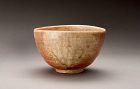
$1,375.00 Sugimoto Sadamitsu (b. 1935) is one of the most important Shigaraki potters alive today and continues to create master works into his old age. Originally a resident of Tokyo, at the age of 33 he moved to Shigaraki and started creating high-quality tea-ware implements, most notably, fine tea bowls in the style of early Raku masters...
Japanese Art Site
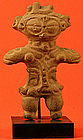
SOLD Fine example of a Jomon Period (13,000-300BC) Dogu, the earliest known Japanese figure. This figure was purchased at a Parke Bernet auction by a renowned author on and collector of Asian art. The Dogu acted as effigies of people. They manifested some kind of sympathetic magic. For example, it may have been believed that illnesses could be transferred into the Dogu, then destroyed, clearing the illness, or any other misfortune. Because of the ritual destruction of Dogu, they are quite rare...
Kyoto Ceramics and Fine Art
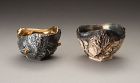
Sold, Thank You! If you are familiar with the work of Hiramatsu Ryoma you know that he creates very unconventional ceramics inspired by forms found in nature. Here we have a set of sake cups inspired by “Ou-tekko” (pyrite) and “Ammonite” (same in English - a kind of sea fossil). Part of a series he has been developing for several years now, the ancient Ammonite fossil has been the inspiration behind his latest creations...
japanes antique textile saiyuu2
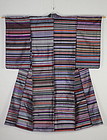
$680.00 This is Tsumugi-Silk Zansi kimono used in Niigata in the end of the Meiji era.
This Tsumugi-Silk is spun by hand. This is thick.
As for this, very good-quality dyed Tsumugi-Silk is used for a weft.
As for this, the warp is a cotton thread. You can enjoy gradation of colorful silk thread. As for this, cotton cloth and muslin cloth are used for lining. There are many small holes on the muslin cloth. However, the state that a dress material does not have the stain damage at all is complete...
t a t a m i
Sold BLACK PULLEY Wood. Early 20th century, Japan. 35 x 32 x 7.5 cm (13.77 x 12.59 x 2.95in). Well used and well mellowed. Massive and exceptional. selected by hotoke * Please understand that EMS shipping fee is additionally charged, and also confirm our Sales Policy before purchase, since your order will be assumed to have fully acknowledged our Sales Policy under any circumstances. Thank you.
Japanese : Woodblock Prints : Pre 1940
item #1507550
(stock #Kunisada006)
Utagawa Kunisada (TOYOKUNI III) 1786-1865
Edo secne of shamisen player at party Date: 1930s. Size: 5.5 x 3.5 inches. Publisher: Takemura Hideo. Seal at lower right. Medium: Japanese woodblock print. Condition: Excellent.
Haruko Watanabe
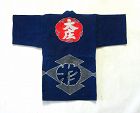
$150.00 Girl's hanten worn at the festival or ceremony with the girl's name "Kimiko" in front. Itis made of hand-spun cotton and cotton lining with katazome (stencil-resist-dye) crane motif. In excellent condition except for two tiny holes in front. Late 19th to early 20th century. W:73cm, L:53cm
A boxwood netsuke depicting Shōki restraining an oni by the horn as it attempts to flee.
Incised signature beneath the feet.
Period: Edo period, 19th century
Dimensions: 5.1 × 3.5 × 2.3 cm
Condition: Very good condition.
GALERIE TIAGO
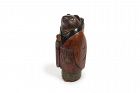
Sold Polychrome lacquered wood sculpture of a tanuki dressed as a pilgrim, carrying its baby on its back. Their eyes are in horn.
The tanuki is a kind of racoon dog which is part of the yôkai (spirits) of Japanese folklore. It is endowed with magical powers: it can metamorphose and take many different forms. This spirit is a symbol of luck and prosperity...
Lilly Parker Antiques, Inc.
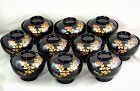
$300.00 10 Japanese Lacquer covered bowls with beautiful sprays of Chrysanthemums in gold and red colors continued from the top cover to the side of the bowl, 3 1/2" high with top on, 4 3/4" diameter-rim, gold painted wavy flowing water design under the cover. The condition is good, no damages.
Lilly Parker Antiques, Inc.
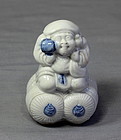
$350.00 Japanese Hirado Porcelain Okimono-Daikoku, god figure, Ca. Meiji period, 3 3/4" high, 2 3/4" wide, 2 3/4" deep, with underglaze blue design in some area. The condition is good, no damages, kiln firing mark on the side of barrel.
Kodo Arts
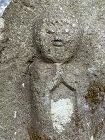
$550.00 Lovely serene buddhist Jizo bodhisattva diety with almost a knowing smile breaking. Carved out of granite in the Late Meiji Period. H:32cm; W:19cm; depth 13cm. Ask for shipping quote.
Asian Art By Kyoko
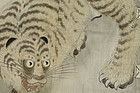
Inquire for Price Japanese antique nobori banner, hand painted on cotton, a tiger in bamboo grove. The style of the painting is derived from ancient Korean paintings of tigers. It is a style that became popular in Japan from the 16th century and you will see many screens and scrolls of tigers painted in this manner. The popularity of these paintings in this style continued throughout the Edo period(1608-1868) and into the Meiji era...
The Kura
sold A heavy vine burgeoning with grapes hangs low with the weight of it sbountiful fruit in sweeping black strokes on this 17th century painting by Toko Shinetsu. Ink on paper with a rough beige silk and rosewood rollers mounted in the Mincho style. It is 59 x 186 cm (23 x 73 inches) in overall fine condition...
Japanese Art Site
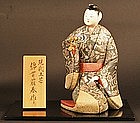
$2,200.00 This beautiful contemporary Ningyo is by an important artist, Nishikitsuka Moeharu. His Kimikomi style of work has been exhibited in many galleries and museums, including the Homma Museum in Japan. She is holding peach sprays. Carved of wood with applied silks brocades. She has a sensitively rendered face with carved lacquered hair adorned with a gold hair ornament. 9 inches (23cm) high. Base: 10.5 x 8.25 inches, 27 x 21 cm.
Japanese : Tea Articles : Pre 1800
item #1500477
(stock #TRC241119)
Kyoto Ceramics and Fine Art
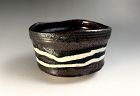
$775.00 Oribe is a visual style named after the late-16th-century tea master Furuta Oribe (1544-1615). Typically, black or green glazes are applied to the bodies of these works and light-colored windows are created using feldspar. These high-contrast areas then act as a canvas upon which abstract, minimalistic, and often naturalistic themes are painted... |