| Home | | | Items For Sale | | | Shops | | | Current Auctions | | | Auction Information | | | Auction Schedule | | | My Vervendi | | | Seller Registration | | | Bidder Registration (free) |
| Directory: Japanese (12515) |
|
Auctions MAIN CATEGORIES
|
This elegant Chōshi is the work of master ceramicist Ogasawara Chōshun, celebrated for his refined porcelain forms and dedication to traditional Japanese aesthetics...
Momoyama Gallery
$450.00 Ohi-yaki Chawan by the 9th Ohi Chozaemon Bathed in the quiet dignity of age, this Ohi chawan — crafted by Ohi Chozaemon IX around 80 years ago — embodies the deep philosophical resonance of wabi-cha, where irregularity becomes elegance, and warmth becomes ceremony. It comes with the originally signed and sealed wooden box. This tea bowl glows with an amber-toned Ohi glaze, flowing like honeyed lacquer over a textured body of soft, iron-rich clay...
DEVAGATI
sold Edo Period Samurai Lacquer Storage Box with Gilded Clan Crests
A rare mid-Edo period (17th–18th century) samurai clothing or armor storage box, crafted from wood and finished in deep black lacquer...
Haruko Watanabe
Sold. Thank you. Five fragments of cotton katazome (stencil-resist dye) which are originally one roll of cloth with many sample katazome patterns. Five fragments have katazome with seven different patterns, vegetable indigo dye and has pale pink pigments, and also handspun cotton. Meiji period (1868=1912) In excellent condition. The largest: W:35cm, L:71cm The smallest: W:18cm, L:25cm
Japanese totai cloisonne on earthenware lidded tea jar, or cha-ire, decorated with two prominent orange-red and rust-red panels featuring a butterfly and a bird flying among leafy flowers. The panels are set against a blue and black background filled with flowers. A flower decorates the center of the lid. The base is cream-colored crackle glaze. Circa 1870s. 5 5/8" high. "Totai," was a short-lived experiment of applying cloisonne onto ceramic objects rather than onto a metal substrate...
Zentner Collection
$3,000.00 A distinctive Japanese ikebana (flower basket) from the late Meiji period, featuring a four-legged base, a bold natural branch handle, and a tight woven-pattern body...
Zentner Collection
SOLD A refined Japanese hanakago (flower basket) from the Taisho to early Showa period (c. 1920–1940), featuring an elegantly arched handle and an open hexagonal weave body...
Zentner Collection
$2,500.00 A dynamic and organically expressive hanakago (flower basket) from Japan’s Meiji period. Featuring an open-weave body of split bamboo and a striking natural wisteria branch handle that curves dramatically across the basket and up into an arching form.
This piece is a beautiful example of how Japanese bamboo artists integrated elements from nature directly into their work...
Zentner Collection
$5,800.00 Antique Japanese two-section stacking choba tansu (merchant’s chest) from the late Edo period. Originally made for shopkeepers and traders. These chests served both practical and representational roles—used to store documents, currency, ledgers, and shop goods.
Constructed of solid hardwood hinoki wood (cypress), this chest features multiple graduated drawers, sliding panel compartments, and original ironwork hardware. The sliding doors reveal additional internal storage and shelves...
t a t a m i
Sold STREAMLINED EBISU Originally a Japanese wooden figure of the Ebisu deity, Showa period, 20th century, meticulously carved and polished into a streamlined form by a dedicated woodworker in the later years. 28 × 19 × 14.5 cm (11.02 × 7.48 × 5.71 in)...
The Kura
sold, thank you Pink waves undulate on the white sides of this contemporary cloisonne vase by legend Shibata Akira enclosed in the original signed wooden box titled Yusen Shippo Chusho Mon Kaki exhibited at the 65th Nihono Dento Kogeiten National Traditional Crafts Exhibition in 2018. It is 20.5 x 12 x 23.5 cm (8 x 4-3/4 x 9-1/4 inches) tall and in excellent condition.
Akira Shibata, was born in Yokkaichi City, Mie Prefecture in 1942...
Zentner Collection
$1,225.00 Original Edo Japanese carved ranma panel, depicting a graceful crane soaring through stylized swirling clouds. This finely carved architectural element would have originally been placed above sliding doors or between rooms in a traditional Japanese home or temple, allowing light and air to pass while maintaining visual elegance.
The crane (tsuru) is one of the most revered symbols in Japanese culture—representing longevity, fidelity, and spiritual transcendence...
t a t a m i
$400.00 SERIOUS-FACED MONKEY 1950s, Japan 16 × 13 × 15 cm (6.29 × 5.11 × 5.90 in) A skillfully crafted ceramic monkey with a serious, expressive face—an excellent example of postwar Japanese folk artistry. A small hole in the right hand, allowing the figure to hold a small object of your choice...
t a t a m i
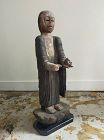
$500.00 RURAL LARGE BUDDHA Edo–Meiji period, Japan 59.5 × 23 × 17 cm (23.42 × 9.05 × 6.69 in) A large wooden Jizō Bosatsu (Bodhisattva) statue, once cherished and prayed to by villagers in a small mountain community in Yamanashi Prefecture. A traditional Minshūbutsu (folk Buddhist figure), it reflects heartfelt local devotion rather than formal temple tradition. Shows natural wear from age and long-term worship...
DEVAGATI
USD $720.00 Fine signed bronze Vase by renown artist. 20th century
Unique Contemporary Bronze Murashido Vase by Aida Tomiyasu (1901–1987) A striking example of contemporary Japanese metalwork, this one-of-a-kind vase is crafted in bronze using the traditional murashido patination technique...
Zentner Collection
SOLD Japanese antique screen painting in two panels with a scene of a family of monkeys. The mother holds a baby close. Over their heads is a bamboo trellis covered with wisteria vines and clusters of white wisteria blossoms. Painted in ink and light colors on a beautifully oxidized ground of silver leaf.
Age: Taisho Period (early 20th century) Dimensions: 47 1/2" high x 85 1/4" wide
Spoils of Time
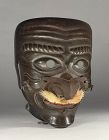
$2,250.00 An early Edo period iron Sōmen (full face mask). The nose is a replacement from the same material, period and school. As the nose is interchangeable by design, this is not objectionable and priced accordingly. As part of a samurai’s armor, a Sōmen would provide greater protection than a menpo. This Sōmen is lighter than later, fanciful Edo period “parade” examples.
Kyoto Ceramics and Fine Art
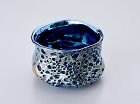
Sold, Thank You! Described as a “Tsuki-no-Umi” (Ocean of the Moon) sake cup we can see immediately the inspiration for this recent work from Kurokawa Daisuke. Fashioned from glass, the smooth and luminous interior starkly contrasts; yet, oddly compliments the textured and crater-marked exterior that refracts light in a brilliant kaleidoscopic display... |