| Home | | | Items For Sale | | | Shops | | | Current Auctions | | | Auction Information | | | Auction Schedule | | | My Vervendi | | | Seller Registration | | | Bidder Registration (free) |
| Directory: Japanese (12525) |
|
Auctions MAIN CATEGORIES
|
Zentner Collection
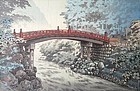
$465.00 A Japanese woodblock print titled "Nikko Sacred Bridge"by renowned artist Tsuchiya Koitsu (1870-1949). Inscription and red seal in bottom corner. Born in 1870 near Hamamatsu City (Shizuoka Prefecture) with the name"Sahei." Koitsu moved to Tokyo at the age of fifteen. He had planned to apprentice with Matsuzaki, a carver for the artist Kobayashi Kiyochika, but instead, he became Kiyochika's apprentice and moved into his home to study art and print design...
Kyoto Ceramics and Fine Art
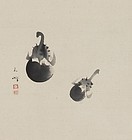
Sold, Thank You! A symbol of health and prosperity, these ripe eggplants were painted by Hasegawa Gyokuhou (1822 - 1879), a disciple of one of Kyoto’s leading Shijo school artists, Matsumara Keibun (1779 - 1843). The attached stylized calligraphic poem, which speaks of accomplishment and being productive in one’s endeavors, was done by one of Japan’s most renowned and loved waka poets of the 19th century—Ōtagaki Rengetsu (1791-1875)...
Kyoto Ceramics and Fine Art
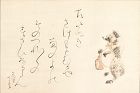
Sold, Thank You! This poetry and artwork, done by one of the most renowned and loved waka poets of the 19th century—Ōtagaki Rengetsu (1791-1875), tells the story of a personal moment of joy and contemplation upon returning home one autumn evening accompanied by the brilliant moon above...
Kyoto Ceramics and Fine Art
Sold, Thank You! This soulful image of a Japanese hamlet in the depths of winter was done by one of the most renowned and loved waka poets of the 19th century, Ōtagaki Rengetsu (1791-1875).
Born into a Samurai family but soon after adopted by the Ōtagaki family, from the age of seven to sixteen Rengetsu was a lady in waiting at Kameoka castle where she was trained in the arts and courtly graces...
Zentner Collection
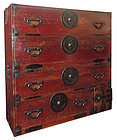
$1,850.00 Antique Japanese Yonezawa two-section lacquered tansu. Made from Kiri wood (paulownia) front with Sugi (cedar) wood frame Its drawers open with iron mokko/melon style handles, and with large, round lock plates incised with kiri leaf mon as well as fan-shaped corner hardware. Side lockbox has two small drawers within.
Original Charming lacquer finish.
Late Edo early Meiji Period (circa 1850's - 1900)
Size: 45.25" height, 44" width, 16.75" depth
japanes antique textile saiyuu2
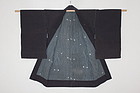
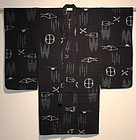
$280.00 This is cotton Haori used in Kyoto for Edo period. As for this, the surface side is a stripe pattern, and the inside is Katazome- dyeing.
The inside Katazome dyeing is a design of the grain of wood. As for this, cotton is spun by hand and is thick.
In the upper part of the sleeve right as for this 4cm (there is a tear of 1.5 “).) And there is a tear of 10cm (3.9 ") in the upper part of the left sleeve. There is not the stain damage elsewhere...
Momoyama Gallery
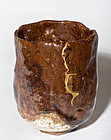
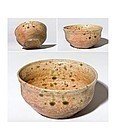
Sold We like to present you from our family collection our only tsutsu winter chawan. Aesthetic old winter chawans are hard to find - so take your chance. Its a Shino Chawan with fantastic glaze and a perfect kintsugi gold repair. Once you hold it in your hands you will refuse to give it back. It dates back to the middle Edo Period and comes with an old wood box. Size: 4,6'' height x 3,6'' in diameter. Shipping included
japanes antique textile saiyuu2
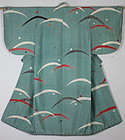
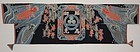
$280.00 This is costume of Kabukino of the Taisho era. Sasani-tuyu of the pattern is bamboo grass and the dew.
There are some a few stains of the aging, but does not stand out. There is not the damage, and the state is complete. Size 127cm x 119cm (50 "x 46, 8")
Zentner Collection
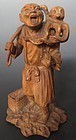
$2,500.00 A whimsical boxwood carving of a fisherman with look of shock on his face as an octopus crawls out of his basket and onto his head and shoulders. The extreme care and detail of this piece along with the amusing expressions make it especially wonderful. Signed by "Kogetsu".
Meiji age (1868-1912) Provenance: From the Jordan Schnitzer Museum of Art, University of Oregon.
Size: 6" height, 3.5" width
Zentner Collection
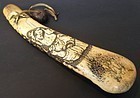
$1,200.00 Antique Japanese pipe holder carved out of an antler, with a detailed front carving of one man in a fighting stance with a second man thrown to the ground. The holder hangs by a carved tree branch.
Late Edo Early Meiji Period (circa 19th Century)
Size: 8" length, 1.75" width
Momoyama Gallery
sold The history of Japanese chawans should not be written without this 15th century Iga chawan. It was produced during the Muromachi Period, which was running from approximately 1337 to 1573...
Intandane ltd
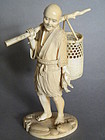
Sold in our Liverpool Shop - April 2016 / 利 物浦店内售出 - 2016年4月 A very finely carved ivory okimono of a fisherman wearing a grass apron and carrying a basket containing a fish. Additionally (within the basket) is a small bound bundle of reeds or sticks...
Zentner Collection
SOLD A charming and Unusual Japanese silk short coat meant to be worn as an over kimono. Many vivid, colorful silk panels have been patched together to create an interesting pattern. Designs of peonies, chrysanthemums, geometric patterns, cranes, butterflies, and many more are seen among the various silk panels.
Meiji period textile (1868 - 1912) assembled in the Taisho Period.
Size: 41" height, 48" width
Kyoto Ceramics and Fine Art
Sold, Thank You! This playful image of a Japanese raccoon dog (tanuki) enjoying a flask of saké was done by one of the most renowned and loved waka poets of the 19th century, Ōtagaki Rengetsu (1791-1875).
Born into a Samurai family but soon after adopted by the Ōtagaki family, from the age of seven to sixteen Rengetsu was a lady in waiting at Kameoka castle where she was trained in the arts and courtly graces...
japanes antique textile saiyuu2
$380.00 This is cotton child Kasuri kimono of Edo period. As for this, a pattern is Hagoita, Hane and Hami of the harness. Hagoita play is play of New Year holidays. As for this, Yokote Kasuriga is used for Edo period of Akita. This has two or three places of stains, but does not stand out. This does not have damage. The state is complete.
Size 90cmx 91cm (35.4 "x 35.8")
japanes antique textile saiyuu2
sold thank you This is personal ornaments of a horse used in the Tohoku district for Edo period. The item giving glory to a horse is called Umakake. This is dyed with a natural indigo plant and other dye. As for this, a thread spun by hand by cotton cloth is used. The influential person of the village had this type of item. In this district, the upper Tsutsugaki technology was used for the personal ornaments of the horse...
Welcome To Another Century
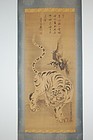
Inquire for Price Hanging scroll. Painting of a tiger before a rock and bamboo, text in the upper half. Black ink and some faint red color on silk. Signed 73 year old hogen Sosen hitsu. Red artist’s seal. Japan, 18th century.
Yamamoto Sosen (1679-1760), Kyoto, Kano School
Painted area: 40 x 17 inches Few tiny worm holes, old very light water stain, otherwise very good condition.
Welcome To Another Century
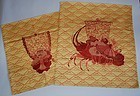
$250.00 Pair of golden yellow silk fukusa or gift covers, with diamond pattern with water birds design in brocade weave, over which is embroidered in different hues of pink and in goldthread. The larger fukusa is decorated with a lobster carrying a treasure boat, holding several of the treasures. The smaller fukusa is decorated with a treasure boat, as well. Reverse decorated in brocade technique with a family crest in white silk. Japan, Taisho or Showa era, ca...
|