| Home | | | Items For Sale | | | Shops | | | Current Auctions | | | Auction Information | | | Auction Schedule | | | My Vervendi | | | Seller Registration | | | Bidder Registration (free) |
| Directory: Japanese (12515) |
|
Auctions MAIN CATEGORIES
|
Asian Art By Kyoko
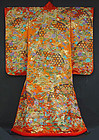
Price on Request This is an a beautiful Uchikake (Japanese wedding gown) covered with embroideries on satin. The workmanship shown in this gown is truely amazing. It is in new condition.
The pair of loving birds are Oshi-dori (Mandarin ducks) which are popular subjects relating to weddings. The theme of this gown is probably from Chapter 5, "Lavender" (Waka Murasaki) in "The Tale of Genji". When Genji was traveling the countryside for the first time, he saw a beautiful young girl crying...
June Hastings
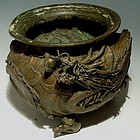
$1,800.00 One of the most spectacular Japanese bronze hibachi's ever encountered and quite unusual in every way. Massive and weighing a solid 18 lbs. this hibachi features a well sculpted dragon that clutches the celestial pearl of wisdom that effort-sly glides about the wind that whips about its body, three monkeys in varying poses or positions support this cauldron-like monstrosity...
Zentner Collection
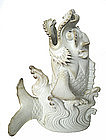
SOLD Wonderful Japanese hirado ware porcelain figure of a dragon fish jumping out of waves, a traditional symbol of transformation, white glazed porcelain with tinge of brown along edges on one side and blue underglazed eyes, Meiji Period (19th century).
Size: 12 3/4" high x 9 1/2" wide x 10" deep.
Asian Art By Kyoko
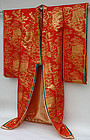
SOLD. Thank you! Elegant Japanese uchikake (traditional wedding gown) sewn in the style of the twelve layered court attire (juni-hitoe) from the Heian period (794-1160). The longing for the beautiful, culture rich era of the aristocrats that existed so long ago never seems to cease in people's mind even after 1000 years. Here on this red background, the classic design of the ox-cart in a pine forest is beautifully woven in gold. The layer of robes could have gone up to 15 or even more...
Asian Art By Kyoko
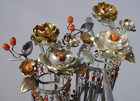
Sold, Thank you! A set of Japanese bira-bira kanzashi (hair ornament) with silver and gold plated peonies, foliage, coral beads and dangling chains. Meiji period. This set has been recently cleaned by a jeweler. Kanzashi 8 1/4" long, chains 4" long.
Asian Art By Kyoko
Price on Request Japanese antique fukusa, a gift cover embroidered with "The Old Couple of Takasago" on wool (rasha, felt like), padded and lined with orange crepe silk, Meiji period (1868-1912).
The story of the old couple, Jo and Uba, came from the Noh play, Takasago, which was written during the Muromachi period (1336-1573) by Zeami. Jo and Uba were spirits who resided in an old pine tree which was two trees that grew together over the years...
Asian Art By Kyoko
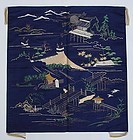
Price on Request This is a Japanese fukusa, a gift cover with the design of the “Eight Views of Omi”. In the beginning of the 16th century, eight scenic spots in Omi (Shiga, Japan) were selected by closely following the Chinese “The Eight Views of the Xiao and Xiang Rivers”...
Asian Art By Kyoko
Sold. Thank you! Antique silk Kesa, an outer garment worn by Japanese Buddhist priests, cotton liner, padded with paper, late Edo to early Meiji period. Dimensions: 76 1/2" x 43 1/2"
Zentner Collection
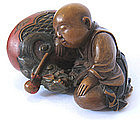
Sale Pending Antique Japanese netsuke of a boy monk fast asleep on a temple bell, carved of boxwood with painted details, signed: Kyusai (1879-1938). He carved this netsuke between the ages of 36-49, well-known for carving mokugyo, temple bells, in various themes.
Meiji Period (1868-1912) Dimensions: 2 1/8"
Zentner Collection
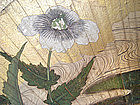
SOLD Wonderful Japanese 2-panel byobu screen painting, 2 intricately painted Meiji Period fans, probably once used in a Noh performance and later mounted on a screen, each fan is painted in colorful mineral pigments with gold leaf, the fan on the left depicts white wild flowers blossoming near a meandering stream with billowing gold mist, the fan on the right is painted with a scene of 3 cranes flying over sea crests and a weeping willow tree, the two fans are mounted on a ground of gold flecks...
Asian Art By Kyoko
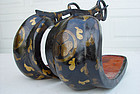
Price on Request A pair of lacquered iron abumi (Japanese stirrups) decorated in fine gold and nashiji (pear skin) lacquer on a roiro urushi, black lacquer ground. Each carries a Tokugawa aoi crest (three hollyhock leaves in a circle) within scrolling leaf background, the bottom constructed with wood pieces within an iron frame which made it lighter, thus gave a better control. Edo period (17th/18th century). 9" high, 5 1/4" wide.
Zentner Collection
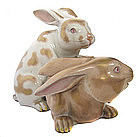
$4,500.00 Wonderful pair of Kutani ware porcelain rabbits, one is white and one is light brown, both with areas of gold in which each hair has been painted, pink eyes and inside of ears, the light brown rabbit has it's mouth open and displays a row of tiny teeth and a red tongue, great detail and attention to modeling , Meiji Period (1868-1912).
Size: 5 1/2" high x 7 1/2" wide x 6 1/2" deep.
Japanese Art Site
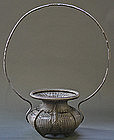
SOLD This stunning masterpiece of extraordinary design is an exceedingly rare Edo Period Botankago (Peony Basket) Ikebana Basket for the Tea Ceremony, with original signed box. One of the rarest and most important baskets to come up for sale. Black with a very large handle that separates into five pieces for portability, a fine complex weave and intricate crayfish motif. A rare and important find for the serious Japanese basket connoisseur. 22.5h x 19.25w inches, 57h x 49w cm.
Asian Art By Kyoko
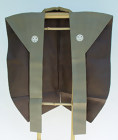
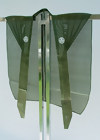
Price on Request This is a "kataginu" (shoulder cloth), only the upper vest of kamishimo without trousers. Kami-shimo simply means top and bottom in Japanese. It was a high ranking samurai's formal attire when they attended official meetings at the Edo castle. It was worn over a kosode (kimono with small sleeves) with trousers. The shoulders are arch shaped and this was the style that developed in the late Edo period (1603-1868). Longer trousers (approx. 1.5 times longer) were chosen for special occasions...
Petrie-Rogers Gallery
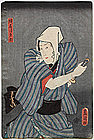
$250.00 Edo Period Japanese woodblock print by Toyokuni III (also known as Kunisada) depicting a half-length portrait of an actor portraying a samurai. This is one of a number of half-length portraits of actors designed by Kunisada in 1852. Signed at the right "Toyokuni ga" (in a red cartouche with yellow snow) with the seal of the publisher Yamazakiya Seishichi below. Fresh color and nice impression quality with fine delineation of the hair and lacquer highlights...
Asian Art By Kyoko
Price on Request This is “kataginu” (shoulder cloth), only the upper vest of kamishimo without a trouser. Kami-shimo simply means top and bottom in Japanese. It was a high ranking samurai’s formal attire when they attended official meetings at the Edo castle. It was worn over kosode (kimono with small sleeves) with trousers. The shoulders are arch shaped and this was the style that developed in the late Edo period (1603-1868). Longer trousers (approx...
Asian Art By Kyoko
Price on Request This is “kataginu” (shoulder cloth), only the upper vest of kamishimo without a trouser. Kami-shimo simply means top and bottom in Japanese. It was a high ranking samurai’s formal attire when they attended official meetings at the Edo castle. It was worn over kosode (kimono with small sleeves) with trousers. The shoulders are arch shaped and this was the style that developed in the late Edo period (1603-1868)...
Japanese Art Site
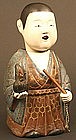
SOLD 18th Century Edo Period Saga Ningyo of a young boy holding a rooster in one hand and a scepter in the
other. His head bobs while his tongue goes in and out. Carved entirely of wood, his robes are built up with pigments in a technique called 'moriage'. He has a gorgeous blue outer robe decorated with foliate scroll
slightly raised in relief. His inner robes are brown with shaped roundels of
geometric patterns and cloud shapes. This rarest of all Ningyo forms almost
never comes up for sale and...
|