| Home | | | Items For Sale | | | Shops | | | Current Auctions | | | Auction Information | | | Auction Schedule | | | My Vervendi | | | Seller Registration | | | Bidder Registration (free) |
| Directory: Japanese: Textiles (1017) |
|
Auctions Shops Active In This Category
MAIN CATEGORIES
|
Asian Art By Kyoko
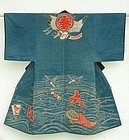
Sold. Thank you! Antique Japanese maiwai, katazome stencil dye on cotton, padded and in excellent condition, 51"(4'2") x 51", circa Meiji (1868-1912) to Taisho period (1912-1926). This maiwai is old but has been well maintained, pretty clean condition without any odor. One damaged area (did not go through to the liner) was repaired with very small stitches (photo #9). The photo #10 shows the area before it was repaired with stitches and filled with red color...
Asian Art By Kyoko
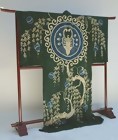
SOLD Thank you! Unique old Japanese yogi (kimono-shaped futon bed cover) from Kaga, a weeping willow tree with a butterfly family crest, 57" x 72", Meiji Period (1868-1912).
Kaga, located in today's Kanazawa prefecture area, was known as "Kaga One-million Koku", the wealthiest domain next to the Tokugawa Shogun family during the Edo period (1603-1868). Each domain was assessed its wealth measured by "koku." Most samurai received stipends in koku...
Asian Art By Kyoko
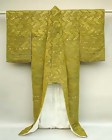
Price on Request Beautiful old Japanese woven silk uchikake gown in new condition. The size of this gown is small (much shorter) and light in weight. We are not sure how gowns in this style were worn but our humble guess would be that they were either made into jackets for upper class women (style is similar to kosode from late Edo period), Noh custumes or wedding gowns (though the sleeves are short). Subtle but beautiful, will make a great wall decoration...
Asian Art By Kyoko
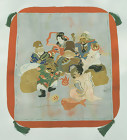
Price on Request Japanese antique gift cover, fukusa, with the design of the Seven Gods of Good Fortune (Shichi Fuku Jin), tsuzure-ri tapestry weave with wide borders (1 3/4"). The liner is made of chirimen crepe silk, Meiji period (1868-1912), 26 1/4" W x 29 1/2"L
This is a beautiful fukusa even with obvious stains. It shows the quality and professional workmanship everywhere. This fukusa is woven in tsuzure-ori...
Zentner Collection
$2,000.00 Antique Japanese tsutsugaki (paste resist) cotton horse cover, bold design of large red characters on either side and white stripes on dark indigo ground in center.
Meiji Period (1868-1912) Size: 14" wide x 89" long
Zentner Collection
$3,500.00 Antique Japanese horse cover made of paste resist died cotton(tsutsugaki), design of fish jumping up waterfall on either side, middle is decorated with a large Tomoe (large commas) mon (crest).
Meiji Period 1868 - 1912 Size: 22" wide x 83 1/2" long
Zentner Collection
$3,500.00 Antique Japanese horse saddle cover, made of tsutsugaki (paste resist died cotton), fan and tassel motif in red and indigo, large Kashiwa (oak leaf) mons on either side.
Meiji Period (1868-1912) Size: 27 1/2" wide x 45" long.
Japanese Art Site
$2050.00 Framed 19th Century Japanese Late Edo Period Embroidery of a Phoenix. Wonderful and elaborate master needle
work with beautiful use of soft colored silk threads accented with gold silk
threads. This a rare find for the Japanese textile collector. This was part
of the Morris collection, which is housed in the Peabody Essex Museum in Massachusetts. It is framed with a Victorian era frame. 26.5 inches (67 cm)w x 25 inches (63.5 cm)h...
Japanese Art Site
$9500.00 A important Rare 18th Century Noh Theater Robe. This extraordinary silk embroidered example of a summer production Noh Robe has a design of Wisteria, Fans and Ropes, and exquisitely captures the art of
Noh. 63.5 inches (161.5cm) height x 52 inches (132 cm) width. Excellent Condition. From a prominent and widely exhibited collection.
Japanese Art Site
$2000.00 Japanese Koto Cover featuring a magnificent Phoenix. The Koto is a traditional Japanese stringed musical instrument. This Koto Cover was
for an important Koto player. A textile of this quality rarely comes along
for sale. Beatifully hand painted with some embroidery on fine silk. Really a work of art. 96 x 13.5 inches, 244 x 34 cm. Excellent Condition. From a prominent and widely exhibited collection.
Zentner Collection
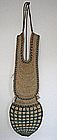
$900.00 Bandori is the local term in the Shonai area for woven straw and indigo fabric back-pads.It is approximately
80+ years of age, dating to the late Meiji Period.
Size is 40" long.
Asian Art By Kyoko
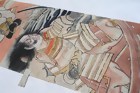
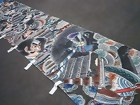
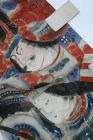
Inquire for Price Two characters on this Japanese banner are Yoshitsune (Minamoto family) and Noritsune (Taira family). It was towards end of the Genpei War (1180-1185), Yoshitsune (Minamoto family) flying high on the top escaping the attack of Noritsune (Taira family). Yoshitsune was said to hopped eight boats at this scene...
Asian Art By Kyoko
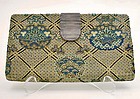
Price on Request This is an old Japanese silk purse, or a tissue holder in a wallet style with a silver clasp. It is truly a beautiful piece. The detail photos show the intricate weaving pattern, Sagara embroidery (Peking, French knot) and deep color of genuine gold. The light reflects on the silk in such a beautiful way. They bounce between the delicate indentions that were created from the weaving pattern...
Asian Art By Kyoko
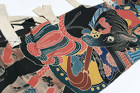
Price on Request Nobori banners, samurai Yoroi and Kabuto helmets, carps, musha ningyo (warrior doll) were all a part of the display used for Boy's Day (renamed to Children's Day) on May 5th in Japan. They reflect the parents’ wish to inspire their sons in manliness, discipline, bravery and the honor codes that are associated with them.
This is an old Japanese nobori banner with Hideyoshi (Toyotomi), retainers, and a streamer in the background...
Asian Art By Kyoko
Inquire for Price Nobori banners, carps, warrior's Yoroi and Kabuto helmets, samurai dolls and swords were all a part of the display used for Boy's Day (renamed Children's Day) on May 5th in Japan. They reflect the parents’ wish to inspire their sons in manliness, discipline, bravery and the honor codes that are associated with them.
Toyotomi Hideyoshi has been one of the popular characters for Boy’s Day. He was born in a peasant family and worked his way all the way up to top commander of Japan...
Zentner Collection
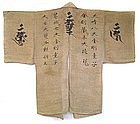
$2,500.00 Antique Japanese pilgrim's coat hand woven of asa (Japanese hemp) fiber. Hand painted with sumi ink calligraphy.
Size: 41" high x 47" wide Mid Edo Period (1603 - 1868)
Asian Art By Kyoko
Inquire for Price Japanese nobori banner, hand painted (dyed) with samurai Yoshinaka (Kiso no) and Tomoe Gozen, a woman warrior. Dimensions: 15 3/4" wide and 147 1/2" long. Hand woven soft cotton with hand spun yarn...
Asian Art By Kyoko
Price on Request Nobori banners, carps, warrior's Yoroi and Kabuto helmets, samurai dolls and swords were all a part of the display used for Boy's Day (renamed Children's Day) on May 5th in Japan. They reflect the parents' wish to inspire their sons in manliness, discipline, bravery and the honor codes which are associated with them.
Originally, nobori were used on the battlefield to identify the troops; some were to show the warriors where their taisho (general) was, others were used to shift the troops. ... |