| Home | | | Items For Sale | | | Shops | | | Current Auctions | | | Auction Information | | | Auction Schedule | | | My Vervendi | | | Seller Registration | | | Bidder Registration (free) |
| Directory: Japanese: Textiles (1033) |
|
Auctions Shops Active In This Category
MAIN CATEGORIES
|
Asian Art By Kyoko
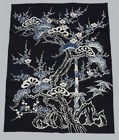
Sold. Thank you! Japanese cloth taken from an old futon bed cover, decorated with an auspicious motif of pine, bamboo and plum blossoms. The evergreen pine symbolizes the strength and devotion of men; plum blossoms are the purity, subtle beauty and inner strength of women. Bamboos are often used to describe the personality of men and women; for example, a person being as straight (honest) as bamboo, it could also mean flexible (bendable) to a large extent...
Asian Art By Kyoko
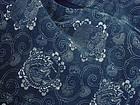
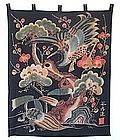
Price on Request Beautiful Katazome stencil dye work on thick, lightweight, coarsely woven cotton. It is decorated with auspicious motives; crane and long-tailed turtle in the framework of sho-chiku-bai (pine, bamboo, plum blossoms), the symbols of longevity and happiness. Bamboos, canes and pines are hidden, actually all over here in the form of scrolls. Three rolls of
13.1/2" (width) x 123 1/4" (long), roughly 98cm wide x 313cm long...
Asian Art By Kyoko
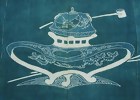
Price on Request This panel was taken from Japanese "futon" bed cover. It is decorated with a chagama and other utencils used in the tea ceremony. They are drawn in the paste resist dying technique called tsutsugaki. The green area appears to be dyed with two colors, "ai" indigo blue first then yellow dye. The fabric (cotton) is loosely woven with one repair as shown in the photos. Meiji Period(1868-1912). Dimensions: 61" x 48"
Asian Art By Kyoko
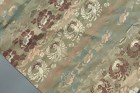
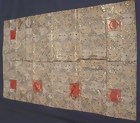
SOLD. THANK YOU! Old silk kesa, an outer garment worn by Japanese Buddhist priests. Kesas were originally made from old scraps of material donated to the temples. The scraps became finer and quite luxious with time. People who gave to Buddhist institutions were often keen to give very expensive items, so some fabulous kesas were created from wonderful silk brocades. This could also mean that the wealthier temples ended up collecting better fabrics or were able to send out for expensive custom made kesas...
Asian Art By Kyoko
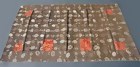
Inquire for Price Large Japanese temple cloth woven with cotton and strips of paper, great for a wall decoration. The dimensions are 107" x 47" (271.8cm x 119.4cm). Many things in Japan were made from paper, just like soy sauce was added in almost all cooking. Textiles were no exception. Some monks in Japan still make their own paper for their clothes. There are few beautiful samurai haori jackets made out of paper that still exist today in textile museums (which we have only seen in photos)...
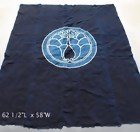
Antique aizome (traditional Japanese indigo dye) cloth taken from a Japanese bed comforter, thick cotton, circa Meiji Period (1868-1912). Excellent tapestry material. The condition is excellent; it was in new condition when we purchased. This was just washed (twice by mistake) prior to when the photos were taken. There are minor holes (shown in photo) concentrated on the top right side. Because of the size (62 1/2L x 58"W), the photos were taken from the bottom and sides.
Asian Art By Kyoko
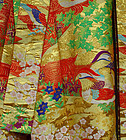
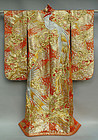
Price on Request Japanese wedding gown with a pair of oshidori (Mandarin ducks), flowers and maple leaves in the background colors of red and gold. This is a newer gown in very pretty cheerful colors and it's in excellent condition like new.
Dimensions: 51"W x 74 1/2"L
Asian Art By Kyoko
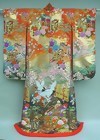
Price on Request Japanese Uchikake (wedding gown) in red and soft gold color. Because of the heavy use of silky gold thread in design, the gown, over all, looks orange than red, thick and the liner with the design of chrysanthemums. Approx. 40 to 50 years old), almost in new condition.
Dimensions: 51"W x 70 1/2"L (sleeve 40 1/2")
Asian Art By Kyoko
Sold. Thank you! Japanese Uchikake (wedding gown) with Imperial Carts, flowers and gold color “maku”
(outside cloth divider). The divider is used as a street on this gown leading the wagons to the large area at the bottom half. The background colors from the top are orange, light pink to dark gray at the bottom. The liner is red. The condition is excellent, like
new.
53" W x 75 1/2" L (sleeve length 41")
Asian Art By Kyoko
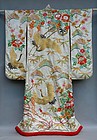
Price on Request Japanese silk wedding gown with beautiful embroideries of flowers, cranes and the imperial gosho-carts. This is an older and top quality gown that is probably dated early to mid Showa period, 1930-1950; it belongs somewhere between antique gowns and newer gowns. The quality is different from later Showa period when most of the gowns were made for rental...
Asian Art By Kyoko
SOLD. THANK YOU! Japanese Kesa, buddhist priests' robe, silk brocades, excellent condition. Circa early 1900 to 1940. Dimensions: 46" x 75"
Asian Art By Kyoko
Sold. Thank you! Japanese Kesa, Buddhist priests' robe, "ro" summer silk. 44 1/2" x 77", the color changed evenly to a tannned tone. There are some stains in the front and back, and the handle and the folding lines in the back are soiled.
Asian Art By Kyoko
Sold. Thank you! Japanese Kesa, Buddhist Priests' Robe, soft brocades with silk liner. The liner has some discoloration and is soiled. 46" x 77 1/2"
Asian Art By Kyoko
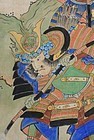
Inquire for Price Rare quality nobori Japanese banner for Boy’s day; beautiful hand-dyed work of the samurais on cotton. The nobori banners were originally used in the battlefields to shift the troops and to show the warriors the location of their generals. The designs on the banners were much simpler then and some were quite large. They must have had a scaring effect on the enemy when
they saw so many flying banners in the sky approaching towards them...
Zentner Collection
$3,500.00 Japanese futon cover with design of crane and turtle, design of Shouchikubai (the Three Friends: pine, plum, and bamboo) in the background, colorful paste resist on cotton, 2 panels, tabs added at top, signed.
Size: 62 1/2” high x 52 1/2” wide
Condition: one nice repair, very good condition
Asian Art By Kyoko
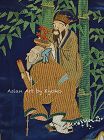
Inquire for Price Japanese fukusa, a silk satin gift cover depicting the Seven Sages of the Bamboo Grove. The development of the Japanese fukusa is closely associated with their custom of gift giving. Japan has been a farming country until recently and crops were directly affected by nature (draft, floods, etc). The rituals were held within their own communities and fresh crops were offered to god. To irrigate and lay the roads, they needed the better their work relationship...
Asian Art By Kyoko
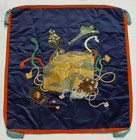
SOLD Thank you! Old Japanese gift cover, fukusa with a black mask and a mask box, bells, hat and fan used in the Noh(No) play, Okina (the sacred old man). The Dance of Okina start with a comtemporary prayer for 'a peaceful reign over the land' Okina wearing a white mask. The black mask is worn by the Kyogen actor in the third dance, "Sanbaso".
Embroidered on satin, lined with red crepe silk. Dimensions: 28" X 29"
Asian Art By Kyoko
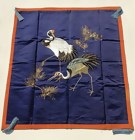
Price on Request Antique Fukusa, a Japanese gift cover with a pair of cranes and pine Tree. This type of silk fukusa was used as a gift cover at the time of a gift-giving ceremony held prior to a wedding. This was one of the rare occasions that the recipients were expected to keep the fukusa as a gift since any return associated with a wedding was considered a bad omen.
The crane and pine trees are both regarded as the symbol of harmonious marriage and longevity in Japan... |