| Home | | | Items For Sale | | | Shops | | | Current Auctions | | | Auction Information | | | Auction Schedule | | | My Vervendi | | | Seller Registration | | | Bidder Registration (free) |
| Directory: Japanese: Textiles (1033) |
|
Auctions Shops Active In This Category
MAIN CATEGORIES
|
Asian Art By Kyoko
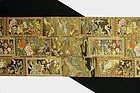
Inquire for Price Antique Japanese fukusa (gift cover), Yuzen-zome (paste regist dye) on silk kabe-ori (coarse crepe silk), early 1900s.
For a man to be a well balanced nobleman, there were requirements to be filled. 'Kin Ki Sho Ga', the four accomplishments of gentlemen, were chosen at an early time in China, practicing Kin (koto, music instrument), ki (go, Chinese chess), sho (calligraphy) and ga (painting)...
Asian Art By Kyoko
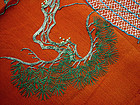
Price on Request There is no visible image of God in the Japanese Shinto religion. For this reason, people naturally find the spirit of God in their surroundings. From the ancient times, God was said to dwell in pine trees and as a result, we find many Meiji fukusa today that are decorated with pine trees. Many of them have their roots in Noh play...
Asian Art By Kyoko
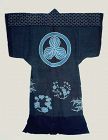
Price on Request Antique Japanese “Yogi” bed comforter, hand-spun cotton with "tsutsugaki" paste resist dye in aizome Japanese indigo dye. The design is auspicious symbol, Sho-Chiku-Bai (pine, bamboo, plums). The shoulder and collar areas are accented with "kasuri" cotton. Excellent condition - no holes on the front except one small L shape cut (3/4"x3/4") on the lower area, some repairs on the liner. Cotton wadding was taken out and cleaned (but not washed)...
Asian Art By Kyoko
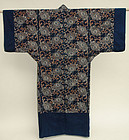
Price on Request Very attractive Japanese Yogi (bed comforter) with a pattern of chrysanthemums and scrolling vine, rice paste resist Katazome stencil dye. The cotton is not as thick as the other yogi. Excellent condition, It is an another "tsukurioki" (it had not been used after it was made - t just sit in the storage as a spare bedding for guests. One of the photo shows where the cotton wadding was taken out before the shipment. The seam at the center of the liner was opened...
Asian Art By Kyoko
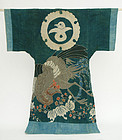
Sold. Thank you! Antique Yogi (Japanese futon bed cover), hand drawn in Tsutsugaki paste resist dye with an auspicious design of a phoenix (ho-o) bird and paulownia tree. The family mon (crest) is a wild goose. Meiji Period (1868-1912). Approximately 59" wide x 74 1/4" long.
The phoenix is a mythological bird known to appear during times of peace and prosperity. It symbolizes immortality, resurrection, and life after death. Its appearance is said to resemble a heron, eagle, and peacock...
Asian Art By Kyoko
Sold. Thank you! Hand-woven Kasuri ramie (high quality hemp) taken from a man’s kimono with a pattern of small arrows. This type of kasuri fabric was not for common people. It was too expensive so it was only worn by wealthy merchants or the samurai class. 3 1/3" cut in the middle, 1 to 2 small hole. Meiji period (1868-1912). 13 1/8” x 111 1/4”
Asian Art By Kyoko
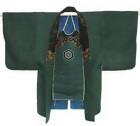
Price on Request Daimyo hikeshi shozoku: Samurai firefighter's wool jacket with a silk velvet collar; the crest and design are couched with gold leaf thread (wrapped around silk thread), chest protector and belt. Excellent, clean condition with some holes and damages in velvet collar. Late Edo period (1603-1868), 50" wide x 39" long, Chest protector, 25 1/4" long.
There were many fires during the Edo period (1603-1868)...
Asian Art By Kyoko
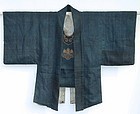
Sold. Thank you! A daimyo’s firefighting wool jacket with a Kiri-no-mon crest, chest protector baring the same crest. It has a silk liner decorated with old marble dye. Dated from late Edo period (1603-1868),
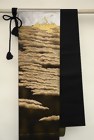
Japanese could not produce wool of their own during the Edo period. Totally depending on Nanban trading, wool was pretty rare and pricey commodity. The liner for this jacket is also unusual. This is our first and only antique marble dyed fabric ever... Beautiful Japanese obi with a woven design of Mt. Fuji above golden clouds. The design has more details than shown in the photos. The length shown in the photos was adjusted to 6'2". The total length of the obi is 14'6" long and 12 1/4" in width. The silver sky (touched up with brown painting) end when the obi is folded in half (7’1”) is followed by the other design in the same silver background...
Asian Art By Kyoko
Price on Request Silk Japanese obi, tapestry weave with a considerable use of genuine gold (Rinpa style as indicated) and some silver (it is either treated or some other metal). This obi is fukuro obi; the design on one side continues 9 feet from one end, 46 inches in a simpler geometric design before it ends with 18 1/4 inches long complicated design at the other end. The reverse side is a plain black satin silk without any design. Total measurements: 12 1/4" wide x 14'4" long.
Asian Art By Kyoko
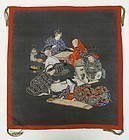
Sold. Thank you! Antique Japanese Fukusa (gift cover), Kinko (Ch. Qin Gao) on a giant carp. According to old Chinese legend, only a mighty carp can climb the upstream of the Yellow River where water plunges a hundred feet, turning into a water fall. When it does happen, a carp can turn into a dragon and is able to ascend to heaven. Based on the legend, a task that seems almost impossible to attain is called ‘passing the Dragon Gate’.
Here in this Japanese fukusa, a well dressed man on the red car...
Asian Art By Kyoko
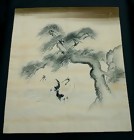
Price on Request Cranes symbolize fidelity. They are known for not leaving their spouse’s side after their partner’s death. When pine needles fall, they fall as a pair and the color is evergreen. A pair of cranes under an old pine tree signifies the union of a couple. It is a perfect wedding fukusa (gift cover). The design is beautifully drawn here in Sumi-e black ink style on Shioze silk. Circa, Taisho to early Showa period, 1930-1940. Dimensions: 25 5/8" x 29"
Asian Art By Kyoko
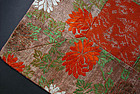
Sold. Thank you! Antique Japanese Kesa with the design of chrysanthemum, lined with silk, Meiji period. Dimensions: 35 1/4" x 64"
Asian Art By Kyoko
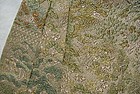
Price on Request This is a Japanese Nishijin obi made in exceptionally high quality. The obi is old but almost in perfect condition. It is beautiful to look at even without using a magnifying glass. The soft colors have an earth tone and the use of the dyed threads tells us that this is a superior work of Kyoto Nishijin. The scenery is of the mountains of Kyoto but if you look closely, you might notice that there is a foreign look to some of the structures. The size of each structure is 1" to 2.5". The...
Asian Art By Kyoko
Sold. Thank you! A Japanese priest's silk ouhi (Buddhist priest's ritual arm - shoulder covering), the green/gray/black brocade silk with an overall design of cranes, pine, stylized shells, verlaid with white line divisions and asymetric gold thread kikyo (Chinese bell flower) designs, pale pink silk liner. Late Edo period. Dimensions - 11 1/8" x 54".
Asian Art By Kyoko
Sold. Thank you! A Japanese silk oohi (Buddhist priest's ritual shoulder covering), deep salmon pink brocade silk with an overall design of overlapping fan shaped panels and snowflakes interspersed with daisies and Chinese bell flowers, etc; internal corners with Japanese symbols on a white ground. The ties and liner are green silk. Meiji period. Dimensions - 12 1/2" x 58 1/2".
Large navy blue cotton cloth, 84" x 80 1/2", meticulously hand stitched with old Japanese folk art, sashiko stitches. It is a piece of art that began as a necessity among the farmers. Cotton stitches were added to their clothes that were made out of hemp to give it softness, warmth, and strength. Old jackets, furoshiki wrapping cloths, etc. that were adorned with interesting designs created with Sashiko stitches, are popular collector’s items today.
This cloth is from the early to mid Sho...
Asian Art By Kyoko
SOLD. THANK YOU! Beautiful Japanese kesa made from a very high quality silk brocade. The work shown on this kesa is truly amazing. The gold picks up light easily and when it does, it changes the whole kesa to a golden color. The decoration is an auspicious floral design of hosoge (ancient imaginary flowers said to bloom in heaven) and karakusa. It will be impossible to produce a kesa of this quality today because of the steep decline in the quality of materials and workmanship since the time that this kesa w...
|