| Home | | | Items For Sale | | | Shops | | | Current Auctions | | | Auction Information | | | Auction Schedule | | | My Vervendi | | | Seller Registration | | | Bidder Registration (free) |
| Directory: (25589) |
|
Auctions MAIN CATEGORIES
|
Zentner Collection
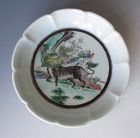
Price on Request Chinese antique small porcelain bowl with lobed edges, painted with a qilin against a background of rocks and trees. The sides are painted with more rural scenes in blue, green, black, red and yellow enamel. The significance of the qilin is that it is said to appear upon the imminent arrival of a sage or "illustrious ruler". It embodies and protects Chinese virtues on earth, using it's magical powers to uplift the good. A chimeric creature, the qilin has the features of various animals inc...
Zentner Collection
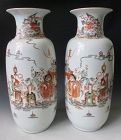
$5,000.00 Antique Chinese pair of large porcelain vases. Painted in black and red tones with elaborate scenes of religious figures, each displaying their specific characteristics and attributes in a spirited scene of multiple story lines. Wonderful detail and energetic subject matter complete with dragons, tigers, elephants and cranes. Six character Qianlong mark on the bottom.
Age: 19th century or earlier Dimensions: 29" high x 8 1/2" wide
Zentner Collection
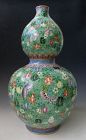
SOLD Chinese large antique porcelain vase decorated with brilliant colored butterflies and twisting fruit vines on a turquoise green ground. The mouth, foot and center are decorated with colorful detailed bands. With Qianlong mark on the bottom.
Dimensions: 20" high x 10 1/2" wide
Hundred and One Antiques
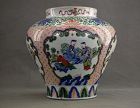
$6,000.00 Magnificent antique Chinese Wucai procaine large baluster vase, 17th century, transitional period, circa 1650.
The vase is decorated to the body with finely hand-painted four large lobed panels with a band of Ruyi heads, all reserved against a trefoil ground of iron red. Each panel encloses figures in landscape scenes. The shoulder is decorated with flower heads amongst profuse scrolling tendrils, and the base is encircled by a border of overlapping leaf tips. CONDITION: In good ...
Zentner Collection
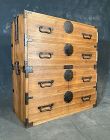
SOLD An antique Japanese Kasane Kimono Tansu (stacking chest on chest) made entirely of Kiri (Paulownia) wood. All original hand forged iron hardware including the Gumbai drawer handles and the stylized Chrysanthemum lock plates. Each section has two full width drawers for abundant storage and each section has side handles for carrying the tansu. Constructed using Japanese joinery and hardened wooden nails.
Age: Early Meiji Era (1868-1880) Dimensions: 39 5/8" Wide by 40 1/2" High by ...
AntiqueTica.com
$1,300.00 A pair of Japanese Hibachi vessels with black lacquer.
Hibachi is a traditional Japanese heating device. Age: Japan, Showa Period, Mid-20th Century
Hundred and One Antiques
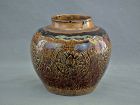
$1,200.00 Antique Chinese, finely potted, amber-brown glazed ceramic jar, 17th century (late Ming dynasty).
The broad-shouldered globular body rises from a flat base to a short neck with a lipped rim, covered with a rich glaze of various shades of amber brown, stopping neatly 2 cm above the foot ring. The sides are finely decorated with six medallions incised in low relief, containing lotus and chrysanthemum flowers with small birds and leaves between the medallions. The jar is finely p...
Zentner Collection
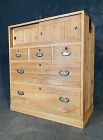
$1,100.00 A mid century Japanese single section Kimono chest called Isho Tansu made entirely of Kiri (Paulownia) wood. All original hand made bronze hardware. With 2 sliding doors that cover a large storage area, 3 small side by side drawers and 2 large drawers below. Side handles allow for moving this tansu from place to place. Constructed using hardened wooden nails and Japanese joinery.
Dimensions: 33 7/8" Wide by 37" High by 16 7/8" Deep
Zentner Collection
SOLD An antique Japanese low Mizuya Tansu (kitchen chest) made of Hinoki (Cypress) and Keyaki (Zelkova) woods. Original hand forged iron hardware with Warabite style handles. 2 Sliding doors behind which a split level shelf allows for abundant storage. Side support slats provide strength and visual design. 4 side by side drawers below provide additional storage.
Age: Meiji Era (1890-1900) Dimensions: 43 1/2" Wide by 32" High by 15 3/4" Deep
Zentner Collection
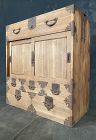
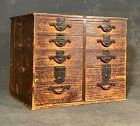
$3,250.00 An antique Japanese Choba Tansu (merchant chest) from the Nihon Matsu region of Japan made entirely of Kiri (Paulownia) wood. All original hand forged iron hardware including the Warabite style handles. Lock plates have double pine tree design to symbolize longevity and good luck. 6 drawers of various sizes for organizing and storage. A pair of sliding doors behind which a split level shelf kept merchant records and books. Side handles to each side for carrying tansu from place to place. Bea...
Zentner Collection
$2,000.00 An antique Japanese Chobako (merchant small chest) made of Kiri (Paulownia) and Sugi (Cryptomeria) woods. All original hand forged iron hardware including the Hikute style handles. 8 drawers of varying sizes used to store merchant wares for sale. Unusual wooden lip surrounding the top where seller showcased each item for sale to the buyer. Custom made tansu specific to the seller needs. Constructed using hardened wooden nails and Japanese joinery.
Age: Meiji Era (1880-1890) Dimen...
Zentner Collection
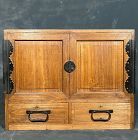
$350.00 An antique Japanese Honbako (book storage chest) made entirely of Kiri (Paulownia) wood. All original hardware with bronze locks added at a later date for security of drawers. 2 hinged doors open with the left door secured by a clasp style lock situated at the center of the shelf. Constructed using hardened wood nails and Japanese joinery.
Age: Meiji/Taisho Era (1910-1920) Dimensions: 26" Wide by 19 3/4" High by 12 3/4" Deep Fine & Rare Chinese Ming Dynasty Blue & White Kraak Porcelain Dish
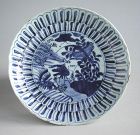
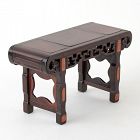
This very rare and unusual fine quality moulded "kraak" porcelain dish was made toward the end of the Wanli reign (1573 - 1620) of the Ming Dynasty at the famous Jingdezhen kilns. It has a scalloped cavetto and the underglaze pattern is a deep blue. The central design features a butterfly and a grasshopper on a rock within an attractive landscape. The pattern surrounding the cavetto is most unusual and dishes with such a bord... A small Chinese hardwood stand in the shape of an altar table, the pierced apron with lingzhi mushroom. Condition: few traces of usage, small restored crack (see photo No. 3). Dimension: c. 25.5 cm long, 10.3 cm wide, 15.2 cm high, weight: 515 g.
AntiqueTica.com
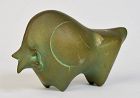
$700.00 Japanese bronze bull with artist sign.
Age: Japan, Showa Period, 20th Century
t a t a m i
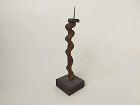
$250.00 CANDLESTAND Old Japanese mingei wooden shokudai (candlestand) that applies the original spiral form created by natural forces to its main body attaching with pedestal, Taisho-Showa period, 20th century, approx. H 41cm (16.14in). Expected aged deterioration as is as seen. Slightly unstable at the joint of pedestal. selected by titcoRet * Please understand that EMS shipping fee is additionally charged, and...
Welcome To Another Century
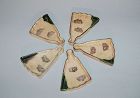
$500.00 A set of 5 mid-size dishes in the shape of half opened folding fans. On the bottom of each a decoration of two wheels, floating in a river in iron brown underneath thick cream-colored opaque glaze, and the right-side corner covered in thick green glaze typical for Oribe. The inside structured through the impression of a muslin-like cloth.
The back is engraved to indicate the spokes of the fan. Unsigned. Seto region, Oribe style, Japan, 19th century H 0.75 x L 6 x W 4 in. ...
Japanese : Tea Articles : Pre 1960
item #1458437
(stock #88)
Dragon's Pearl
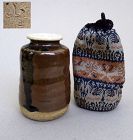
$350.00 Tea Ceremony Seto Chaire Tea Caddy of
cylindrical form with slightly tapering sides, covered with a light chocolate brown and a running mottled black glaze. Ivory lid lined with gold leaf on the inside. Signed: Hikari.
It comes with a silk shifuku storage pouch.
Size: H 9,5 x 6 cm. Taisho -Showa period.
Good Condition!
|