| Home | | | Items For Sale | | | Shops | | | Current Auctions | | | Auction Information | | | Auction Schedule | | | My Vervendi | | | Seller Registration | | | Bidder Registration (free) |
| Directory: (25550) |
|
Auctions MAIN CATEGORIES
|
GALERIE TIAGO
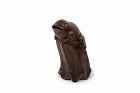
Sold Bamboo toad on a bluebell flower. The node of the wood is used as the base of the statuette.
The toad and the frog, referred to under the same term in Japanese (kaeru) are associated with good luck and wealth. Kaeru means both "toad/frog" and "coming home" in Japanese. This extension of meaning is due to the ability of the toad to return to the pond of its birth every year. A gong in the shape of a toad can thus sometimes be used as a door hammer or to protect a house.
The bluebell...
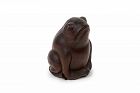
Bamboo sitting toad. The node of the wood is used as the base of the statuette.
The toad and the frog, referred to by the same term in Japanese (kaeru) are associated with good luck and wealth. Kaeru means both "toad" and "coming home" in Japanese. This extension of meaning is due to the ability of the toad to return to the pond of its birth every year. A gong in the shape of a toad can thus sometimes be used as a door hammer or to protect a house.
Japan - Taishô Er...
GALERIE TIAGO
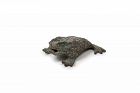
Sold Three-legged toad in bronze.
The three-legged toad, originating from Chinese mythology, is a Feng Shui symbol of prosperity and wealth.
Chan Chu, the three-legged toad, is mentioned by the poet Qu Yuan in The Songs of Chu. He compares the moon to a toad with a rounded body, whose three legs represent the three phases of the moon.
According to some authors, the toad on the moon is the beautiful Chang-e, transformed into an amphibian by Xiwangmu, the queen of the Western P...
Welcome To Another Century
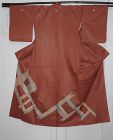
$250.00 Brown silk homongi formal kimono with dots in jacquard and with gold threads interwoven, so that the fabric sparkles when the light hits it. The upper part is undecorated, except for three crests of the Sakagami family on the back.
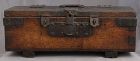
On the section that is underneath the obi, there are hand-painted crossing strips, decorated in bright colors blue, purple, red, orange, green, yellow, silver and gold sprinkle with geometric, auspicious motifs: Waves, shippo, diamonds, kikko hanabishi (hexagons... Japanese dated Edo period rectangular form wood "senryo-bako" hinged coin box on two geta feet with cast iron hardware including edge brackets, hinges, handle, and front lockplate. A barely readable black ink inscription on the bottom dates the box to the first year of the Bunkiu era (1861). Excluding protruding hardware, the wood measures about 15 1/4" long x 5 7/8"deep x 5 1/2" high. Good, solid overall condition with typical wear from age and use. One iron corner bracket has losses from ...
Conservatoire Sakura
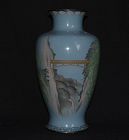
$4,500.00 Cloisonne enamel vase on hammered copper base. The meticulously positioned wires are in silver, as are the borders. The decor is simple, showing a bridge between two hills but exceptional because of its historical interest. Indeed it is a vase commemorating the bold construction of an aqueduct by a Japanese electricity company in the 1900s. The Chinese characters written below must relate the event, date it and also probably give the name of the creative artist or that of the enameling workshop....
June Hastings
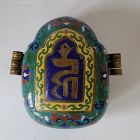
$1,450.00 An unusual Tibeto-Chinese cloisonne gau box having a domed and hinged cover with a multi-colored scroll pattern surrounding a central cartouche. The cartouche features the Tibetan character “hum” which translates as “the spirit of enlightenment” or “the enlightened mind”. This gau would have been worn by a high ranking lama. An almost identical gau, which most likely came from the same workshop, comprised lot 428 of Christie’s New York, ‘The Scholar’s Vision: The Pal Famil...
Conservatoire Sakura
$900.00 Lacquered wooden box. Decor of a painted landscape, colors and details powdered with gold. Chinese work from the end of the Ming dynasty, 17th century. The lacquer has withstood the centuries well, it bears the beautiful wrinkles of the retraction of the wood, typical of this period. Worn decor, broken wooden base, glued. No restored parts or hidden defects. The condition is visible on photos. Inside 2 Chinese characters painted in cinnabar red lacquer. Length: 415mm
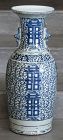
23 1/4" high Chinese late Qing dynasty Guangxu period baluster form floor vase decorated in underglaze blue against a white background with “shuangxi” symbols (indicating double-happiness and wedded bliss) surrounded by a stylized pattern of pencil style scrolling sweet pea vines (symbolizing “many children”). This type of decoration with a sweet pea floral background was produced for the Straits Chinese communities and is also referred to as blue and white nonya ware or "Shanghai ware"...
Conservatoire Sakura
$400.00 Un panneau de bois sculpté en relief d'une divinité. Travail indien ou Himalayen. Ceratinement trés ancien. Au revers le bois a été fortement vermoulu, toutefois l'ensemble est solide. 205x130mm
Japanese : Woodblock Prints : Pre 1940
item #1471694
(stock #Hasui612)
Era Woodblock Prints
SOLD Kawase Hasui
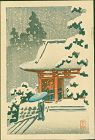
Vermillion-lacquered Temple Gate in Snow Date: 1930s. Size: Approximately 6.125 x 4.125 inches. Publisher: Watanabe Shozaburo Hasui seal at lower right. "Made in Japan" stamped on back. Medium: Japanese woodblock print. Reference: Hotei Hp-48. Condition: Excellent.
Japanese : Woodblock Prints : Pre 1970
item #1471659
(stock #Koitsu711)
Era Woodblock Prints
$350 Tsuchiya Koitsu
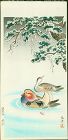
Mandarin Ducks Date: 1930s. Size: Mitsugiri-ban. Approximately 15.75 x 7.5 inches. Publisher: Doi Hangaten. Reference: Koitsu catalog no. TK-DH-76. Carver: Harada. Printer: Yokoi. This seal combination indicates an early post-war edition. Medium: Japanese woodblock print. Condition: Excellent. Back top margin has tape residue. Note: An usual subject for Koitsu.
Abhaya Asian Antiques
$230.00
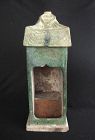
Ming Dynasty ceramic wedding booth. Traditionally in China, a woman was carried in a covered wedding sedan chair by bearers accompanied by musicians. This piece has a detachable roof, replicating a draped cloth and is in good condition- only a few minor glaze frits. Would make an excellent display stand for a small Buddha. H: 35cm/13.8in and 12.5cm/4.8in.
Abhaya Asian Antiques
$300.00
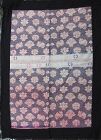
Fine old wedding blanket from the Mulao ethnic group in Southern China. This has a classic floral, butterfly and phoenix weft embroidered pattern. Excellent condition with no damage- this is woven with all handspun cotton thread with some tiny bits of silk floss. The dyes are a combination of indigo and possibly aniline and organic mix in the red and orangeish colors. L: 100cm/39.5in and W: 72cm/28.2in - with border L:122cm/48in and W: 88cm/35in.
Abhaya Asian Antiques
$130.00
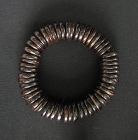
54 old coconut disc shaped beads, mala. I acquired these beads in 1991 in the Barkhor Market in front of the Jokhang Temple in Lhasa. These have been restrung on elastic chord so it may be worn around the wrist. These are old hand made beads with beautiful natural patina. Each bead is Diameter: 14mm the entire strand is L: 225cm/8.8cm. free shipping.
Korean Art and Antiques
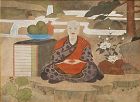
$3,500.00 Rare and Fine Painting on Silk of Dokseong, The Hermit Saint, from the renowned Charles J. Chu Collection. Sold on June 25, 2010 in Skinner's Asian Works of Art auction (Sale 2512, Lot 445). The last Dokseong painting we had was sold several years ago to the Art Institute of Chicago. Good and old Dokseong paintings rarely come onto the market. This is a rare opportunity to acquire a beautiful and important painting with an impeccable provenance. Rendered with old mineral pigments and ink, Dokseo...
Momoyama Gallery
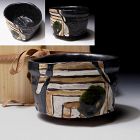
$495.00 A large Kuro-Oribe chawan, hand thrown and carved from fine Mino clay during the later Meiji Period (1868 - 1912). It comes with a very good Japanese wooden box. Oribe-yaki – I guess no other pottery had a greater influence on the aesthetics of Japanese pottery. Oribe ware is a historically important Japanese pottery variety that emerged during the late Momoyama and early Edo periods in Tajimi, in modern day Gifu prefecture. Developed under and named after th...
Indian Subcontinent : Himalayas : Pre 1920
item #1471606
Global Ceramics
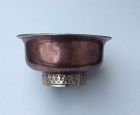
$150.00 Red copper and silver bowl, Tibetan and probably used for buttered tea. Silver lining and foot rim, the latter with a border of stylized leaves, embossed and chased, probably early 20th century. Tibetan silver normally lacks hallmarks and this bowl tested for a silver content of 500/1000. Diameter "3 3/4 / 9.7 cm, height "2/ 5 cm. Condition: fine.
|