| Home | | | Items For Sale | | | Shops | | | Current Auctions | | | Auction Information | | | Auction Schedule | | | My Vervendi | | | Seller Registration | | | Bidder Registration (free) |
| Directory: (25574) |
|
Auctions MAIN CATEGORIES
|
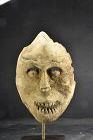
Unusual mask carved in wood, in the form of a skull face, with a strong expression in relief. Remnants of the original pigments meant to enhance the mask features. This mask, which was never worn, was used by a "dukun" for ritual practices and ceremonies. The mask was found in the island of Java, Indonesia. Its height: 17 cm. Mounted on a custom stand. Despite signs of great age and old accidents, the mask is in rather good condition. Provenance: old Dutch collection.
NOTE: A dukun is an Ind...
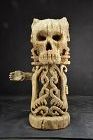
Extraordinary, rare and very old ancestral statue, "korwar", carved from single piece of wood representing a standing human figure on a rounded base with a symbolically oversized skull head, with a lodging on top to accommodate a real partial ancestor skull. Two small dieties figures were carved in relief on the sides of the skull. Addionally, the right arm of the human figure was carved separately and affixed to the korwar with a tenon.
Korwar figures represent ancestor spirits that are hig...
Japanese : Tea Articles : Contemporary
item #1485865
(stock #TRC240707)
Kyoto Ceramics and Fine Art
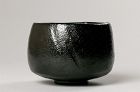
Sold, Thank You! When the founder of the Urasenke style of tea ceremony, Sen-So Soshitsu (1622 -1697) was invited to Kanazawa as the master of tea ceremony for the powerful Kaga lords in 1666, the first Chōzaemon came with him and established Ōhi-yaki in Kanazawa. Chōzaemon had been the chief apprentice to the Raku family in Kyoto and took with him many of the principles and ideas associated with Raku-ware. Since those auspicious beginnings, Ōhi-ware has held a high place in the world of tea cere...
The Kura
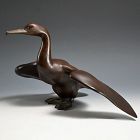
sold, thank you The cormorant prepares to take flight, wings extended, captured in bronze in a moment of excitement, the shapr eyes focused ahead. Captivating realism with simple Art-deco overtones signed below the tail. It is 32 x 36.5 x 25 cm (14-1/2 x 13 x 10 inches) and is in excellent condition. The cormorant, known in Japanese simply as U, is a migratory bird native to the east Palearctic with a range from Taiwan to the Russian Far East. It has a black body with a white throat and cheeks and a partial...
Mastromauro Japanese art
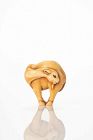
EUR €5,500 Ivory netsuke depicting a dromedary with a long neck that bends backwards. The surface is distinguished by its shine and blonde patina, with color transitions ranging from yellow to lighter ivory. To the touch, the netsuke feels soft and smooth.
Origin: Japan
Period: Edo 19th century
Dimensions: 4 x 3.5 x 1.7 cm.
State of conservation: Very good
Mastromauro Japanese art
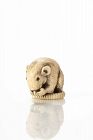
EUR €2,800 Ivory netsuke depicting a rat with black horn eyes. The rat is represented resting on its hind legs, while its long tail surrounds an acorn that it is gnawing with its front legs.
The object is accompanied by an original label which certifies its origin from the former Tamanini collection in Milan.
Origin: Japan
Period: Edo 19th century
Dimensions: 3.4 x 4.3 x 2.9 cm.
State of conservation: Very good
Haruko Watanabe
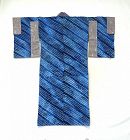
$150.00 Cotton juban (under kimono) with shibori pattern whose techniques are Miura shibori and Ori-nui shibori. The collar cloth is silk crepe with woven pattern. It has thin wool muslin with pattern in both sleeves. In good condition except for several small moth holes. It is from Tohoku district where has cold weather in winter. The first half of the 20th century. W:123cm, L:125cm
Chinese : Snuff Bottles : Pre 1900
item #1485745
(stock #WN406)
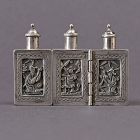
Chinese hinged triple snuff or medicine bottle made of silver. One side depicting immortals, the reverse with Chinese characters. The stoppers worked en suite, two bottles with spoon. All bases with silvermark. Condition: traces of usage. Dimension: c. 4.2 cm high, total width: c. 6 cm, weight: c. 47 g.
Zentner Collection
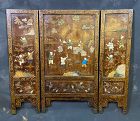
$1,200.00 An antique Chinese Coromandel screen in 3 parts made of hardwood with lacquer and hardstones. Depicts a pair of nursemaids watching over the Imperial children at play.
Made for export for the European market possibly for use as a fireplace screen. Age: Early Republic Period (1910-1920) Dimensions: Overall 38 3/4" Wide by 34 3/4" High
Zentner Collection
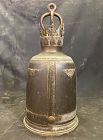
$6,500.00 An antique Hindu/Buddhist temple bell cast of bronze. Exquisite detailing with 4 surrounding dieties and a 4 prong Vajra finial. Striking nodes on four sides with a beautiful clear resonating sound when struck.
Age: 1920's-1930 Dimensions: 36" High by 18" Diameter
Zentner Collection
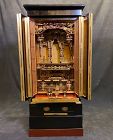
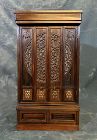
SOLD An antique Japanese Buddhist family altar called Butsudan in 2 sections. All lacquer finish with gilt lacquer interior. Exterior doors open to inner sanctum doors. Upper transom was hand carved with religious figures meditating in a wooded forest. The altar features a centerpiece dragon with 3 flying Phoenix birds above each compartment. Hanging ornaments on each side. With front slide out tray, sliding doors hiding a storage compartment and 2 drawers where Buddhist accoutrements were kept...
Zentner Collection
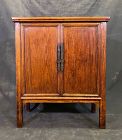
SOLD Antique Chinese cabinet made of jumu (elm) wood with natural finish. The two doors open to a large compartment with a shelf. The interior has traces of original deep red lacquer finish. Nice patina and beautiful wood grain over all.
Age: 19th century Dimensions: 44 1/2" high x 38" wide x 18" deep
Zentner Collection
SOLD Antique Japanese Butsudan, Buddhist shrine for a home. This butsudan is in two sections. The top section has four folding doors that open to a shrine interior: An multilevel altar with carved details, gold leafed silk and columns. There is a small storage compartment closed by carved sliding panels. The bottom section has two storage drawers. The doors of the butsudan are carved with a round pierced filigree design of chrysanthemums.
Age: Taisho Period (1912-1926) Dimens...
Zentner Collection
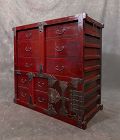
$2,950.00 Antique Japanese tansu with original deep-red lacquer finish. The top portion of the chest has three full-width drawers and locking bar. The lower portion of the chest has two medium sized drawers with a locking bar on the left hand side, a safe box on the right. The safe box door has heavy iron work and opens to reveal 3 small interior drawers. Other iron hardware includes warabite drawer pulls, extensive corner bracing and handles for carrying. The sides and back of the tansu are reinforc...
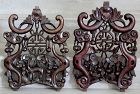
Two Chinese Qing dynasty hardwood carved panels with tabs at the top and bottom indicating they likely were originally inset into a larger piece of furniture. Each panel features a bat above a central double-happiness symbol flanked on both sides by ruyi forms. Gourds hang from vines. The slightly smaller panel includes a deer at the center bottom. The backs are flat. The smaller panel is mounted for hanging. They measure about 15 1/4" high (including tabs) x 10 3/4” wide and 14 1/2” h...
Momoyama Gallery
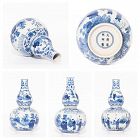
sold Beautiful Chinese antique vase, 18th century (Kangxi Period, 1662-1722). It is sculpted in double gourd shape and painted with various scholar scenes and glazed in white and blue. Continuous scenes depicting figures in a landscape are a common motif in Transitional porcelain, they often referenced popular plays, histories or poems. Very fine Kangxi mark on the bottom. PROVENANCE A Private German Collection, acquired in the 1930's in Japan. Dimension...
Conservatoire Sakura
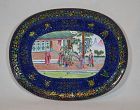
$1,500.00 Enamelled copper dish. Decor, in the center, of a palace scene painted in enamels of the "Famille Rose", surrounded by a deep Sèvres blue on which Chinese emblems stand out in gold and in silver armfuls of flowers which have lost their shine, silver having oxidized over the centuries. On the margin are represented in gold on a blue background dormouses feasting on grapes, this theme was very popular around 1800. The white reverse clearly shows the stains of the old restorations which have yel...
Japanese : Woodblock Prints : Pre 1940
item #1485631
(stock #Hasui646)
Era Woodblock Prints
$1,700.00 Kawase Hasui
Dawn Over Lake Shoji Size: Approximately 8.75 x 7 inches. Date: 1935. First and only edition. Publisher: Watanabe Shozaburo for a calendar commissioned by Japan Government Railways. Please see the included original Japanese Government Railways tag. Reference: Hotei #370. Medium: Japanese woodblock print. Condition: Margins trimmed. Back has areas of paper residue and slight thinning. Note: Not many examples of this woodblock print have survive... |