| Home | | | Items For Sale | | | Shops | | | Current Auctions | | | Auction Information | | | Auction Schedule | | | My Vervendi | | | Seller Registration | | | Bidder Registration (free) |
| Directory: (25551) |
|
Auctions MAIN CATEGORIES
|
GALERIE TIAGO
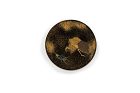
SOLD Small Kobako circular box in lacquered wood with a cicada and unidentified insect, probably a gryllotalpa orientalis, displayed on its top part.
The background is decorated in maki-e, creating a gold spray on black, and the cicada’s body is incrustated with blue pearly blue shell with the raden technique, probably kenma raden given the thinness of the pieces of shell.
Insects (mushi) play an important role in Japanese culture. Insect hunting is a popular pastime, especially among chil...
GALERIE TIAGO
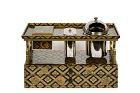
Sold Tabako Bon, or tobacco smoking set, adorned with gold and black fundame lacquer, in the form of cross braces and floret of the Hanabishi flower. The regular pattern is dotted with circular lockets representing flowers, birds, lions and dragons.
The upper plate holds its hibachi, or heating station, and two tobacco stashes in silvered bronze, the bottom part contains two superimposed drawers. The two distinct parts are separated by a perforated support, decorated with the same regular patter...
GALERIE TIAGO
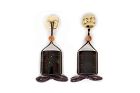
SOLD Three cases inro in ro-iro lacquer with its hira-maki-e ornaments of crows with inlaid eyes in mother of pearl. The interior in nashiji lacquer. A label of a private collection in the last compartment. The ro-iro lacquer technique comes in too variants, Hana-nuri et ro-iro-urushi. For this object the second technique was used, its specificity is the addition of iron oxide in the traditional carbon pigment and the tedious process of polishing gives this object its deep maroon color and its glos...
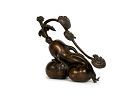
Bronze sculpture representing a group of genoderma mushrooms developing on the long stem of a Ginseng root that is standing on two kakis. Logically this root would be Panax ginseng, the Asian breed, as a matter of fact the peduncle is longer that the petiole (the part surmounted with a flower and surrounded by leaves), which is not the case with the American ginseng (Panax quinquefolius).
Plant with medicinal virtues known for centuries, the ginseng was believed to cure any disease, its scie...
Japanese : Woodblock Prints : Pre 1940
item #1500839
(stock #Hasui723)
Era Woodblock Prints
$325 Kawase Hasui
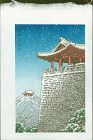
Ulmil Pavilion, Pyongyang - Blue Sky Series: Korean Prints. Size: Koban. Image size: 7 x 4.5 inches. Paper size: 9.0 x 5.875 inches. Date: 1939 (This example 2018). Produced in 2018, when a limited edition of this print was commissioned by Ukiyoe-Gallery, who discovered Hasui's little-used original set of blocks. This example is an artist's proof. Printer: Atsushi Kawai. Requiring 12-14 impressions on paper produced by Ichibei Iwano. Publisher's label o...
Japanese : Woodblock Prints : Pre 1940
item #1500838
(stock #Hasui722)
Era Woodblock Prints
SOLD Kawase Hasui
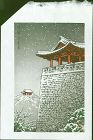
Ulmil Pavilion, Pyongyang - Grey Sky Series: Korean Prints. Size: Koban. Image size: 7 x 4.5 inches. Paper size: 8.25 x 5.875 inches. Date: 1939 (This example 2018). Produced in 2018, when a limited edition of this print was commissioned by Ukiyoe-Gallery, who discovered Hasui's little-used original set of blocks. This example is an artist's proof. Printer: Atsushi Kawai. Requiring 12-14 impressions on paper produced by Ichibei Iwano. Hasui seal lower r...
GALERIE TIAGO
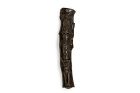
Sold Two cicadas in bronze facing each other on a bamboo segment
One is an adult while the other is at the nymph phase. Three foundry stamps, one underneath and one alongside each insect.
Cicadas have a very prominent role in Japanese folklore, it symbolizes the arrival of hot summer days. Its song became an emblematic sound marker of hot weather. By its sole presence cicadas emphasize not only the heat of the day but also the briefness of nature, representing an intense but ephemera life cyc...
GALERIE TIAGO
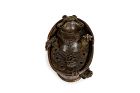
Sold A small bronze sculpture of a frog represented in its bath soaking with a lotus root. It was designed to be used as an incense burner. A Chinese poem has been engraved on the back. The frog (kaeru) is associated with luck and wealth. In feudal Japan, tax collectors could be recognized by the frog-shaped netsuke they wore on their belts. Nowadays people keep frog amulets in their wallet to be wealthy. Kaeru means both "frog" and "coming home" in Japanese. This extension of meaning is due to the f...
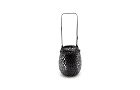
Small Ikebana basket with a black lacquer finish, solely made of bamboo slats. The
handle is of rectangular shape, made of a single slice of bamboo split and fixed by four
knots deep rooted in a braided belt. The body is rather coved but held tight by
diamond shaped weaving and kept in place at its base by a fish bone braiding motif
only visible underneath the basket.
Includes its water cup that is also in black lacquered bamboo.
Ikebana or Ka-do (the way of flowers) is a traditional J...
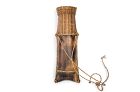
Rare hanging bamboo basket for ikebana (hanakago).
The body is made of bamboo folded on itself, reinforced by rattan braiding at the
round neck and on the sides to hold the suspension wires.
Japan – Showa era (1926-1989)
Height: 13.4 in / 34 cm – diameter (neck) : 4 in / 10 cm
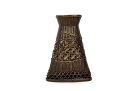
Rare brass ikebana basket made to imitate the traditional Japanese basketry
(hanakago) that usually use bamboo and rattan. Of trapezoidal form with a round
opening, a tight colar and its foot stretch to the base. The basket can be exposed both
standing on its foot or hanging by the hook on its back. Adorned with a dragon on
the upper section and a bee and butterfly in the middle section. Its shape and details
are finely excuted and imitates the classic basketry perfectly. With a differ...
GALERIE TIAGO
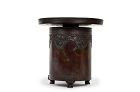
sold Very elegant bronze vase with a beautiful patina, its three feet are representing
Buddhist guardian lion. Topped with a plate standing on shrink collar. On the bottom
part a very impressive work of patina ranging from green to cherry red and golden
brown. The upper third part is adorned with a frieze symbolizing both water and wind
as elements highlighted with a second frieze of parallel stripes extending to the top.
(Presented with second and smaller vase design to be used within)
Jap...
Japanese : Tea Articles : Pre 1920
item #1500830
(stock #2024-1288)
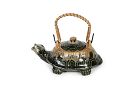
Teapot made of stoneware with slip decoration, shaped like a turtle. Glazed interior, unglazed rim around the lid and lower part.
In Japan, the turtle (known as "kame" in Japanese) is a symbol rich in meaning and holds a special place in Japanese culture, Taoism, and folklore. It is perceived as a wise and protective creature, recognized for its exceptional longevity. According to popular belief, a turtle can offer its owner 10,000 years of happiness and prosperity due to its long life and sl...
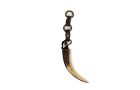
This type of knife is often called fisherman knife although it was used by a wide range
of workers and social classes. It opens thanks to a push system with no lock, the steel
blade is in decent condition even if a little oxidation was once there, the antler piece is
a nice yellow and brownish shade patina. A very curious system is clogged into the
blade, probably so one could hang it and carry it around. It is made of three bronze
ring links to one another with leather straps firmly t...
GALERIE TIAGO
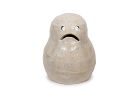
SOLD Interesting lanterns are made of white crackled ceramic, bell shaped. Thought to be
representing a ghost, a wide opening on one side grant you access to the inside while
three other openings suggest a mouth and eyes in transparence.
Japan – Meiji era (1868-1912)
Height: 30 cm – Maximum diameter : 25 cm
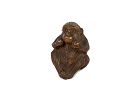
Chiseled wood sculpture representing a seated monkey holding peaches of longevity in his
hands. The impression of the fur is quite realistic, and its eyes are enhanced with black lacquer.
The figure of the monkey with longevity peaches is a popular image in China, however this
subject was also widely used by the Japanese.
According to the legend the monkey Sun, king of monkeys, upset that he was not invited to
the banquet of the Queen Mother, entered the garden of the goddess Xiwangmu in...
Inrō with four gold lacquer compartments, decorated with a lake landscape.
Accompanied by a bronze ryusa manju.
Small boxes formed of compartments that fit one on top of the other, inrō (印 籠) are
traditional Japanese clothing items. Since the kimono had no pockets, everyday objects
were carried in small boxes (sagemono) hung on the belt (obi). To prevent them from
slipping, a netsuke, a small wooden or ivory figurine, was used to hold the cord of the inrō or other types of sagemo...
AntiqueTica.com
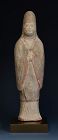
$1,750.00 Chinese pottery standing court man.
Age: China, Tang Dynasty, A.D. 618 - 907
|