| Home | | | Items For Sale | | | Shops | | | Current Auctions | | | Auction Information | | | Auction Schedule | | | My Vervendi | | | Seller Registration | | | Bidder Registration (free) |
| Directory: (25549) |
|
Auctions MAIN CATEGORIES
|
Japanese Art Site
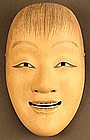
SOLD Edo Period (circa 1850) Japanese Noh Mask of Shojo, representing a happy, merry soul. He has a reddish complexion from drinking sake. This mask has a wonderful, happy presence. Beautifully carved to create a compelling expression. Lacquer over Paloma wood. 8.5 x 5 inches, 21.5 x 13 cm. Excellent Condition. From a prominent and widely exhibited collection.
Japanese Art Site
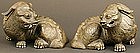
$2300.00 An early pair of Japanese Kutani Porcelain Shishi (Foo Dogs). These unique porcelains
have a rich brown glaze with black and white under glaze. They have a wonderful mythological presence. 7 x 4.5 inches, 18 x 11.5 cm each. Excellent Condition. From a prominent and widely exhibited collection.
Japanese Art Site
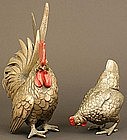
SOLD Rooster and Hen Sculpture, wonderfully and finely detailed bronze over white metal with accents of red lacquer. This Art Nouveau pair is from a London collection. Japanese Art Nouvaeu flourished in Europe in the late
19th and early 20th Century. The Rooster and Hen is a popular subject in
Japanese art. Symbolic of Yin and Yang, male and female. Rooster: 8 inches, 20.5 cm tall. Hen: 4.5 inches, 11.5 cm tall. Excellent Condition. From a prominent and widely exhibited collection.
Japanese Art Site
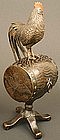
$2650.00 A superb bronze casting of a Rooster on a Commonwealth Drum. It is of the finest quality, a master work of the art of Japanese bronze metal art. The Rooster on a drum is a popular image for the New Years Geon Festival. 11 inches, 28 cm tall. Excellent Condition. From a prominent and widely exhibited collection.
Japanese Art Site
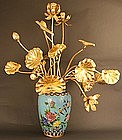
SOLD Japanese pair of very large gold lacquer on carved wood Lotus Flowers, 11 flowers in each pair for 22 all together, of them fully bloomed Lotus Flowers. Edo Period, Early 19th Century. They were likely used on the altar of a Buddhist temple, representing the full cycle of life. They have a rich gold patina. This size and condition are extremely rare and almost never found. Height of the tallest: 41.5 inches, 105.5 cm. Excellent Condition. From a prominent and widely exhibited collection. (Vase i...
Japanese Art Site
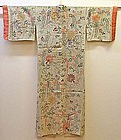
$9500.00 A important Rare 18th Century Noh Theater Robe. This extraordinary silk embroidered example of a summer production Noh Robe has a design of Wisteria, Fans and Ropes, and exquisitely captures the art of
Noh. 63.5 inches (161.5cm) height x 52 inches (132 cm) width. Excellent Condition. From a prominent and widely exhibited collection.
Japanese Art Site
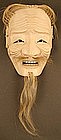
$3750.00 A Superb, Rare Pristine 18th Century Japanese Noh Theater Mask of Ko-jo, an elegant old man
in Noh Drama. This mask is of the highest quality carved to dramatic perfection. Finely lacquered over wood. A magnificent addition for the serious Noh mask collection. 8 inches (20.5 cm) height x 5.5 inches width. Height with beard is 14.5 inches (37 cm). From a prominent and widely exhibited collection.
Japanese Art Site
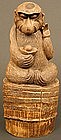
SOLD Antique Japanese Okimono Bamboo Sculpture of a Snow Monkey Holding a Peach. Unique
master carving of wonderful charm and presence with a fine patina. A must for the monkey and Japanese enthusiast. 12 inches, 30.5 cm tall. Excellent Condition. From a prominent and widely exhibited collection.
Japanese Art Site
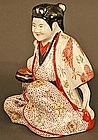
SOLD Japanese Imari porcelain figure of a seated girl. Beautifully done in a blue,
yellow, green, and red under glaze. A wonderful, fine example for the discerning
collector. 9 inches, 23cm tall. Excellent Condition. From a prominent and widely exhibited collection.
Japanese Art Site
$2000.00 Japanese Koto Cover featuring a magnificent Phoenix. The Koto is a traditional Japanese stringed musical instrument. This Koto Cover was
for an important Koto player. A textile of this quality rarely comes along
for sale. Beatifully hand painted with some embroidery on fine silk. Really a work of art. 96 x 13.5 inches, 244 x 34 cm. Excellent Condition. From a prominent and widely exhibited collection.
Japanese Art Site
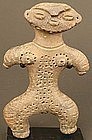
SOLD Fine example of a Jomon Period Dogu, the earliest known Japanese figure. This figure was purchased in Japan and belonged to the renowned Japanese art historian, Shirley Day. The Dogu acted as effigies of people. They manifested some kind of sympathetic magic. For example, it may have been believed that illnesses could be transferred into the Dogu, then destroyed, clearing the illness, or any other misfortune. Because of the ritual destruction of Dogu, they are quite rare. This primitive abstract...
Japanese Art Site
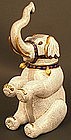
$2050.00 Japanese Cloisonné Elephant Jar. This is a wonderful, charming figure and is
an unusual fine example that is a joy to behold. In a circus pose with elaborate
fittings. 11.5 inches, 29 cm tall. Excellent Condition. From a prominent and widely exhibited collection.
Japanese Art Site
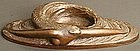
$2100.00 Japanese Bronze Sculpture of a Mermaid in a Whirlpool. An exquisite example by the important artist Isihara of the type of Japanese art that was having a major influence on Art Nouveau. A rare example of this artist's work. 9.5 inches (24 cm) long. Excellent Condition. From a prominent and widely exhibited collection.
Japanese Art Site
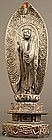
$1550.00 17th Century Japanese Standing Buddha. A rare and fine example from the early Edo Period. Carved of Poloma wood with a rich dark patina. Complete with Stand and Mandala. It has a spiritual presence and a beautiful face to contemplate. 15 inches, 38 cm tall. From a prominent and widely exhibited collection.
Japanese : Pre 1800
item #697160
(stock #R63)
Japanese Art Site
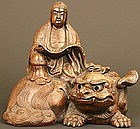
$3200.00 A spectacular Edo Period Bizen Ceramic Sculpture representing the Goddess Kannon riding a Shishi. This is an early and Museum Quality piece used as a Brazier Cover in the
tea ceremony, used by the highest class. 8 inches (20.5 cm) high. Excellent Condition. Mid 18th Century. From a prominent and widely exhibited collection.
Japanese Art Site
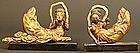
SOLD Pair of Exquisite Gilded 18th Century Japanese Angels Wood Sculpture. One angel has her scarf unfurled and caught in a tree. The other is up in the clouds in heaven. Legend has it the angel’s scarf is caught in a tree and did not allow her to heaven. A young man passing heard her and fell in love with her, but was distraught at her sadness and released her scarf so that she could fly back to heaven. Angel with scarf: 5 inches (13cm) long, Angel on clouds: 6 3/4 inches (17cm) long, height of bo...
Indian Subcontinent : Himalayas : Pre 1920
item #697090
(stock #T116)
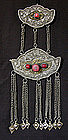
Originally, this Tibetan ornament would have been sewn to the clothing or looped around a belt and worn for festivals.
The upper medallion has a background of traditional wave/clouds patterns. In the center is a coral bead inset into the silver and surrounded with a narrow gilded wave pattern.
The lower medallion has a background of 2 dragons chasing the pearl. Inset into the center of this medallion are 3 coral beads which are surrounded by gilded wave patterns.
The silver is, of course...
Southeast Asian : Metalwork : Pre 1900
item #696944
(stock #C5475)
AntiqueTica.com
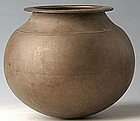
$650.00 Burmese bronze jar in beautiful and well-balanced shape.
Age: Burma, 19th Century
|