| Home | | | Items For Sale | | | Shops | | | Current Auctions | | | Auction Information | | | Auction Schedule | | | My Vervendi | | | Seller Registration | | | Bidder Registration (free) |
| Directory: Japanese (12526) |
|
Auctions MAIN CATEGORIES
|
Zentner Collection
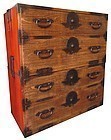
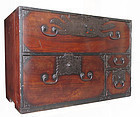
SOLD Unusual Antique Japanese two section (imho) clothing tansu with a kiri wood front and beautiful lacquered top, sides, and back. Each drawer has a round iron lockplate with the image of a crane. Nice small size for a two section tansu. Original finish. Meiji Period (1868 - 1912).
Size: 37" H x 35" L x 16" W
Zentner Collection
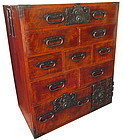
$4,750.00 Antique Japanese unusual tansu made from a very attractive Keyaki (elm wood) burl coated in original lacquer finish. It has drawers of varying sizes, with warabite shaped iron handles, the top and bottom drawers have decorative iron lock plating incised with a floral design, safebox in bottom corner with original key. Unusual size with stunning original finish and exquisite iron work.
Early Meiji Period (1868 - 1912)
Size: 34.5" H x 29" L x 17" D
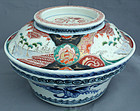
Japanese late Meiji period Imari porcelain lidded serving dish or bowl decorated in underglaze blue and overglaze polychrome enamels with gilt highlights. The center of the densely patterned brocade lid features a butterfly among gourds. The bowl is decorated entirely in underglaze blue (sometsuke) and holds three floral sprays about the circumference. The interior is undecorated. Measures about 8 ¾” diameter by 5 7/8” high. Late 19th to early 20th century...
Momoyama Gallery
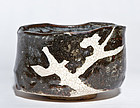
sorry sold Slightly distorted cylinder shaped (hanzutsu) tea bowl made of light, fine, unrefined Mino clay. Shape and style make it appear contemporary with the late Oribe bowls. The expertly thrown body is covered with the typical black oniita engobe inside and outside - with the exception of the bottom - over which a white, feldspatic Shino glaze has been poured. Just the foot ring and its immediate surrounding was left unglazed...
Modern Japanese Ceramics
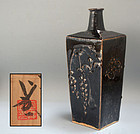
Sold, with thanks! A faceted bottle-form vase with ukibori designs by Kawai Takeichi enclosed in the original signed wooden box. It is 11 inches (27 cm)tall, 4 inches (10 cm) square and in excellent condition.
Kawai Takeichi (1908-1989) studied the art of pottery under his legendary uncle Kawai Kanjiro in Kyoto from the age of 19. He stayed with Kanjiro for many years, one of his most loyal supporters, and the two were very close...
Kodo Arts
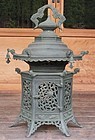
$580.00 Superb late Meiji Period C.1900 bronze lamp that used oil and wick. Absolutely spectacular bronze craftsmanship and detail from floral vine lattice on the door and side panels to the treasure symbols in fine relief around the base. H:49cm; diameter:30cm. Condition excellent except for a missing bell or two on the protruding eaves. Ask for shipping quote.
Zentner Collection
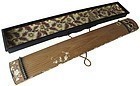
SOLD Antique Japanese stringed instrument called a koto, with a black lacquer box lined in fabric with floral motif and a cherry blossom crest in gilt lacquer on the lid. It is made from kiri wood (paulownia) and is covered in beautiful, intricate inlay of coral, mother of pearl, and shells in the forms of various flowers and birds. A koto player would kneel before the instrument to play. Special bridges are used on each string to alter the pitch.
Size: 4.5" H x 9" W x 70" L
Zentner Collection
SOLD Japanese single section isho tansu (clothing chest) from the Iwayado area. It is made with keyaki (elm) wood on the front and has a beautiful all original translucent lacquer finish. This chest consists of four drawers of different sizes. Elaborate iron hardware includes a very large phoenix shaped lock plate on the top drawer and two peony shaped lock plates on two of the other drawers. Drawer pulls are warabite shaped...
Japanese : Woodblock Prints : Pre 1920
item #1322970
(stock #Ohara100)
Era Woodblock Prints
SOLD Ohara Koson
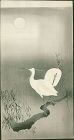
Two little egrets on a branch, full moon Size: O-tanzaku. Approximately 14.5 x 7.5 inches. Date: ca. 1900s-23. Bears Koson seal. Publisher: Daikokuya (53). Reference: K14.12 in Crows, Cranes and Camellias: The Natural World of Ohara Koson (Reigle Newland). Condition: Excellent. Pencil number on back. Provenance: The Bedford, NY estate of Eleanor Jay and Arthur Iselin. Eleanor Jay was a descendant of United States founding father, John Jay...
japanes antique textile saiyuu2
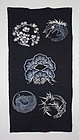
$480.00 This is an item used in a village headman for Edo period. As for this, cotton is spun by hand and is dyed with an indigo plant. This is that the theme of the pattern is happy. A pattern is round, and this is drawn. It is simple, and this is good-quality Tsutsugaki. This does not have a stain and damage. Size 180cm x 94cm (70.8 "x 37")
Zentner Collection
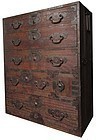
SOLD Original example of a Japanese antique isho tansu from the Matsumoto area. Made all of kiri (paulownia) wood with original patina (frame, top, sides, and drawers). Iron hardware includes money bag shaped lock plates specific to Matsumoto tansu, moko shaped drawer pulls and elaborately cut handle back plates and drawer corner bracing. The tansu has 5 large drawers and the lower right hand side has a safe box with 2 small interior drawers.
Late Edo to Early Meiji Period...
Lilly Parker Antiques, Inc.
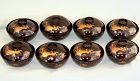
$300.00 Set of Eight(8) Japanese different shades of Gold Maki lacquered covered bowls, Ca. late Meiji early 1900, 3 1/4" high include top or cover, 4 1/2" diameter top rim. Raised low relief design of Gold Maki Lacquered Ferns and other flowering plants behind rock garden in early spring on dark chocolate color of lacquer on wood. The beautiful and detailed fine Lacquer work was done two different shades of gold in different relief design continues to the cover, bottom and side...
Japanese : Other Prints : Pre 1980
item #1322772
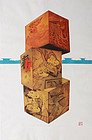
Oversized limited edition etching and relief print by Ouchi Makoto (1926-1989) titled “Firebird” dated 1971. The print is pencil-signed, numbered 30/60, and titled in kanji in the lower section beside the artist’s red seal. Paper size: 35 7/8”V x 23 1/2"H. Very good overall condition. The right paper edge cut is slightly irregular. This image is illustrated as plate 19 in the reference book “Aramusha: Ouchi Makoto The Artist Warrior” by Mary and Norman Tolman...
Momoyama Gallery
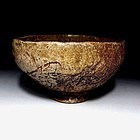
sold Special offer: very old Shigaraki Chawan, hand shaped around the early 19th century (Edo Period). It has a great wabi sabi aura without chips, cracks or repairs. A wood box is available for 50 $, a shifuku (silk pouch) for 30 $, box and shifuku together for 60 USD. Size: 7,5 cm height x 12,6 cm in diameter. Shipping included
SwisSiam-Arts-Antiques-Gems
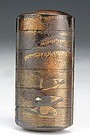
USD $950.00 An antique Signed "ZEN-MYO GA" for the artist who drew the pictures, and "E-OKI" for the artist who made this Inro (see photograph 4) Japanese Gold Lacquer 6-Case INRO, ca. 1775-1850, depicting low relief scenes of 4 Ducks on one side and 3 Ducks on the other side in a Landscape with foliage, rocks and a river (on both sides)...
Japanese : Other Prints : Pre 1970
item #1322560
Petrie-Rogers Gallery
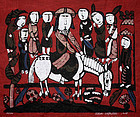
$700.00 Oversized limited edition Japanese "kappa-ban" (stencil print) by Sadao Watanabe (1913-1996) titled “The Triumphal Entry to Jerusalem.” The print is signed, dated 1968, and numbered 25/50 in white ink at the bottom. The image depicts Christ, at the center, calmly riding down the Road of Flowers toward Jerusalem. A crowd of curious and admiring people surround him. The print is executed primarily in black and white against a bold red background on the crumpled, hand-made momogami paper cha...
Kyoto Ceramics and Fine Art
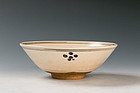
Sold, Thank You! This lovely plum patterned chawan (umebachi) is done in a classic style known as e-Gorai (“e” meaning picture and “Gorai” meaning Korean). This classification is somewhat of a misnomer as the style is said to have first developed at China’s Cizhou kilns in early Ming—only later being widely copied and popularized in Korea. e-Goriai wares first made an appearance in Japan by way of Korea at the end of the 16th century and have been highly appreciated among tea enthusiasts to this day....
Kyoto Ceramics and Fine Art
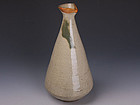
Sold, Thank You! Like many pottery traditions in Japan, Karatsu takes its name from the city where it originated. As early as the 15th century, Korean potters heavily influenced the development of this form—helping to endow it with the earthy, simple, and natural qualities it is so appreciated for. With crackled glazing and a beautiful gold repair along the top rim, this tokkuri is quite attractive and a pleasure to use.
Housed in its own fine kiri wood box, this piece is 4.3 inches in diameter at... |