| Home | | | Items For Sale | | | Shops | | | Current Auctions | | | Auction Information | | | Auction Schedule | | | My Vervendi | | | Seller Registration | | | Bidder Registration (free) |
| Directory: Japanese (12510) |
|
Auctions MAIN CATEGORIES
|
Zentner Collection
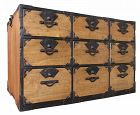
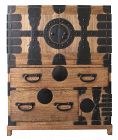
SOLD Antique Japanese tansu from the Nigata area of Japan. Most likely used by a merchant for storage. The 9 drawers are in three rows with the shallowest drawers along the top and gradually getting deeper toward the bottom of the chest. The hardware is all of iron and includes elegant hirute shaped drawer pulls, fan shaped lock plates and corner bracing. The wood is paulownia (kiri) wood.
Edo Period (early 1800's) Dimensions: 19 1/2" high x 31" wide x 19" deep.
Japanese : Woodblock Prints : Pre 1930
item #1367804
(stock #Ohara170)
Era Woodblock Prints
SOLD Ohara Koson
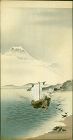
Snow-capped Mount Fuji Size: O-tanzaku. Approximately 14.5 x 7.5 inches. Date: ca. 1900s-1923. Bears Koson seal. Publisher: Daikokuya (6) Reference: K44.8 and plate 103 in Crows, Cranes and Camellias: The Natural World of Ohara Koson (Reigle Newland). Medium: Japanese woodblock print. Condition: Lower right corner reinforced. Tone line at bottom edge. Some fading. - A well-known and rarely seen Koson design.
Japanese : Tea Articles : Pre 1950
item #1367780
(stock #TRC201111)
Kyoto Ceramics and Fine Art
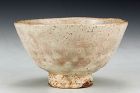
Sold, Thank You! The natural ash Hagi glaze gives this piece a mellow yet robust feel. The foot of the bowl is unglazed in places showing traces of ferrous-rich clay in the form of an orangish hue. The sides of the bowl show pale ash, ivory, and faint hints of lavender. Overall a classic and attractive example of an expertly crafted Hagi tea bowl.
The creator of this work, Korai-zaemon Saka XI was born in Yamaguchi prefecture in 1912...
Zentner Collection
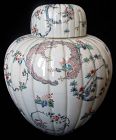
SOLD Rare Japanese kakiemon ware porcelain jar. Of a tapered melon shape, with circular floral enso motifs of bamboo, blossoming cherry branches, hydrangea, kiri leaves. The Imperial dragon and phoenix paired to represent the emperor and empress. With overglaze green, red, and blue on white bisque ground. The domed lid topped with karakusa (octopus vine) and kiri leaf pattern.
19th century Dimensions : 7.5" W x 10" H
Japanese : Woodblock Prints : Pre 1990
item #1367748
(stock #Yuichi001)
Era Woodblock Prints
$625 Yuichi Hasegawa (b. 1945)
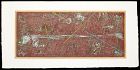
Record of Wind Erosion (Red) Japanese title: Fushoku-ki (Aka) Date: 1989 Edition: 4/20 Signed in pencil by the artist. Paper size: 24.25 x 12 inches. Image size: 20 x 8.75 inches. Reference: Art Gallery of New South Wales. Medium: Japanese woodblock print. Condition: Excellent.
Modern Japanese Ceramics
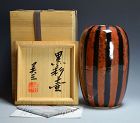
Sold, thank you! A striking black and orange striped vase in simplified ovoid form by Mukunoki Eizo enclosed in the original signed wooden box titled Kokusai Tsubo. This was purchased at a Mitsukoshi Exhibition. It is 8 inches (20 cm) tall and in excellent condition.
Mukunoki Eizo Born in Shimane, and graduated the prefectural ceramics research facility before he apprenticed under Kawai Kanjiro in 1958. He would stay with Kanjiro until the masters death in 1966...
Momoyama Gallery
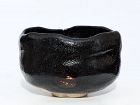
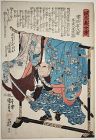
sold A superbly well balanced Kuro Raku Chawan made by one of the few masters of this genre, Ogawa Choraku (1912-1991), second heir to the Choraku lineage of Raku potters. The founder of the Choraku lineage studied under Keinyu (11th Raku) and Konyu (12th Raku) of the Raku Kichizaemon family, and in 1904 with the support of Konyu, founded his own kiln in Kyoto. He received the name Choraku in 1906 by Choyuken, the head of a very influential tea ceremony association... Japanese Edo period woodblock print depicting “The lay priest Ryuen, Uramatsu Kihei Hidenao, behind a rack of kimonos” from the series “Stories of the Faithful Samurai.” The print is signed at the lower left "Ichiyusai Kuniyoshi ga" (1797-1861). The red Yoshi Kiri seal is beneath the signature. The publisher’s seal and series number is below the artist’s seal. The date seals are above the signature. The series title is at the upper right...
Momoyama Gallery
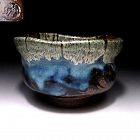
sold Mint Hagi masterpiece chawan by star potter Seigan Yamane. This extraordinary tea bowl is covered by a wonderful color glaze on brown pottery. In my opinion it is the most aesthetic chawan that he made. The seal of the artist is stamped on the bottom. Seigan Yamane was born in 1952, and started making Hagi ware in 1987. And then, he started his own pottery in 1992 and has ever been awarded a lot of prizes for his great work. Size: 9 cm height x 13,5 cm in diameter...
Zentner Collection
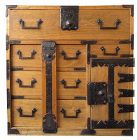
SOLD Antique Japanese small Kiri (paulownia) wood bar tansu, with five front drawers opened by squared iron handles. Its three mid front drawers are kept secure by a locking bar with decorative iron plates. The side of the chest has a safe door, with pierced iron hardware. The safe door opens to reveal three more small drawers inside.
Meiji Period (1868-1912) Dimensions: 23" L x 12" x 24" H
EastWest Gallery
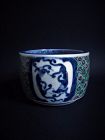
$280.00 A koro of rounded barrel shaped profile decorated with a repeating pattern of underglaze dragons, chilong, framed by rectangular shaped reserves constructed from c form scrolls set against a pine scale ground painted in aubergine, green and yellow enamels. The lip of the rim painted in blue and the interior of the rim painted with a diaper band...
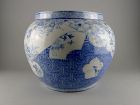
Large and heavily potted porcelain body, decorated in an nice pale cobalt blue in Shunzui style and with medallions showing flying birds and wild gees, birds sitting on branches, sailboats and Fujiyama mountain.
Japan, nineteenth century.
Diameter: 42 cm. H : 33 cm.
Condition: Broken at one area to the rim. This broken area would be absolutely suitable to ennoble the piece with a most beautiful Kintsugi repair ( Gold lacquer repair, please see the images ).
Zentner Collection
SOLD Antique Japanese kannon biraki (opening door) isho tansu (clothing chest) in 2 sections. Made with kiri (paulownia) wood front with sugi (cryptomeria) wood top and sides. The top section has a pair of hinged doors which open to reveal two large drawers. The bottom section has two large drawers and a safe box in the lower right hand side. The hinged safe box door opens to reveal two small interior drawers, one of which has a hidden compartment...
Japanese : Woodblock Prints : Pre 1950
item #1367275
(stock #Jacoulet053)
Era Woodblock Prints
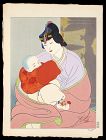
SOLD Paul Jacoulet
Le Tresor, Coree (The Treasure, Korea) Date: May 21, 1940. Size: Approximately 18.25 x 14 inches. Jacoulet signature and watermark with butterfly seal. Edition: 155/250. Carver: Maeda. Printer: Honda. Reference: Print #66 in The Prints of Paul Jacoulet by Richard Miles Condition: Excellent. "This classic scene of mother and child is one of Jacoulet's best received prints." - Miles
Momoyama Gallery
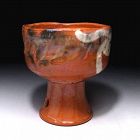
$350.00 Very interesting antique Aka Raku Bajyohai Tea Bowl, made with a rare long foot. Bowls like this are called 馬上杯, Bajyohai: Rider's Cup. Its form makes them convenient for the ancient horse-riders to drink tea from. Our Tea Bowl was made in the early stage of the last century during the Japanese Meiji Period (1868-1912). No chips or cracks. Size: 12,5 cm height x 11,5 cm in diameter. Shipping included
Zentner Collection
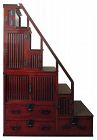
SOLD Antique Japanese 2-section kaidan tansu, or step/stair chest of drawers. Made of solid Keyaki (elm) hardwood, the bold woodgrain is well-complimented by the original deep red lacquer finish and heavy iron hardware. With original set of keys.
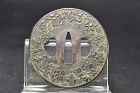
Exhibited at the Prestigious SF Fall Art and Antique show, 2017. Meiji Period (1868-1912) Dimensions: 55" L x 26 1/8" D x 80" H Shakudo tsuba with a relief decor representing foliage and flowers, with gilt highlights on a background of tiny dots. The tsuba is unsigned. Japan, late Edo period. Height: 7.2 cm. Very good condition despite a slight erosion all over the piece. Sold with its box.
EastWest Gallery
Sold
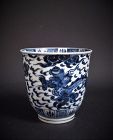
A tall beaker of bell form decorated in underglaze blue with a pair of auspicious Dragons each clasping a “tama” pearl above its head set against a lightening field with auspicious ruyi form clouds supporting respectively artemesin leaves on which are a pair of scrolls bound by ribbons and a flaming pearl.
The design has been adapted from a Chinese precedent of the sixteenth century but with a Japanese twist to the design...
|