| Home | | | Items For Sale | | | Shops | | | Current Auctions | | | Auction Information | | | Auction Schedule | | | My Vervendi | | | Seller Registration | | | Bidder Registration (free) |
| Directory: Japanese (12515) |
|
Auctions MAIN CATEGORIES
|
Haruko Watanabe
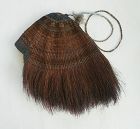
Sold. Thank you. Yuki-boshi (snow hat) made of weed and from Shonai region in Yamagata prefecture in Tohoku district. It is said it was worn by "matagi", a hunter. It has fragments of washi dyed with kakishibu (persimmon tannin) for waterproof. The second half of the 19th to early 20th century. In good condition. 45cm x 50cm
Japanese : Woodblock Prints : Pre 1940
item #1440512
(stock #YoshidaH049)
Era Woodblock Prints
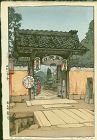
SOLD Hiroshi Yoshida
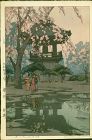
In a Temple Yard Date: 1935. Size: Oban. Approximately 16.00 x 10.625 inches. Signed and sealed in the image. Titled and signed in pencil. Jizuri seal at upper left margin indicating self-printing by the artist. Reference: Abe #197. Medium: Japanese woodblock print. Condition: Excellent color. A few surface marks at upper right. On the back, a conservator has removed adhered paper at the top and bottom right.
Japanese : Tea Articles : Pre 1920
item #1440429
(stock #TRC210220)
Kyoto Ceramics and Fine Art
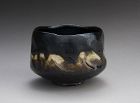
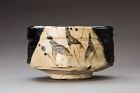
Sold, Thank You! A black Raku ceremonial tea bowl displaying an excellent patina bestowed by time. The light colored clay peeks through in areas giving this piece a unique feel. Though the box is signed by the artist known as Rakuen, details on this particular potter seem to be lost to time...
The Kura
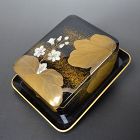
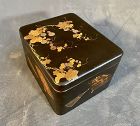
Sold, thank you! Mother of pearl flowers rise among the large leaves of a paulownia tree on this small lacquer box and tray dating from the early 20th century enclosed in the original signed wooden box by Yoshida Rissai. The workmanship is flawless, with a fine sense of depth brought on by the mother of pearl lined with gold powder and set against a ground of golden mist on black. Inside is a rich, red tinged nashiji ground...
Japanese : Woodblock Prints : Pre 1940
item #1440345
(stock #YoshidaH048)
Era Woodblock Prints
SOLD Hiroshi Yoshida
A Little Temple Gate Date: 1933. Size: Oban. Approximately 15.75 x 10.75 inches. Signed and sealed in the image. Titled and signed in pencil. Jizuri seal at upper left margin indicating self-printing by the artist. Medium: Japanese woodblock print. Reference: Abe #181. Condition: Excellent color. Light foxing on back very faintly visible in sky in places...
Japanese : Tea Articles : Pre 2000
item #1440331
(stock #TRC210223)
Kyoto Ceramics and Fine Art
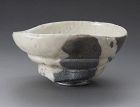
Sold, Thank You! The potter who made this exquisite Oribe tea bowl came to be master of his craft in a rather unusual way. Born into a potting family and eventually taking over as the 6th generations head of the kiln. He carried on the family tradition while incorporating ancient potting techniques and methods from foreign lands...
Kyoto Ceramics and Fine Art
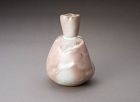
Sold, Thank You! The trademark glaze on this delightful sake flask (tokkuri) is by none other than 8th generation Hagi potter Masanao Kaneta. Close inspection reveals flecks of reflective powdered shell on a backdrop of thick, translucent glaze with hues of orchid, salmon, and ivory. One of our favorite Hagi potters, if you have not previously experienced works by this artist we cannot recommend him enough.
Like the seven generations who proceeded him, Masanao Kaneta (b...
Kyoto Ceramics and Fine Art
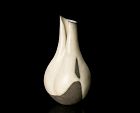
Sold, Thank You! According to Kei Wakao, the artist who crafted this extraordinary work, it took him years of trial-and-error to perfect the unique rice-porcelain glaze covering this finely shaped vase. Not only was it a challenge to achieve the demure milky translucence of the glaze—similar to the appearance of a grain of rice when held to the light—but also to get the right flowing consistency and pooling effect in desired areas...
japanes antique textile saiyuu2
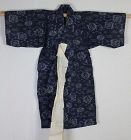
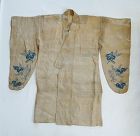
sold thank you The end of the Edo period omijyofu indido dye hemp kasuri child kimono of charming pattern of treasure.There is no stain. There are two small holes in the sleeve. , but they don't stand out.
It is a very delicate jyoufu hemp and is the best children's kimono. A hand-embroidered amulet is attached to the back. The silk waist straps on a white background are all original.
It was carefully communicated and stored. I recommend it to your collection...
Zentner Collection
Price on Request A stunning fine antique Japanese makie lacquer box decorated with a tataki-nuri style black background with makie of vines and gourd and folding fans on the exterior. The interior is decorated in nashiji with a still life of a flower arrangement set in a basket with a charming lifelike rabbit and autumn grass for the inner tray. The vibrant colors and designs are often seen in lacquer works from the Edo and Meiji periods...
Kyoto Ceramics and Fine Art
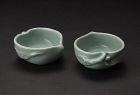
Sold, Thank You! In Asian folklore, the peach is said to represent long-life for mortals and immortality for the gods. According to legend, the moon goddess—a powerful alchemist—can make an elixir from peaches that grow in the garden of the western paradise with miraculous revitalizing properties. Here we have an exceptionally rare set of sake cups by Suwa Sozan, one of only 5 Imperial Court Artists from Meiji...
Japanese : Tea Articles : Pre 1940
item #1440197
(stock #TRC210219)
Kyoto Ceramics and Fine Art
Sold, Thank You! One of the most important Japanese potters of the 20th century, skilled in an impressive number of styles, today his pieces can be found in museum collections around the world...
Japanese : Tea Articles : Contemporary
item #1440183
(stock #TRC210111)
Kyoto Ceramics and Fine Art
Sold, Thank You! A beautiful example of modern Bizen-ware—with a thick feldspar glaze partially covering the clay body allowing the natural ash glaze underneath to show through in areas. This piece along with others by the same artist tend to push the bounds of what you usually see in Bizen pottery.
The craftsman who made this piece, Takahiro Ishii, was born in Tokyo, and, after studying ceramics for a number of years, he moved to Bizen to become a ceramics teacher and later opened his own kiln...
Zentner Collection
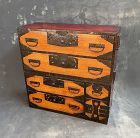
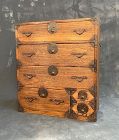
$6,500.00 An antique Japanese Sado Island Kasane Tansu made of Kiri (Paulownia) and Sugi (Cryptomeria) woods. All original hand forged iron hardware (including Warabite handles) and wiped Urushi lacquer finish. The metalsmith showcased his talent adding Chrysanthemum corners to each drawer front and Mum backplates to each handle. As if that were not enough, the tansu maker added iron plating to the front frame showcasing the individual drawers...
The Kura
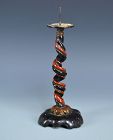
sold, with thanks! A 16th to 17th century (Momoyama to early Edo period) candle-stick of vine or root set onto a hollow carved base and covered in black and red lacquer with a metal stud and drip pan. It is 11 inches (28 cm) tall and in overall fine condition, with wear typical of centuries of use.
Haruko Watanabe
$600.00 Rare item. Rokushaku Kanban which was worn by a palanquin bearer (kago-kaki) who was a servant worked for a feudal lord (tono-sama) and a bearer of a palanquin when the lord went out. There are various theories that the kimono is called "Rokushaku-Kanban": servants worked in the lord's residence or a castle are called "rokushaku" and the kimono has "kanban" which means a symbol or a family crest. Another theory is the length of the kimono is 6-shaku (approx.2m).
This one is made of hemp whose w...
Zentner Collection
SOLD An antique Japanese Ko Tansu (personal storage chest) made of Kiri (Paulownia) and Sugi (Cryptomeria) woods. All hand forged iron hardware including the Hikute drawer handles. and the Warabite side handles. Constructed using straight dovetail Japanese joinery as well as hardened wooden nails. Full moon lock plates, Atari handle stoppers and drawer front corner hardware complete this beautiful chest.
Originally used as an all purpose storage chest in Japan, it would make an elegant sid...
Zentner Collection
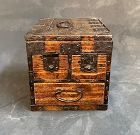
SOLD An antique Japanese Suzuribako (calligraphy writing box) made of Kirinoki (Paulownia) and Suginoki (Cryptomeria) woods. All hand forged iron hardware including the Warabite handles on the lid and drawer front.
This box originally functioned as an essential instrument for storing writing paper, brushes, ink and the inkstone. Whether it was a merchant writing a customer receipt or a professional calligrapher writing a personal letter for a farmer, this box was always ready for duty. <... |