| Home | | | Items For Sale | | | Shops | | | Current Auctions | | | Auction Information | | | Auction Schedule | | | My Vervendi | | | Seller Registration | | | Bidder Registration (free) |
| Directory: Japanese (12515) |
|
Auctions MAIN CATEGORIES
|
Japanese : Woodblock Prints : Pre 1930
item #1501303
(stock #Urushibar022)
Era Woodblock Prints
$1,100 Frank Brangwyn and Yoshijiro Urushibara
In the Docks Series: "Ten Woodcuts" No. 8. Date: 1924. Paper size: Approximately 11 x 9.25 inches. Image size: Approximately 8.625 x 6.875 inches. Edition: No...
Japanese : Woodblock Prints : Pre 1930
item #1501302
(stock #YoshidaH076)
Era Woodblock Prints
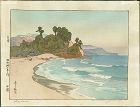
SOLD Hiroshi Yoshida
Shirahama Date: 1927. Size: Oban. Approximately 14 x 10.75 inches. Signed and sealed in the image. Titled and signed in pencil. Jizuri seal at left margin indicating a first edition self-printed by the artist. Self-published by the artist. Reference: Abe catalog #214. Medium: Japanese woodblock print. Note: Features embossed waves. Condition: Toned paper. Pencil notes at bottom margin...
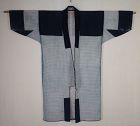
japanes antique textile saiyuu2
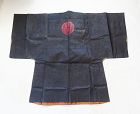
$1280.00 This is a sashiko boro long noragi on indigo-dyed hemp fabric from Aomori Prefecture, dating from the Meiji period (1868-1912). The lining is cotton, woven by hand. The sashiko was all hand-sewn. There are some minor stains and minor damage, but overall, it is in good condition. Recommended for wearing or for your collection. Size: Length 110cm / Sleeve end to sleeve end 122cm
japanes antique textile saiyuu2
$1100.00 This is a noragi from the Tsugaru region of Aomori Prefecture during the Meiji period. The indigo-dyed hemp fabric is beautifully embroidered with indigo-dyed cotton thread.
There are no stains or damage, and the condition is very good.
Size: Length 90cm, Sleeve length 106cm
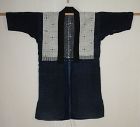
japanes antique textile saiyuu2
$1580.00 This is a noragi from the Tsugaru region of Aomori Prefecture in the Meiji period. The indigo-dyed hemp fabric is beautifully kogin-stitched with white cotton threads.
There are slight repairs on the sleeves. However, it is in very good condition.
Size: Length 94 cm / Sleeve end to sleeve end: 112 cm
The Kura
sold A Maiko (apprentice Geisha) holds up a large silver mirror for her sempai (senior), a beautifully sculpted pottery figurine of raw, unglazed red earth signed underneath by the artist. It is 11.5 x 11.5 x 18 cm (4-1/2 x 4-1/2 x 7-1/4 inches) and is in excellent condition. Late 19th to early 20th century.
japanes antique textile saiyuu2
$880.80 Tsutsugaki Yogi textile featuring a brave hawk and pine, bamboo and plum design.There are some minor stains and small holes, but overall it is in very good condition.
Size::length:148cm / Sleeve end to sleeve end:148cm G
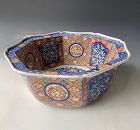
Zentner Collection
SOLD Large Japanese Imari bowl. Faceted form with 8 sides. Flared rim with foliate edge. Bright multi-colored glaze with gold dragon medallions alternating with bird in blossoming tree. Design of peony blossoms in the bottom. 6 character mark on the underside.
Age: Meiji period (1868-1912) Dimensions: 14 1/2" diameter
Kodo Arts
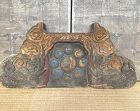
Price on Request Spectacular Zen Temple carving featuring the Hosokawa clan 'Kuyo Mon' crest. Shachihoko dragons on each end frame the crest with zen clouds carved above. Ca. 1770.
Kuyo-mon, the family crest of the Hosokawa family, is considered to represent nine stars, which are the seven luminaries (the Sun, the Moon, Mercury, Venus, Mars, Jupiter, and Saturn) and Rahu and Ketu (planets that are associated with eclipses and comets)...
Mastromauro Japanese art
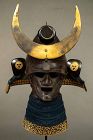
EUR €12,000.00 Kabuto, the Momonari-type samurai helmet, so called because of its characteristic shape that recalls a peach, made of natural iron.
The visor (mabizashi) is enriched by raised eyebrows, while the front decoration (maedate), features an elegant gold-lacquered crescent moon. The side fins (fukigaeshi) are decorated with the golden mon of the Takenaka clan...
Mastromauro Japanese art
EUR €1,750.00 A bronze okimono depicting a walking elephant. Every part of the elephant's body, from the legs to the trunk, from the ears to the eyes, is sculpted with impressive precision.
Signature engraved under the belly Hideyoshi.
Period: Meiji late 19th century.
Dimensions: 13.5 x 20.5 x 8 cm.
Weight: 1.5 kg.
Condition: Excellent.
Haruko Watanabe
$100.00 Two bags, made of cotton and vegetable indigo dye, the long one is for coins and the short one is possibly for bank notes, or other items. Both have owner's logos with sashiko. The long one is made of handspun cotton and has some stains and a few holes, however it has beautiful vegetable indigo dye asa cloth inside. The short one is twill weave and in excellent condition. The second half of the 19th to early 20th century. W:18cm, L:31cm
W:15cm, L:44cm
Haruko Watanabe
Sold, Thank you. Sakiori hanten (coat) made of cotton strips for wefts, which are recycled from old vegetable indigo dye and handspun cotton cloth. Warps are hemp yarn. Sleeves and the collar belt are made of indigo dye cotton. In good condition. The first half of the 20th century. From along the Japan Sea areas of Tohoku or Chubu districts.
W:124cm, L:93cm
Haruko Watanabe
Sold. Thank you. Han-gappa made of washi, Japanese handmade paper, which is made from mulberry fibers. It is painted with paulownia oil and kakishibu (persimmon tannin) for waterproof. The word kappa was taken from Portuguese "capa" which was worn by Portuguese Christian missionaries, who came in mid 16th century. The early kappa was circular form, and one with sleeves was made later, especially for traveling.
This one is painted with sumi and oil outside and kakishibu (persimmon tannin) and oil inside...
The Kura
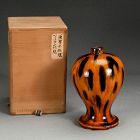
sold A rare and beautiful Binshi vase covered in tortoise-shell glaze (Bekko-yu) from the Hirasa kilns. Dating from the later Edo period, it is 11 cm (4-1/2 inchese) diameter, 17.5 cm (6-1/2 inches) tall and in excellent condition.
Following the Japanese invasion of Korea in the late 16th century Shimazu Yoshihiro brought to Japan with his returning army Korean potters who established a kiln in Uzumachi (Modern day Nagasaki prefecture). This was the origin of Kochosa-yaki...
Japanese : Woodblock Prints : Pre 1930
item #1501146
(stock #YoshidaH075)
Era Woodblock Prints
SOLD Hiroshi Yoshida
Kameido Series: Twelve Scenes of Tokyo. Date: 1927. Size: Oban. 15.5 x 10.75 inches. Brush signed and sealed in the image. Jizuri seal at upper left margin indicating a first edition self-printed by the artist. A rare early example for the Japanese market, hence no pencil signature in English. Medium: Japanese woodblock print. Publisher: Hiroshi Yoshida Reference: Abe catalog #62. Condition: Excellent color...
The Kura
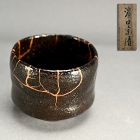
sold Interlaced gold lightning strikes all about the rim of this textured black tea bowl enclosed in an old Kiri-wood box titled Kuroraku Chawan and signed Hamaguchi Sosei. It is 10 cm (4 inches) diameter, 8 cm (3 inches) tall and in excellent condition.
Kintsugi embodies the spirit of wabi-sabi, a Japanese aesthetic worldview centered around imperfection, transience, and the beauty of the natural cycle of growth and decay...
The Kura
sold A white pigeon sits on the peak of a broken Kawara roof tile forming this peaceful okimono by Miyanaga Tozan enclosed in the original signed wooden box titled Shiro Hatto. It is 15.5 x 10.5 x 22.5 cm (6 x 4 x 9 inches) and in excellent condition.
Miyanaga Tozan I (1868-1941) is one of the most important names in Kyoto ceramics. He was born in Ishikawa prefecture, and graduated from the (now) Tokyo University of Art... |