| Home | | | Items For Sale | | | Shops | | | Current Auctions | | | Auction Information | | | Auction Schedule | | | My Vervendi | | | Seller Registration | | | Bidder Registration (free) |
| Directory: Japanese: Textiles: Kimono (338) |
|
Auctions Shops Active In This Category
MAIN CATEGORIES
|
Asian Ethnic Artifacts
Price on Request Boys kimono
lovely silk with hand painted
Haruko Watanabe
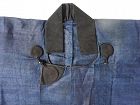
Sold, Thank you. Sakiori hanten (coat) made of cotton strips for wefts, which are recycled from old vegetable indigo dye and handspun cotton cloth. Warps are hemp yarn. Sleeves and the collar belt are made of indigo dye cotton. In good condition. The first half of the 20th century. From along the Japan Sea areas of Tohoku or Chubu districts.
W:124cm, L:93cm
japanes antique textile saiyuu2
$188.90 This is a Japanese antique shibori & katazome cotton kimono.
Indigo dyeing and Plant dyeing. To dye it black, you first dye it with a liquid made by boiling the nuts of trees such as tsurbami and yasya, then soak it in a liquid containing iron to develop the color.
It is in good condition with no damage.
Size: Length: 137cm (53.9") / Cuff to cuff, full back: 122cm (48")
Haruko Watanabe
$120.00 A role of cloth (tanmono) for a cotton kimono (yukata) with shibori. Shibori technique is one kind of Chidori shibori (plovers) which was invented in 1920s. Mostly in good condition but has a slightly indigo faded part in the selvedge. 1920s to 1980. W:30.5cm, L: about 7m40cm (before ironing with steam)
Haruko Watanabe
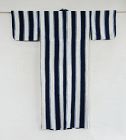
$100.00 Cotton yukata with bold stripes. The dye technique is "chusen", cloth is folded in many layers and the dye liquid is poured through katagami (stencil). It is used for dyeing tenugui (towel), fukin (kitchen cloth) and yukata (cotton unlined kimono). The second half of the 20h century. In excellent condition. W:128cm, L:140cm
Haruko Watanabe
$60.00 Cotton cloth with katazome (stencil-resist dye) for kimono (yukata) wich is handspun. Late 19th to early 20th century. In good condition but has a hole in the middle: 5mm x 4cm
W:33cm, L:136cm
Haruko Watanabe
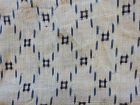
$90.00 Cotton cloth dyed with rare suji shibori and katazome, which is named Koyanagi Shibori (Small Willow Pattern). It is first katazome (stencil-resist dye) dyed and then finely pleated by machine and dyed with indigo. The technique is invented in 1949, and the pattern was very popular after a few years for a cotton kimono (yukata). In excellent condition. Mid 20th century. 34cm x 160cm
Haruko Watanabe
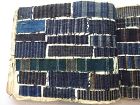
$450.00 A sample book of indigo dye cotton stripes, pasted on Daifukucho, which is a record book of a merchant, made of washi. It has 238 fragments. About half sheets of wash are pasted with fragments, but another half ones are not. In good condition. 19th century. W:21cm, L:20.7cm, Thickness:1.7cm
Haruko Watanabe
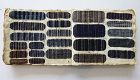
$500.00 Shimacho, a sample book of cotton stripes with 414 fragments. Meiji period to early 20th century. (mid 19th to early 20th century). In good condition, but the ground washi (Japanese handmade paper) has some wear. W:18.5cm, L:14.8cm, Thickness:2cm
japanes antique textile saiyuu2
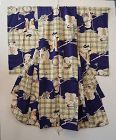
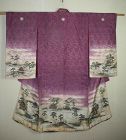
$280.00 This is a Japanese antique silk yuzan dye child kimono Meiji (1868-1912).This design is of Kinkakuji Temple in Kyoto. The figured satin has a very auspicious design of cherry blossoms and cranes, and is shiny and beautiful. There is a slight stain on the collar, but it is not noticeable. There is no damage.
size: Length :120cm (47.2inch) / sleeve to sleeve:111cm (43.7inch)
Haruko Watanabe
Sold, Thank you. Bashofu kimono hand-woven of ito-basho, which is a family of banana tree. Both wefts and warps are hand-plied. The brown warp kasuri yarns are dyed with extract liquid from tree or root of "sharinbai", which is a family of rose, and the very dark blue weft and warp kasuri yarns are dyed with Ryuku-ai, vegetable indigo in Okinawa. Bashofu has been woven in many Islands in Okinawa and this kimono is woven possibly in Kijoka Island. 20th century...
japanes antique textile saiyuu2
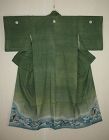
sold thank you This is a silk kimono from the Edo period that is dyed with natural plants and made with tsutsugaki.
The carp swimming in the rough waves is drawn in great detail using the tsutsugaki technique.
There are slight dye spots, but there is no damage or stains and it is in very good condition. The lining has been changed to new silk.Size:Length:151 (59.4") / Cuff to cuff, entire back: 130cm (51.1")
Haruko Watanabe
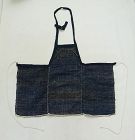
$120.00 Maekake (apron) remade from sakiori cloth, whose warps are hemp and wefts are cotton strips of vegetable indigo dye cotton. The frame cloth is also vegetable indigo dye cotton.
20th century. W:79cm, L:58cm, Cords:80cm
Haruko Watanabe
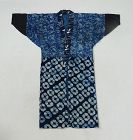
$380.00 Cotton kimono with beautiful lining with Itajime shibori (board-clamp dye), both outside cloth and lining are made of hand-spun cotton and vegetable indigo dye. In good condition but has one hole and one mending patch. 19th century. W:124cm, L:136cm
Haruko Watanabe
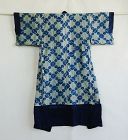
$280.00 Juban (under kimono) made of cotton katazome (stencil-resist dye) with hyotan (gourd) motif in th body, and cotton suji-shibori and katazome in the bottom, both textiles are hand-spun and vegetable indigo dye cotton. Both sleeves are made of silk and cotton velure piping. In good condition. Late 19th early 20th century. W:124cm, L:125cm
Haruko Watanabe
$380.00 Naga-gappa made of kudzu (Pueraria lobata) fiber for wefts and cotton yarn for warps. Naga-gappa or dochugi is a kind of coat worn over kimono and kudzu-fu one is worn in summer. Kudzu-fu has been produced mainly in Kakegawa in Shizuoka prefecture since 13th century and sold to many places in Japan. Clasps made of silk cords in spiral are made before Tempo period (1831~1845), according to "Kinsei Fuzokushi" by Morisada Manko...
Haruko Watanabe
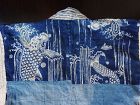
$350.00 Cotton kimono with Kikai Suji-Shibori (Machine-Pleated Stripes) which is vegetable indigo dye. The lining has cotton katazome (stencil-resist dye) carp and fall motif which is also vegetable indigo dye. It has mending stitches,
many light stains in the shibori side. Early 20th century. W:126cm, L:124cm
Zentner Collection
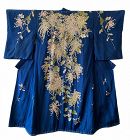
$850.00 Antique Japanese kimono made of blue chirimen silk and embroidered with yellow and white chrysanthemums. The silk embroidery is especially fine with details of tiny knots.
Age: Meiji/Taisho Period (early 20th century) Dimensions: 57 1/2" high x 53" wide |