| Home | | | Items For Sale | | | Shops | | | Current Auctions | | | Auction Information | | | Auction Schedule | | | My Vervendi | | | Seller Registration | | | Bidder Registration (free) |
| Directory: Japanese: Ceramics (2431) |
|
Auctions Shops Active In This Category
MAIN CATEGORIES
|
Zentner Collection
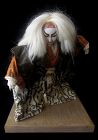
sold Japanese kabuki actor doll, dressed as a fearsome white lion with long, flowing mane, made with real hair. He wears silk garments of bright orange, white and grey, with his face done in traditional cat eye makeup of white, black, and red.
Size: 16.75" x 13.75" x 20.5" H
EastWest Gallery
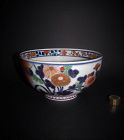
Sold A finely enamelled Japanese export bowl decorated with Chrysanthemums and Peonies between a pair of Fan Shaped reserves of Kiku form. The petals alternating between a gilt leaf and tendril blue brocade and an unusual iron red shaded wash. The veins of the gilt leaves created by the use of a scraffito technique. The interior with a band of peony and prunus sprigs. The central well of the bowl decorated with an iron red and gilt kiku mon. A single ring to the interior of the foot-rim of the bowl...
Zentner Collection
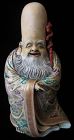
SOLD A charming porcelain figurine of Fukurokuju, one of the Seven Lucky Gods of Fortune. Fukurokuju is the god of wisdom and longevity, and is easily recognized by characteristics such as his dramatic, elongated forward, his root wood cane, and the scroll he holds. He wears a beautiful, flowing robe with flying cranes accented by gilt outlines. The cranes are an attribute to Fukurokuju as they, too, are a symbol of longevity.
Meiji period (1868-1912) Size: 7" L x 6" W x 12" H
Kyoto Ceramics and Fine Art
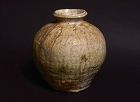
Sold, Thank You! Fired for days at over 1,400C degrees, this primordial-looking wonder of ancient potting technology displays a number of beautiful natural effects from the interaction of the clay, minerals, and ash from the unique style of kiln.
The creator of this work Michio Furutani (1946 - 2000) is regarded as one of the true greats of Shigaraki potting and is noted for being the first to revive the ancient art of anagama kiln firing in this region...
Modern Japanese Ceramics
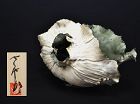
Sold, with thanks! An incredible organic form, the delicate petals appearing to waft in some tide by Shingu Sayaka enclosed in the original signed wooden box. A closed bud on the side is lined with hundreds of tiny sharp needles in black. It is 8 x 5 x 4 inches (20 x 12 x 10 cm) and in excellent condition.
Shingu Sayaka was born in Osaka, the industrial and commercial heartland of central Japan, in 1979...
Modern Japanese Ceramics
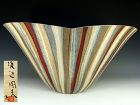
Sold, with thanks! Stripes of vivid color define this very large pottery bowl by Watanabe Kunio enclosed in the original wooden box titled Iro-e Kin/Gin-Sai Sen Mon Hachi. It is 43 cm (17 inches) diameter and in excellent condition. Due to size the cost of shipping will be accrued separately.
The first time I saw this artists work I was blown away by the precision, skill and beauty inherent...
The Kura
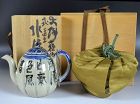
Sold, with thanks! A Teapot by Teishitsu Gigei-In Suwa Sozan I decorated by his friend the famous scholar artist Tomioka Tessai and enclosed in a signed double wood box. A custom pad between the pot and lid protect it during storage from chipping, and it has a silk bag in which it is wrapped. . It is 4-1/2 x 7-1/2 x 6 inches (11 x 19 x 15 cm) and in excellent condition. The box is titled Daibutsu Sozan – Chossen – Suichu and signed Hachiju Okina Kyuso Tessai Dai, Sozan Yakisei...
Kyoto Ceramics and Fine Art
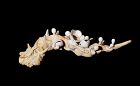
Sold, Thank You! This Hirado-yaki brush-rest—fashioned for the scholars desk of a bygone era—features meticulously sculpted plum blossoms set in a porcelain reproduction of a knotted plum branch. Hirado wares—alternately known as Mikawachi wares in some contexts—are known throughout Japan and also abroad for their high quality and fine craftsmanship and date back at least as far as the mid-18th century when they were produced exclusively for powerful lords and their families...
Modern Japanese Ceramics
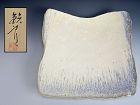
Sold, thank you An exquisite platter on two legs by Aoyama Tetsuro enclosed in the original signed wooden box. The rush of white and and soft blue across the surface is reminiscent of the “Ma”, or blank space of an ink waterfall painting. It measures 41 x 40.5 x 10 cm (16 x 16 x 4 inches) and is in excellent condition.
Aoyama Tetsuro was born in Gifu, home of the Mino potteries, in 1946. He apprenticed under Kato Jin in 1961, moving out on his own in 1973...
EastWest Gallery
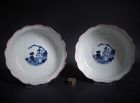
Sold A pair of Namasu or small serving bowls in revived Kakiemon style decorated with a depiction of the Seven Sages of the Bamboo Grove in low moulded relief; here represented by just two of them. The Sages were synominous with a hedonistic lifestyle of drinking and poetry. The foliate rims of the dishes are painted with a fuchi beni, iron brown glaze...
Modern Japanese Ceramics
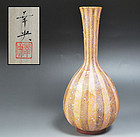
Sold, with thanks! A soft pallet of blurred pastels blend between gold risers on this elegant form by Yoshita Yukio enclosed in the original signed wooden box titled Saishoku Kinsai Hanike and dating circa 2002. It is 11 inches (28 cm) tall and in excellent condition.
Yoshita Yukio is the fourth generation head of the Kinsan Kiln in Kutani, specializing in Kinsai and Yuri-Kinsai wares. Unlike standard Kutani wares, he uses a pallet of soft, earthy or pastels with accents in gold to create a new appeal...
Modern Japanese Ceramics
Sold, with thanks! Like the charred remains of an open book deep fingerprints still visible from the opening hands within, this is a fine example of the work of Avante Garde Akiyama Yo enclosed in the original wooden box dating from 2013. It is 6-1/2 x 5 inches (16/5 x 13 cm) and is in excellent condition.
Akiyama Yo was born in Yamaguchi, home of Hagi pottery) in 1953, but went to Kyoto to study at the Kyoto Municipal University of Arts in 1976...
Kyoto Ceramics and Fine Art
Sold, Thank You! This antique Seto piece features a warm matte ash glaze with several patches of darker and lighter pigmentation. The molded clay shows striations that resemble textured wood grains—highlighted by a soft patina developed over many decades of use...
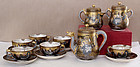
Fifteen-piece Japanese Satsuma earthenware tea set consisting of lidded teapot, lidded sugar vessel, lidded creamer, six cups and six saucers. The set is densely decorated with the Kannon, Rakan (Buddhist disciples), and dragon pattern in raised moriage enamels and gilt. “Great Japan Satsuma” mark to base. Meiji period (circa 1900). Teapot: 6 1/4" high x 7 1/4" wide (handle to spout); sugar vessel: 5 1/4" high; creamer: 4 3/4" high; saucer: 5 1/2" diameter; cup: 1 7/8" high x 3 3/4" diam...
Modern Japanese Ceramics
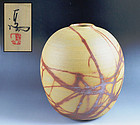
Sold, thank you! An iconic representation of this artists work, a large hidasuki Tsubo of red clay marked with burnt straw by Isezaki Mitsuru enclosed in the original signed wooden box titled Bizen Tsubo. It is 9-1/2 inches (24 cm) diameter, 10-1/2 inches (26.5 cm) tall and in excellent condition.
Isezaki Mitsuru (b. 1934) was born to a family of potters, his father Yozan and brother Jun both very important in Bizen pottery. In 1998 Mitsuru was named a Prefectural Intangible Cultural Property for Okayama...
Lilly Parker Antiques, Inc.
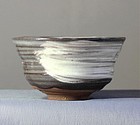
$50.00 Japanese Pottery Gray and White Tea Bowl, 5" diameter-top rim, 2 3/4" high, with impressed mark on the bottom, 2" long glaze hairline on the side of the bowl.
Modern Japanese Ceramics
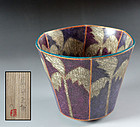
Sold, with thanks! A spectacular work by Maeda Masahiro enclosed in the original signed wooden box titled Iro-e Kin-gin-sai Mentori Hachi (Faceted Bowl with Gold, Silver and Colored Decoration). It is roughly 6-1/2 inches (16.5 cm) diameter, 5-1/4 inches (14 cm) tall and in excellent condition.
Maeda Masahiro (b. 1948) graduated the Tokyo National University of Fine Arts in 1975where he received instruction from Living National Treasure Fujimoto Yoshimichi and Tamura Koichi as well as Asano Akira. He has ...
Modern Japanese Ceramics
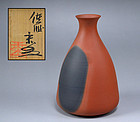
Sold, with thanks! A red Sado Mumyoi-yaki Tokkuri (Shuchu) by Living National Treasure Ito Sekisui V enclosed in the original signed wooden box. It is 5 inches (13 cm) tall and in excellent condition.
Ito Sekisui V (Yoichi) is the 14th generation of the family to follow in the pottery tradition. His father, Ito Sekisui IV, died when Yoichi was only 19. Upon completion of studies at Kyoto University in 1966, he returned to his hometown of Sado to succeed the lineage. His work was displayed for the first... |