| Home | | | Items For Sale | | | Shops | | | Current Auctions | | | Auction Information | | | Auction Schedule | | | My Vervendi | | | Seller Registration | | | Bidder Registration (free) |
| Directory: Japanese: Ceramics (2435) |
|
Auctions Shops Active In This Category
MAIN CATEGORIES
|
Zentner Collection
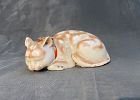
$1,500.00 An antique Japanese Kutani sleeping cat known as Nemuri Neko that was hand made and hand painted. Delicate free-form feathered gold lattice pattern decorating its back with a persimmon colored collar around its neck.
Peaceful somber face displaying a calm dream-like state as time and the world around it passes by...
Kyoto Ceramics and Fine Art
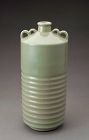
$1,750.00 A student of Itaya Hazan, one of the most sought after potters in the world of Japanese art, the ceramicist who crafted this fine vase displays here a high degree of mastery, both in form and glazing technique. For the collector who has always wanted a Hazan but has never been lucky enough to chance upon one, this may be a worthy acquisition...
Conservatoire Sakura
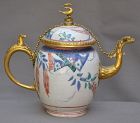
$1,800.00 Extremely rare and probably unique porcelain and gilt copper ewer.The body of the object is a Japanese porcelain covered pot of the 2nd part of the 17th century around 1660 coming from Arita of the Kakiemon kilns but maybe from the Yambeta kiln. The pot was transformed in Europe into a teapot by the addition of a handle supporting a horse and a spout forming a dragon in gilded and embossed copper, the lid is formed by a swan. All these animals in relief are certainly in cast bronze...
Conservatoire Sakura
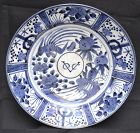
Price on Request Rare porcelain dish decorated in cobalt blue underglaze. In the center the prestigious mark VOC (Vereenigde Oostindische Compagnie) of the Dutch East India Company. The decoration of flowers and birds in cartridges inspired by the Chinese style of the late Ming.This dish was created for a member of the powerful company.
Japan Genroku period end of 17th century.
Perfect condition.
Diameter: 35 and 35,5cm.
Kyoto Ceramics and Fine Art
$450.00 An often overlooked implement in tea ceremony, here we have the humble kogo (incense box) with an image of a sleek and flowing dragon. Commonly thought to represent strength, freedom, good luck, and magic, dragons are a popular theme in the artwork across Eastern cultures. Interesting to note, the dragon here is portrayed in the Korean style with four claws, with dragons in China typically having five claws and dragons in Japan typically having three...
Modern Japanese Ceramics
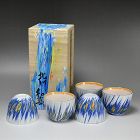
sold, with thanks! A set of five brightly colored tea cups by Kitagawa Kazuki enclosed in the original signed wooden box titled Kasaneirome Chawan (Tea Bowl of Layered Colors). Each is 8 cm (3-1/2 inches) diameter, 6 cm (2-1/2 inches) tall and in excellent condition, directly from the artist this Spring. The artist creates each of these cups individually by pouring liquified porcelain into a mold, swirling it around, allowing it to dry slightly, then pouring it out and adding another layer of differing color...
Modern Japanese Ceramics
Sold, thank you! A riot of spring flowers in minute detail covers this dainty tea cup by Kawada Satomi enclosed in the original wooden box titled Hanazukushi-wan, and signed Kutani Satomi. The cup is 7.5 cm (3 inches) diameter, 6.5 cm (2-1/2 inches) tall and is in excellent condition.
There are two types of Kutani overglazes, one like watercolor, opaque and vivid, the other like translucent glass...
Kyoto Ceramics and Fine Art
Sold, Thank You! First born son to Living National Treasure Isezaki Jun, Koichiro (b. 1974) has quickly made a name for himself as an independent artist. Not content to rely solely on family reputation, he has set off on his own path, making innovations in clay and also in the ideas and principles surrounding his craft...
Modern Japanese Ceramics
Sold, thank you! Rivulets of ash dribble down the red earth sides of this vase by Nishiura Takeshi enclosed in the original signed wooden box titled Echizen Henko. Positioning in the kiln, with one shoulder angled toward the flame, ensure the lip and one rounded corner are charred in that distinct ocher inidicative of the region. Elsewhere the ash is molten green. A great example of this lesser known ancient kiln site. The vessel is 18 x 13 x 17.5 cm (7-1/2 x 5 x 7-1/2 inches) and is in excellent condition...
Zentner Collection
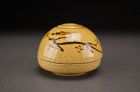
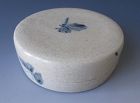
$1,200.00 Antique Japanese porcelain kogo (incense box). Round in form and flat on top. Glazed with a lovely crackled white ground and two blue butterflies, one on the lid and one on the side where the two pieces join. Signed "Taisuiken" on the inside of the lid. With original tomobako.
Age: Meiji Period (1868-1912) Dimensions: 4 3/8" wide x 1 1/2" high
Zentner Collection
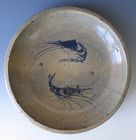
SOLD Antique Japanese Seto Ware stoneware ishizara (food plate). Covered with a cream colored slip and painted with a pair of crayfish in gosu blue glaze. Produced in or around the city of Seto in Aichi Prefecture. Seto is considered one of the Six Ancient Kilns of Japan.
Age: Tokugawa Shogunate, Edo Period (late 18th/early 19th century). Dimensions: 8 3/4" wide x 1 3/4" high
The Kura
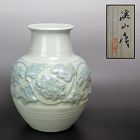
Sold, with thanks! Fabulous carved florals rise in vibrant color off the surface of this yellow glazed vase by Kato Keizan II enclosed in the original signed wooden box. It is 31 cm (12-1/2 inches) tall, 24 cm (9-1/2 inches) diameter and in excellent condition.
Kato Keizan I (1886-1963) was born in Tajimi city, Gifu, a pottery center in its own right, however came to Kyoto to apprentice under Kiyomizu Rokubei IV...
Kyoto Ceramics and Fine Art
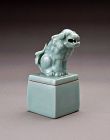
Sold, Thank You! Considered auspicious symbols of wealth, status, and good fortune; foo dogs—commonly referred to as shishi or koma-inu in Japan—are often seen in pairs guarding shrines, straddling the doorways of shops, and protecting public buildings. Here we have a fierce guardian adorning an incense cady (kogo)...
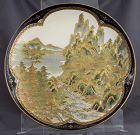
Japanese Taisho to early Showa period Satsuma earthenware charger finely decorated in polychrome enamel and gilt with a single large foliate form cartouche set against a black background that extends to cover the back walls. The cartouche features a landscape scene with temples set among high mountain peaks. A bridge over water holds a single figure. The decoration is set against a cream colored finely crackled glaze background. Koshida workshop mark to the base...
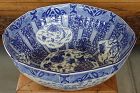
Massive Japanese Arita porcelain punch bowl decorated in underglaze blue with four alternating dragon and phoenix panels surrounded by a dense background of floral and geometric forms set against a white ground. The center features a treasure ship among kiri (pawlonia) crests, flaming pearls, and patterned balls...
Conservatoire Sakura
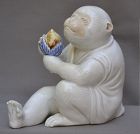
$3,200.00 A Hirado porcelain monkey from Japan 19th century. He holds in his hand a peach glazed in iron brown and cobalt blue. Rare model, we know a similar monkey that is housed in Lacma (Los Angeles county museum of art). Our monkey must be older because there are important differences in quality, such as the expression of the face, the folds of the dress, the delicacy of the ear and the curve of the limbs.
Perfect condition. Height 15cm.
Modern Japanese Ceramics
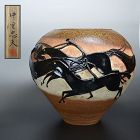
Sold, Thank you! Horses dash past in a fervent black mass both carved into and built up onto the paddled surface of this large vessel ballooning open from a narrow base by Nakazato Tarouemon XIII enclosed in the original signed wooden box. Inside the box is written Tataki Tsubo (Paddled Vessel), Kurabe Uma (Horse Race), exhibited Autumn 1958 at the Tokyo Mitsukoshi Sports Theme Art Exhibition; Ochawangama, Nakazato Tadao (given name of Nakazato Tarouemon XIII) followed by the artists seal. An excellent exampl...
Kyoto Ceramics and Fine Art
Sold, Thank You! This depiction of the eternal “ensō” on a backdrop of pearly white feldspar over red clay signifies enlightenment, the eternal, the nothingness, and the freedom of the mind to envision and to create. Wood-fired in a small-batch ana-gama, the techniques used to produce such works stretch back over 500 years and were only recently revived in the first half of the previous century by a dedicated group of artists.
The potter who created this piece (Kato Kozo) was born in 1935 in Gi... |