| Home | | | Items For Sale | | | Shops | | | Current Auctions | | | Auction Information | | | Auction Schedule | | | My Vervendi | | | Seller Registration | | | Bidder Registration (free) |
| Directory: (25573) |
|
Auctions MAIN CATEGORIES
|
Lilly Parker Antiques, Inc.
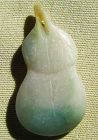
$95.00 Chinese Jadeite Jade Double Gourd shape Pendant with etched design, Ca. 1920's, 1 1/4" high(30mm), 5/8" wide(17mm), 1/4" depth(6mm), the condition is good.
Lilly Parker Antiques, Inc.
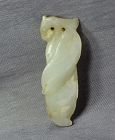
$150.00 Chinese Nephrite Jade Owl shape Pendant, or Leaf shape, Ca. 1900, 2 1/4" high(60mmm), 3/4" wide(20mm), 3/8" depth(10mm), even white color Nephrite Jade, the condition is good with some old stain..
Lilly Parker Antiques, Inc.
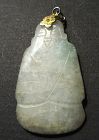
$125.00 Chinese Jadeite Jade old scholar figureal Pendant, Ca. 1920's, 1 3/4" high(45mm), 7/8" wide(22mm), 1/8" depth(4mm), carved old scholar in sitting position, the condition is good.
June Hastings
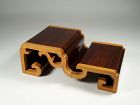
$1,800.00 Chinese Scholar’s two-tier solid rosewood stand with carved boxwood edges. Produced in the 1950s, this is actually a copy of a 17th - early 18th century style that was made of zitan and edged in boxwood. A strong stand that will hold your heaviest object, the pieces were machine made with rough carvings, hand assembled (pegged and glued), and then hand finished and polished. In excellent condition, the stand measures 12” long x 7.25" wide x 4” high.
The Oriental Room
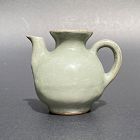
SOLD A Chinese Longquan Celadon Teapot. Circa, 13th-14th Century, Yuan Dynasty.
Found in the Philippines.
Featuring a globular body with a short waisted neck and a curved handle opposite a short spout. The teapot is covered in a green celadon glaze, except for its foot-ring.
A similar example can be seen in the book 'Chinese and Southeast Asian Greenware found in the Philippines' by: The Oriental Ceramic Society of the Philippines, on page: 56;42. See photos provided for this reference.
M...
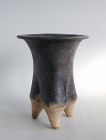
Fine Chinese Neolithic Xiajiadian Culture Burnished Pottery Li Tripod
This superb and rare tall pottery vessel was made some 4,000 years ago by people of the Xiajiadian culture (c. 2300 - 1600 BC) from Inner Mongolia. The form of this vessel is characteristic of this Neolithic culture with its wide rim, partly hollow udder-shaped legs and carefully constructed body. The surface of the body above the legs, and the inner mouth, have a finely burnished surface, its smoothness making it a real p...
Japanese : Tea Articles : Contemporary
item #1484715
(stock #TRC231017)
Kyoto Ceramics and Fine Art
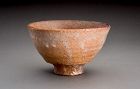
Sold, Thank You! Simple yet classic styling—this tea bowl is perfect for anyone looking for the quintessential Ido-shaped chawan crafted by one of Japan’s premier Hagi potters. Born in the famed pottery town of Karatsu in 1942, Zenzo Hatano spent a number of years learning the various styles particular to his region before taking up an apprenticeship under well-known Hagi potter Yoshiga Taibi. Winner of a number of awards including the Japan Crafts Exhibition Award in 1977, Hatanoâ€...
Japanese : Tea Articles : Pre 1900
item #1484714
(stock #TRC231021)
Kyoto Ceramics and Fine Art
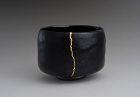
Sold, Thank You! We have a particular interest in beautiful old Raku tea bowls and spend quite a bit of time searching for exceptional examples to include in our gallery. Here we see a beautiful work that appears to be at least 100-200 years old which would place its era of production in late Edo or Meiji. We had our master kintusgi craftsman add a skillfully applied repair to the side giving it some added character; a truly one-of-a-kind treasure. A tradition dating from the mid-16th ce...
Japanese : Tea Articles : Pre 2000
item #1484713
(stock #TRC231011)
Kyoto Ceramics and Fine Art
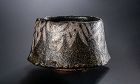
$1,250.00 Splashed across a beautifully textured backdrop of shimmering black, the willow leaves painted in silver bring with them a sense of calm and contemplation. Generously proportioned though not too heavy in the hand, the wide base ensures stability while the upward curvature of the sides breaks with convention and offers a unique and decidedly modern flair. Born in Kyoto as the 4th son of a famous lacquer artist named Shogo, Banura Shiro (1941-2001) followed suit and went i... Large Chinese Neolithic Machang Phase Painted Pottery Jar (c. 2300 - 2000 BC)
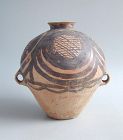
This large pottery jar was made over 4,000 years ago during the Machang Phase (c. 2300 - 2000 BC) of the Majiayao culture, also known as the Gansu-Yangshao culture, from present day Gansu or Qinghai province. The decorative pattern, applied on top of the smooth burnished surface with a fired-on mineral-based pigment, features four roundels containing geometric patterns. On opposing sides just below its waist are tw...
Brian Page Oriental Art
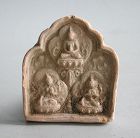
GBP £65 Ancient Chinese Buddhist Pottery Amulet - Ming Dynasty
This is one of a group of moulded pottery tablets that we bought about twenty years ago. They are made from a relatively high-fired pottery and have a surprising amount of detail. They were made as amulets and votive offerings and were reported to have been excavated from the foundations of an ancient Buddhist temple, where originally many would have been placed to ensure the success of the temple. We find it quite difficult to date thes...
AfricAsia Primitive and Antiques
€1,200.00 Small gilt bronze altar dedicated to Bodhisattva Padmapani, resting on four pillars, showing the Bodhisattva standing, backed by an aureola, holding a gourd in his left hand, his right hand in appeasing/blessing posture (abhaya mudra). Fine patina. China, Northern Wei Dynasty. Height: 8.3 cm. Very good condition.
Zentner Collection
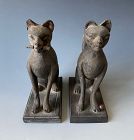
$1,500.00 Antique pair of small Inari Shinto shrine foxes carved of wood. Originally painted, these foxes have acquired a deep, dark over many years. Also called Zenko, these good spirit Kitsune (foxes) are specifically associated with the Goddess, Inari.
Believed to be both messengers and guardians, Kitsune serve Inari in her role as the Goddess of agriculture, specifically rice. Part of the folklore surrounding the fox is it's ability to shape shift into a human form. It is believed that Inari ...
Era Woodblock Prints
$1,100.00 Saito Hodo (aka Nishimura Hodo)
Street in Front of Restaurant Date: 1920s-30s. Size: Oban. 19.75 x 13 inches. Publisher: Takemura Hideo. Signed "H. Saito" by the artist. Medium: Japanese watercolor. Condition: Excellent. Note: Paintings and woodblock prints variously signed "H. Saito" (Saito Hodo) and "Nishimura Hodo" were published by Takemura Hideo. They are very likely by the same artist. Works with these signatures had similar style and at times depict...
Era Woodblock Prints
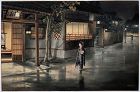
SOLD Saito Hodo (aka Nishimura Hodo)
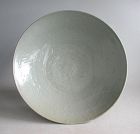
Street After Rain (雨後の街) Date: 1920s-30s. Size: Oban. 19.75 x 13 inches. Publisher: Takemura Hideo. Signed "H. Saito" by the artist. Medium: Japanese watercolor. Condition: Excellent. Note: Paintings and woodblock prints variously signed as "H. Saito" (Saito Hodo) and "Nishimura Hodo" were published by Takemura Hideo. They are very likely by the same artist. Works with these signatures had similar style and at times ... Rare Large Chinese Ming Dynasty Swatow Porcelain Incised Celadon Dish - Flying Horses
This large and rare porcelain dish, of the type known as "Swatow" ware, was made during the Wanli reign (1573 - 1620) of the Ming Dynasty at the Zhangzhou kilns in Fujian province where many such wares were made for export around South-east Asia. More specifically, this dish was very likely produced at one of the kilns in Pinghe County, possibly at Wuzhai village where very similar incised celadon dishes ar...
Brian Page Oriental Art
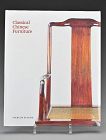
GBP £145 New Reference Book: Classical Chinese Furniture – Marcus Flacks
Unlike other Asian cultures of the 17th and 18th centuries, the Chinese did not sit on the floor. The simple fact that the Manchu invaders imported highly flexible furniture from their yurts influenced the development of Chinese design and decorative arts. Within a few years of the Manchu invasion, Chinese craftsmen combined their highly refined design aesthetic with extraordinary exotic woods, veneers, and lacquer to create s...
Brian Page Oriental Art
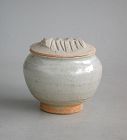
GBP £95 Chinese Song / Yuan Dynasty Qingbai Glazed Porcelain Covered Jar
This attractive small covered jar was made during the 13th / 14th Century (Song / Yuan Dynasty). This jar has quite a wide body and is unusually "heavily-potted" for its type. It is coated inside and out in a pale green Qingbai glaze that is very finely-crackled. The colour of the glaze varies a little, especially to the cover where it is a little paler. The cover has a carved pattern to give it the appearance of a tiled roof... |