| Home | | | Items For Sale | | | Shops | | | Current Auctions | | | Auction Information | | | Auction Schedule | | | My Vervendi | | | Seller Registration | | | Bidder Registration (free) |
| Directory: (25583) |
|
Auctions MAIN CATEGORIES
|
Brian Page Oriental Art
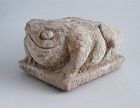
GBP £1,850 Very Rare Chinese Eastern Han Dynasty Stone Toad Money Tree Base (AD 25 - 220)
This extremely rare toad-shaped pedestal, or base, for the legendary coin-shedding tree dates to the Eastern Han Dynasty (AD 25 - 220) and has been excavated from Sichuan province. The coin-shedding, or money, tree is known from late Han Dynasty funerary art from the south-west of China. It was believed that if shaken, coins would fall from it. The money tree itself would comprise a bronze trunk, or pole, to which...
Japanese : Woodblock Prints : Pre 1950
item #1487986
(stock #Unidentif190)
Era Woodblock Prints
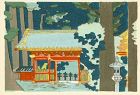
$65.00 Shrine in Forest
Seal not read. Artist unidentified. Elsewhere attributed to Okamoto Kouen Date: ca. 1940s. Print size: 3.75 x 2.75 inches. Publisher: Unsodo. From a group included in an Unsodo client sample book. Medium: Japanese woodblock print attached along top edge only to original holiday card. Condition: Excellent.
Japanese : Woodblock Prints : Pre 1950
item #1487979
(stock #Unidentif189)
Era Woodblock Prints
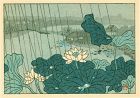
SOLD Rain at Shinobazu Pond
Sealed "S". Artist unidentified. Date: ca. 1940s. Print size: 3.75 x 2.75 inches. Publisher: Unsodo. From a group included in an Unsodo client sample book. Medium: Japanese woodblock print attached along top edge only to original holiday card. Condition: Tiny dot in sky.
Momoyama Gallery
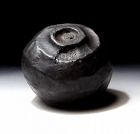
sold A beautifully crafted and remarkable example of an early Edo period (1603-1868) Raku Chawan. This bowl is strongly reminiscent of the Chōjirō tea bowls, the first head of the Raku family. This exceptionally well-crafted tea bowl has a very meditative presence and reveals its highlights of a typically Momoyama Period classic black glaze. It comes with an old Japanese wooden box. Raku tea bowls occupy a unique space in the world of tea because they strongly embody the ae...
Conservatoire Sakura
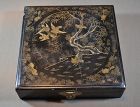
$6,000.00 Black lacquer box finely incised with motifs of birds, dormice, vines and flowers, the golden designs stand out pleasantly against the black background with discretion. This Chinese lacquer technique called Ch'iang Chin is very old, it consists of making slight incisions on the dry lacquer then filling them with gold powder mixed with fresh lacquer for good, lasting adhesion. On the box presented here, the very thick and solid lacquer is a sign of excellent quality which has allowed it to calmly...
tomoe art
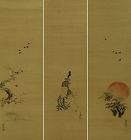
$4,400.00 A set of three hanging scroll paintings finely depicted auspicious motifs such as rising sun and old pine tree, jurojin with divine deer and a sacred scroll, as well as a flock of crow rest in the winter old tree that reminds of the zen like scenery. Painted with ink and pigments on silk. Signed Tsunenobu and sealed. It is attributed to Kano Tsunenobu.
Kano Tsunenobu (1636-1713) was the eldest son of Kanō Naonobu (1607-50), younger brother of the renowned artist Kanō Tan'yū (1602-74). ...
Conservatoire Sakura
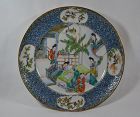
$600.00 Chinese hard porcelain dish. Decorated with a palace scene in the center and a rich variegated decoration on the margin, interspersed with a cartouche containing birds. A dominant blue enamel happily illuminates the whole. Although this style of decor is relatively common, it is exceptional to come across some of such good quality, in fact here the firing was perfect, the enamels are superb which is very important.
China, probably Jingdezhen kilns mid-19th century.
Excellent state of conservat...
June Hastings
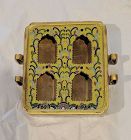
$1,150.00 A square Chinese cloisonne enamel gau box with four arched apertures and gold gilt strap loops for personal carrying. Richly decorated on a yellow ground with designs of formal lotus and foliage, the top side panel has a dark blue fylfot. The back panel, with the large red Shou-type character, slides up to open. Made for the Tibetan market, this dates
early to mid 19th century, but could possibly be late 18th. Measures 3.35 inches high, 3" across, 1" deep.
tomoe art
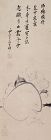
$970.00 Hotei, one of the seven lucky gods. Painted with ink on paper. Signed and sealed. It is accompanied by an inscripton authenticating the painting that it is painted by Okamoto Hansuke. It is attributed to Okamoto Hansuke(1575-1657).
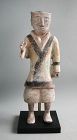
Okamoto Hansuke(1575-1657) was a military tactician and calligrapher of the early Edo period. His original surname was Ishigami, and he later inherited the Okamoto clan. He is well known by his given name, Nobunari, and his common name, Hansuke. He originally se... Fine Tall Chinese Western Han Dynasty Painted Pottery Soldier (with stand)
This impressive pottery model of a warrior was made over 2,000 years ago during the Western Han Dynasty (206 BC - AD 8). It is made from a dense grey pottery and quite highly-fired. He stands alert with his right hand raised. The pack on his back, a container for arrows, shows that he is an archer. In the hands would originally have been placed a miniature wooden shield and weapon, now long since rotted away and lost....
Brian Page Oriental Art
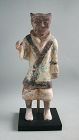
GBP £850 Fine Tall Chinese Western Han Dynasty Painted Pottery Soldier (with impressed seal)
This impressive pottery model of a warrior was made over 2,000 years ago during the Western Han Dynasty (206 BC - AD 8). It is made from a dense grey pottery and quite highly-fired. He stands alert with his right hand raised. The pack on his back, a container for arrows, shows that he is an archer. In the hands would originally have been placed a miniature wooden shield and weapon, now long since rotted away ... Rare Chinese Neolithic Xindian Culture Pottery Jar
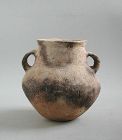
This rare pottery jar was made around 3,000 years ago by peoples of the Neolithic Xindian culture (c. 1200 - 500 BC). The Xindian culture is a relatively late Neolithic culture and overlaps with the Chinese Bronze Age. Xindian pottery is rarer and generally less refined, more coarse and brittle than pottery from some earlier Chinese Neolithic cultures. This jar, however, is well-made and of an attractive form. It is made from quite a gritt...
Mastromauro Japanese art
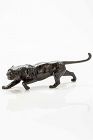
EUR €1,400.00 Bronze okimono depicting the study of a powerful tiger in a furtive position.
The animal is represented with its legs bent, its tail curled upwards and its body in a lowered position just before launching the attack.
The streaks of the fur, typical of the animal, are depicted in a masterful way and highlighted with a marked engraving.
This okimono is signed Hideyoshi 秀義 under the belly.
Origin: Japan
Period: Meiji second half of the 19th century.
Dimensions: 10 x 36 x 9 cm....
Haruko Watanabe
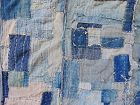
Sold, Thank you. Amazing boro made of hand-spun and vegetable indigo dye cotton fragments. It used to be the lining of yogi, which is one kind of futon, in the shape of kimono. It is from the Japan Sea side district in Kansai, such as Fukui or Kyoto. It is partly sewn with hemp yarn. Late 19th to early 20th century. W:95cm, L:165cm
Momoyama Gallery
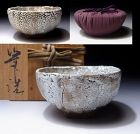
sold Late Edo (1603-1868) Period Shino Chawan with all highlights of the Japanese aesthetics of wabi sabi. It is in perfect antique condition and comes with its original wooden box, a cloth bag (shifuku) and the attestation of a tea master inside. Shino-ware dates to the Momoyama period when potters were attempting to recreate white porcelain-wares that were being imported from China at the time. Originally they were made in single-chamber anagama style kilns set into the hillsides. La...
Abhaya Asian Antiques
$200.00
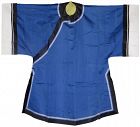
Late 19th early 20th century blue satin silk woman’s wide sleeved upper garment (ao/shan). Excellent condition (appears to have never been worn) with glass buttons and greenish patterned lining. All hand sewn upper width: 118cm46in (sleeve end and to sleeve end), mid width 72cm/28in height 108cm/42in (top of collar to bottom)
tomoe art
$700.00 Kano School painting depicted Inkwash landscape/Suiboku Sansui. Painted with ink on paper. Signed Naonobu and sealed. It is attributed to Kano Naonobu.
Kanō Naonobu (1607–1650) was a Japanese painter of the Kanō school of painting during the early Edo period. He was the younger brother of Kanō Tan'yū, who was to continue the line and become one of the foremost painters of the school. Together with Tan'yu, Naonobu completed a number of prominent commissions for the Tokugawa shogunate...
The Kura
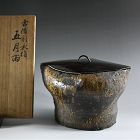
sold, thank you A radical Bizen Mizusashi with two lacquered wooden lids enclosed in a black lacquered wooden box with gold lacquer writing titled Samidare which is in turn enclosed in a kiri-wood storage box by the same title compartmentalized to allow the lids to be stored safely. Samidare is a poetic reading for Rain of the Fifth Month (June in the traditional calendar). It has a seal of overlapping rings impressed into the earth of the base, and dates from the Edo period. The lids are for differing event...
|