| Home | | | Items For Sale | | | Shops | | | Current Auctions | | | Auction Information | | | Auction Schedule | | | My Vervendi | | | Seller Registration | | | Bidder Registration (free) |
| Directory: (25574) |
|
Auctions MAIN CATEGORIES
|
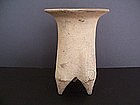
From our Early Chinese Collection, an excellent neolithic tripod (Li) pottery vessel from the Xiajiadian Culture of either Inner Mongolia or Liaoning Province, circa 2500-1500 BC. These strange, other-worldly looking vessels belie their true age, which is an astonishing 3500 to 4500 years old. Constructed of a buff colored earthenware with partially hollowed-out udder-shaped legs, it has a slender and well-burnished body that flares out to a wide rim. This particular piece has signs of root grow...
The Bodhisattva Collection
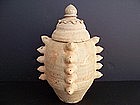
$2,995.00 From our Early Chinese Collection, a very rare, large, and striking Song Dynasty (960-1279 AD) stoneware jar with lid, executed in a straw colored glaze over buff colored stoneware (or proto-porcelain as it is sometimes referred to, which is clay fired at higher temperatures than pottery but lower temperatures than true porcelain, which had yet to be invented at that time). The jar has four sets of very distinctive and unusual udder-shaped protuberances in columns of 5, and four illegible, presu...
The Bodhisattva Collection
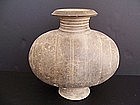
Price on Request PLEASE NOTE: WE HAVE RECENTLY RE-ACQUIRED THIS VERY FINE COCOON JAR FROM A CLIENT WHO IS LIQUIDATING HIS ANTIQUE HOLDINGS DUE TO HEALTH ISSUES AND MEDICAL EXPENSES: WHILE WE ARE VERY SADDENED TO LEARN OF THIS CLIENT'S CONDITION AND CURRENT CIRCUMSTANCES, WE ARE GRATIFIED AT LEAST TO BE ABLE TO ASSIST THIS WONDERFUL GENTLEMAN IN THIS MANNER, AND TO RE-OFFER THIS FINE COCOON JAR ONCE AGAIN: From our Early Chinese Collection, a very good Qin or Han Dynasty (221 BC- 220 AD) cocoon jar, of well-know...
The Bodhisattva Collection
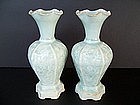
$3,995.00 From our Early Chinese Collection, a fine and rare pair of Song Dynasty (960 – 1279 AD) qingbai vases on integral bases, with a molded six panel floral sprig design and flared petal-form aperture. The glaze is a very good and very attractive translucent blue/blue green color, deeper where pooled in the recesses. The underside is burnt orange-brown from the firing. They bear exhibition labels from the "1953 South Africa National Gallery Chinese Exhibition," and also the "Henry Brown Collection....
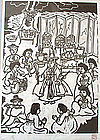
Shaman's Feast Woodblock Print on Traditional Hanji Paper by Hong Sung Dam in 1982 (21 x 15 inches, 53.5 x 38 cm, including margins). Hong Sung Dam is a woodblock print artist who was a leader of the minjung, the peoples' political movement that arose from the ashes of the Gwangju Massacre where the Korean government slaughtered hundreds (some witnesses say thousands) of their own citizens in the streets in response to demonstrations in Gwangju. He was arrested in 1989, and suffered brutal tortu...
Chinese : Pre 1910
item #935201
Global Ceramics
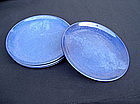
$180.00 Four flat dishes with spur marks and so probably Japanese, Meiji c 1900, all with a matted powder blue glaze, also covering the back and the foot rim. Diameter "8/ 20 cm. Condition: minimal glaze frits to the rim of two plates, as seen on photos.
Japanese Art Site
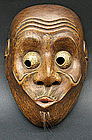
SOLD Very Fine and Rare Edo Period Usobuki Kyogen Mask in Excellent Condition. 8h x 5.5w inches, 20.5h x 14w cm. From the collection of Irwin Hersey, renowned author on Asian and primitive art, and publisher of the Primitive Art Newsletter in the 1970s. Irwin Hersey was an advisor to museums and prominent collectors, and vetted pieces for many of the international tribal art fairs and Asian art fairs.
Welcome To Another Century
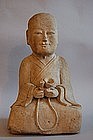
P.O.R. Sculpture of a bald headed man with a serene face, sitting while holding a small cymbal and drum stick in his hands. The cymbal and stick are connected to each other by a cord. The man dressed in Korean garment, as it is worn by Boddhisatva. Lime stone? Inside hollowed out. Korea, Choseon period, 18th century.
Height inches 14.2 inches (36 cm). Excellent condition. Some pits in the surface, some traces of former pigmentation. This piece was exhibited by The Chinese Porcelain Compa...
Japanese Art Site
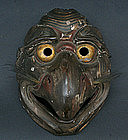
SOLD Edo Period Kyogen Theater Karura (Garuda) Mask, donated in the 19th Century by the prominent collector, Dr. C.G. Weld to the Museum of Fine Arts in Boston. Karura is a mythical fire-breathing bird-human creature from Buddhist-Hinduist mythology. A fine and rare example. Wood with lacquer. 8 x 6.25 inches, 20.5 x 16 cm.
Japanese Art Site
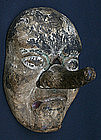
$4,000.00 A unique Edo Period Tengu (Devilish Imp) Mask with an inscription and a handle in the back for use in parades. In fact, this was purchased directly from a Japanese parade participant by Irwin Hersey in Japan in the 1960's, after the parade was over. 8h x 5w x 5.75d inches, 20.5 x 12.5 x 14.5 cm. Wood with traces of pigment. From the collection of Irwin Hersey, renowned author on Asian and primitive art, and publisher of the Primitive Art Newsletter in the 1970s. Irwin Hersey was an advisor to mu...
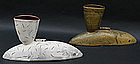
Seo Byung Ho was the recipient of the top prize in the 2009 World Ceramic Biennale, the highest paid ceramic art prize in the world. With this lovely pair of sculptural vases, Seo has combined the shape of a traditional vessel with the form of a fish, a symbol of eternal vigilance because the fish never closes its eyes. For the same reason, the fish is also a symbol of diligence that has long been a source of inspiration for Korean scholars, and is a common motif employed in scholar's implements...
Asian Art By Kyoko
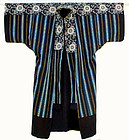
Price on Request Antique Japanese yogi, thickly woven cotton, trimmed and lined with dark aizome (Japanese blue dye). There is a opening in the center of the liner where the cotton wadding was taken out. Excellent condition (old but new). The accent piece (dyed in Katazome, stencil dye) on the collar and shoulder area were added (remove and wash purpose) and slightly soiled. Late Meiji to early Showa.
Dimensions: 63" x 68" L
Asian Art By Kyoko
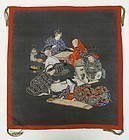
Inquire for Price Antique Japanese fukusa (gift cover), Yuzen-zome (paste regist dye) on silk kabe-ori (coarse crepe silk), early 1900s.
For a man to be a well balanced nobleman, there were requirements to be filled. 'Kin Ki Sho Ga', the four accomplishments of gentlemen, were chosen at an early time in China, practicing Kin (koto, music instrument), ki (go, Chinese chess), sho (calligraphy) and ga (painting). Here on this fukusa, with some variation (tea - sencha? was added), are the Six Immortals of the...
Zentner Collection
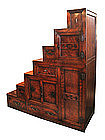
SOLD Beautiful Japanese antique kaidan tansu (step tansu) made of dramatic keyaki (elm) wood burl, iron hardware with hirute shaped drawer pulls, in two sections, Edo Period, circa 1850s, (early 19th century).
Size: 76 3/4" high x 71 1/2" wide x 27 1/2" deep.
Zentner Collection
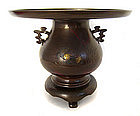
SOLD Japanese bronze usubata (container for ikebana flower arranging), with pair of Mandarin ducks with gold inlay, wonderful red patina pattern over all, in two pieces, Taisho Period (early 20th century).
Size: 10" high x 12" wide
June Hastings
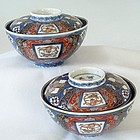
$525.00 Two very rare Ko-imari rice bowls from the Genroku period. C. 1690-1710. These are just gorgeous, the bottoms are painted in the chevron pattern, and various geometrical patterns of roundels with honey comb patterns throughout. Two dragons adorn either side of each cup and each surrounded with colors of iron red and green enamels with gold gilt accents. Each bowl and cover are in perfect condition with very little wear to the enamels, almost non-existant. They measure with lid on about 3 1/8" ...
Welcome To Another Century
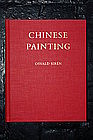
$500.00 Osvald Siren: Chinese Painting: Leading Masters and Principles. Part I; The First Millennium (3 vols.), London: Lund Humphries/New York: Ronald Press, 1956.
Vol.I: Early Chinese Paintings (xi+235pp., colored frontispiece and b/w ills.) Vol.II: The Sung Period (vi+189pp. and annotated lists 95pp., colored frontispiece and b/w ills.) Vol.III: Plates (xviii pp., 372 b/w plates). Bound with red cloth, gilt title to front board and spine. With slip cases. 28.5x23cm. Books very g...
The Kura
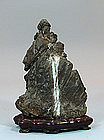
Sold, Thank you The turret of a lonely outpost rises from the mountain peak formed by this small Japanese scholar rock set into a hand carved wooden base and enclosed in a wooden box titled Ko jinkaku (Small Armored Tower). The stone is 7 inches (18 cm) tall, 5 x 3 inches (13 x 8 cm). It likely was put together in the early 20th century.
|