| Home | | | Items For Sale | | | Shops | | | Current Auctions | | | Auction Information | | | Auction Schedule | | | My Vervendi | | | Seller Registration | | | Bidder Registration (free) |
| Directory: (25574) |
|
Auctions MAIN CATEGORIES
|
SEBASTIAN ASIAN ART AND ANTIQUES
$1,250.00 Chinese Yaozhou celadon bowl, Northern Song. 18 cm diameter. Bowl has been repaired at the rim.
DEVAGATI
Price on Request Japanese Embroidered Silk Screen with Cranes and Turtles — Meiji to Taisho Period (Early 20th c)
A refined two-panel silk screen beautifully embroidered with cranes in flight and turtles gliding among stylized waves and drifting clouds. The deep indigo silk ground creates a striking contrast with the delicate embroidery in gold, white, and vermilion threads, expressing both serenity and celebration. Cranes and turtles—symbols of longevity and harmony—have long been cheri... A white heron stands as a solitary centurion in the vast twilight of autumn on this exquisite Utsutsugawa-yaki tea bowl by Yokoishi Gagyu XIII enclosed in the original signed wooden box titled simply Chawan. It is 13 cm (just over 5 inches) diameter, 6.5 cm (2-1/2 inches) tall and in excellent condition.
His first exhibited piece at the age of 20 in 1955 took the governors prize at the Nagasaki Kenten Prefectural Art Exhibition. That was the beginning of a prestigious career prolific wit...
Brian Page Oriental Art
GBP £395 Large Chinese Neolithic Burnished Pottery Jar - Caiyuan Culture (c.2600 - 2200 BC)
This attractively-shaped pottery jar was made over 4,000 years ago by peoples of the Caiyuan Culture (c.2600 - 2200 BC) and comes from the Ningxia Autonomous Region in the north of China. It has a wide body, neck and a wide flared mouth. It is quite highly-fired, having a ring to it when tapped. The surface colour varies a little due to its original uneven firing from a deep orange to shades of grey to part of...
Brian Page Oriental Art
GBP £395 Chinese Western Han Dynasty Painted Pottery Cocoon Jar (206 BC - AD 8)
This pottery "cocoon" jar was made some 2,000 years ago during the Western Han Dynasty (206 BC - AD 8). It is made from a fine-grained grey pottery that has been decorated with cold-painted coloured pigments in a design of swirling cloud patterns within vertical bands. The paint does not extend all around the jar - this is intentional, as though the painted decoration were intended to be viewed from above. It is of good p... Chinese Western Han Dynasty Painted Pottery Cocoon Jar (206 BC - AD 8)
This pottery "cocoon" jar was made some 2,000 years ago during the Western Han Dynasty (206 BC - AD 8). It is made from a fine-grained grey pottery that is relatively highly-fired and has been decorated with various cold-painted coloured pigments in a design of swirling cloud patterns within vertical bands. The paint does not extend all around the jar - this is intentional, as though the painted decoration were intended t... Rare Chinese Zhou Dynasty Pottery Pouring Vessel
This very rare pottery vessel was made between two and three thousand years ago during the Western Zhou period (11th century to 771 BC) or possibly the Eastern Zhou period (770 - 221 BC), most likely in Zhejiang province. It is of a very unusual form and is made from a high-fired earthenware that has an almost "metallic" sound to it when tapped. It is a pouring vessel with a wide body, a single handle with the thinly-potted wide neck fashioned... Rare Chinese Neolithic Decorated Pottery Jar - Banshan Phase
This very rare and interesting pottery jar was made over 4,000 years ago during the Banshan Phase of the Majiayao culture (c. 2600 - 2300 BC) , from present day Gansu province. Banshan pottery is usually recognised as being finely burnished and elaborately painted, but more unusual vessels such as this were also made and are sometimes found alongside the painted vessels. This jar is quite "heavily-potted" and made from quite a...
Brian Page Oriental Art
GBP £185 Rare Chinese Neolithic Xindian / Tangwang Pottery Jar
This very rare pottery jar was made around 3,000 years ago by peoples of the Neolithic Xindian culture (c. 1200 - 500 BC). The Xindian culture is a relatively late Neolithic culture and overlaps with the Chinese Bronze Age. This cup is of the Tangwang type, described by some as a separate culture, by others as part of the Xindian culture. It is quite heavily-potted with two large loop handles at the waist and a thinly-potted flared mouth.... Rare Chinese Neolithic Xindian / Tangwang Pottery Cup
This very rare grey pottery cup was made around 3,000 years ago by peoples of the Neolithic Xindian culture (c. 1200 - 500 BC). The Xindian culture is a relatively late Neolithic culture and overlaps with the Chinese Bronze Age. This cup is of the Tangwang type, described by some as a separate culture, by others as part of the Xindian culture. It is quite heavily-potted and relatively highly-fired. The surface is smooth and it has a large... Fine & Rare Chinese Western Han Dynasty Painted Pottery Attendant Figure
This fine quality pottery model of a court official or attendant was made over 2,000 years ago during the Western Han Dynasty (206 BC - AD 8). It has been "cold painted" in a base coat of a creamy-white pigment with other coloured pigments on top. The figure stands alert with his hands clasped together beneath his robe. Note the detail of the clothing, the folds to the sleeves and to the rear, as well as the fine facial...
Brian Page Oriental Art
GBP £1,200 Fine & Rare Chinese Warring States Impressed Pottery Jar / Ewer
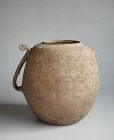
This fine rare pottery vessel was made during the Warring States period (475 - 221 BC) in Zhejiang province. It is of a particularly attractive form and made from a high-fired earthenware. It has a curved handle and a small appliqué on the opposite side giving it the form of a ewer, albeit without a spout. The upper body surface is very nicely decorated with repeated impressions giving it a woven mat pattern. Faint impressions ... Rare Chinese Neolithic Three-Handled Pottery Jar - Caiyuan Culture
This very rare pottery jar was made over 4,000 years ago by peoples of the Caiyuan Culture (c. 2600 - 2200 BC) and comes from the Ningxia Autonomous Region in the north of China. It has an attractive form, is finely-potted and relatively highly-fired. The outer surface as well as that of the inner mouth have been burnished to a smooth finish. There are three loop handles spread equidistant around the body joining the low wais... Small Chinese Neolithic Painted Pottery Jar - Machang (c. 2300 - 2000 BC)
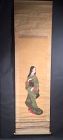
This twin-handled pottery jar was made over 4,000 years ago during the Machang Phase (c. 2300 - 2000 BC) of the Majiayao culture, also known as the Gansu-Yangshao culture, from present day Gansu or Qinghai province. It is relatively highly-fired and made from a buff-coloured pottery. It has a wide body and two loop handles joined at the shoulder and rim. The outer surface and inner mouth have been decorated with geome... The size of Scroll: 20 1/4” Wide x 73 1/4” Long. Image area size: 15 1/2” Wide x 46 3/4” Long. This is beautiful Japanese Bijin-Ga Scroll painting. The scroll has Japanese Bjin-Ga, Beautiful Japanese Girl design painted. It is painted on fine silk background. The condition of scroll is very good. Please note girl’s left eye lid area has mole like spot. The colors of girls Kimono is just beautiful with green colors. Please note two Jiku end, Scroll ends are new wooden parts. not origina...
DEVAGATI
Price on Request Six-Panel Japanese Screen “Spring Landscape with Cherry Blossoms and Sparrows”
A refined six-panel folding screen depicting a tranquil spring landscape with blooming cherry blossoms, peonies, and sparrows fluttering over a gentle stream. The soft gold-leaf background contrasts elegantly with the natural motifs, creating depth and warmth. Painted in mineral pigments and ink on paper, this screen captures the serene beauty of nature awakening in spring. The composition reflec...
Objets D'Art
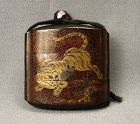
$1,200.00 Three case gold lacquer inro decorated tiger on one side and plants (bamboo) on the other side. Ojime is a glass bead.
3” x 2 ¼ ”
Objets D'Art
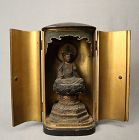
$525.00 Early Edo Japanese carved and gilded wooden statue of Kannon (Guanyin) sitting in a lotus base, zushi, travelling case. Based on the elaborate crown, the figure is a Bodhisattva rather than a fully enlightened Buddha. The style of the statue, with its royal appearance, is often associated with figures like Bodhisattva of Compassion, or Dainichi Nyorai, the Cosmic Buddha.
Zushi 10 ½ “ x 5 x 4 “
Kannon with its base 8” x 4 x 3 ½’ ”
|