| Home | | | Items For Sale | | | Shops | | | Current Auctions | | | Auction Information | | | Auction Schedule | | | My Vervendi | | | Seller Registration | | | Bidder Registration (free) |
| Directory: (25589) |
|
Auctions MAIN CATEGORIES
|
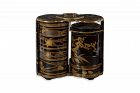
Black and gold lacquer sageju-baco (picnic box) decorated with floral motifs in hiramaki-e. It includes a sake bottle, a four-compartment box with nashi-ji lacquer inside, a simple tray and a hollow tray. At the top, there is a bronze handle for transport.
The sageju-bako is divided into four superimposed boxes for food on the left; a simple tray, a sake bottle and a hollow tray on the right. They are in the shape of a plum blossom.
On the top, on both sides a phoenix. The ph...
GALERIE TIAGO
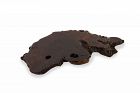
Sold A large presentation tray in finely carved polished wood in the shape of a rounded stump cutout. The sides mimic the knotty grain of a tree trunk. This type of tray was used to present bonsai.
Japan – Shôwa era (1926 – 1989)
Length : 15.75 inch (40cm) – Width : 9.9 inch (25cm) – Height : 0.8 inch (2cm)
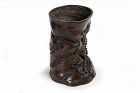
Bronze vase with a dark brown patina in the shape of a trunk.
It bears a three characters signature underneath : 京翁斎 « made by an old man in Kyôto”.
Japan, Meiji period (1868-1912)
Height : 22 cm-Diameter : 14 cm
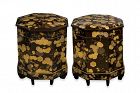
Two big eight-sided kaioke boxes in black lacquer, decorated with mon and maple leaves in golden lacquer.
Japan, Meiji period (1868-1912)
Height: 17,6 in (44,7 cm) -Width : 14,9 in (38 cm)
GALERIE TIAGO
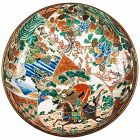
Sold Large hollow porcelain bowl with polychrome decoration of flowers, landscapes, and a samurai on horseback.
The village of Kutani, located in the province of Kaga, is a famous place for the production of ceramics, characterized by a particular decoration. The first pottery kilns were built around 1640 at the instigation of the lord of the province, eager to encourage the nascent industry.
The industry of Kutani developed considerably and became famous towards the end of the 17...
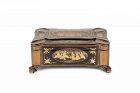
Gold and black lacquer painted box. The decor consists of reserves containing pictural scenes of characters in gardens with pavilions. The bottom is decorated with flowers.
The inside of the lid is decorated with tea leaves in gold lacquer on a black lacquer background.
This box rests on four wood polychrome lacquer feet carved in the shape of a bat.
China circa 1880
Height 4.72 in. (12 cm) – Width 11.42 (29 cm) – Depth 8.27 (21 cm)
EastWest Gallery
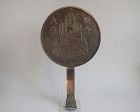
Sold A long handled bronze mirror Kagami-e decorated with a representation of the Great Buddha of Kamakura, Dai Butsu Kamakura, set against a nashiji style ground suggestive of small billowing clouds. The handle terminating with a representation of a Temple Bell.
The mirror is a so-called Makyo or magic mirror, when a strong light source at a certain angle is placed in front of the mirror an image of the Buddha Amida is projected (see last image).
This mirror dates to the middle of the 19th cen...
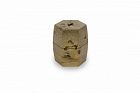
Incense burner in lacquer, hexagonal and curved shaped, decorated with hira and takamaki-e in gold and silver lacquer on a nashi-ji background, peonies along the banks of a river and a mount. The lid has a cruciform opening.
A mon is affixed to one side of the diffuser. It is the mon of the family Ōkubo (大久保氏)a family belonging to the Fudai-Daimyo house (the vassals of the Tokugawa family).
The head of the family was created Daimyo by the Tokugawa family in 1684. From 1725...
EastWest Gallery
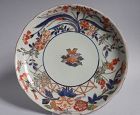
$215.00 A high quality "Porcelain for Palaces" type Arita dish with foliate rim in Imari export style decorated in the full Imari five colour palette principally with Irises, Peonies and Chrysanthemums, with Fence-work and Plum trees and a central motif of Peonies. The reverse decorated with flowering Plum and Rock peonies and an Artemesia leaf.
For a set of thirteen dishes with the same pattern in the Royal Collection see
C&J : Ayers, J., 2016. Chinese and Japanese Works of Art in the Collection of H...
EastWest Gallery
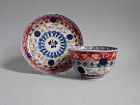
$215.00 A bowl and accompanying saucer or stand both with slightly everted lips. Decorated in a combination of underglaze blue with enamels, iron red and green, with gilding. A truncated version of the gosai palette, a three rather than the full five colour palette, which would have included in addition yellow and aubergine coloured over-glaze enamels.
The design is composed of a series of contrasting narrow bands of geometric diaper with Matsu and Kiku inclusions in the lozenge shaped cells and band...
EastWest Gallery
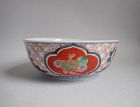
$215.00 An unusual low bowl with the primary subject of a Minogame, a symbol of longevity, decorated in somenishikide style in underglaze blue with additional enamels. The three Lobate reserves outlined in underglaze blue with yellow enamels framing an iron red ground inset with an auspicious minogame set against an iron red diaper ground. Each reserve divided by a stylised symmetric floral arrangement of a Poppy flower surrounded with foliage in underglaze blue and gilt detailing. The interior decorate...
Haruko Watanabe
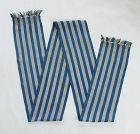
Sold, Thank you. Shonai obi (sash) hand-woven of cotton for warps and paper yarn for wefts. It is made in Shonai region in Yamagata prefecture in Tohoku district. It is dyed with vegetable indigo and has beautiful tassels in both ends. In excellent condition except for a few tiny stains. The first half of the 20th century. 29cm x 3m56cm
Korean Art and Antiques
$1,500.00 Choi Sung Jae (born 1962) is the most widely exhibited Korean ceramic artist, in international galleries and in the permanent collections of major museums, such as the Victoria and Albert Museum, the Art Institute of Chicago, the Museum of Fine Art in Boston, the Peabody Essex Museum, and many others. He is a master of white slip buncheong ceramics, a style revered and imitated by Japanese artists for centuries. This lovely Pond with Geese and Reeds is a fine example of his work. This is an anci...
Zentner Collection
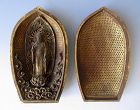
SOLD Japanese antique small Buddhist zushi shrine in the form of a lotus blossom enclosing a tiny figure of Buddha Amitābha. Also known simply as Amida Buddha, he stands on a lotus blossom, floating on swirling clouds. His hands are in vitarka mudra, also known as Raikō gesture of welcoming souls to Paradise (Jōdō or Sukhavati in Sanskrit). Amitābha (which means Infinite or Immeasurable light) is much loved for his gentle wisdom and his all accepting nature. Carved of wood and intricately dec...
Zentner Collection
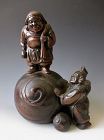
$850.00 Antique Japanese ceramic bizen ware sculpture of Ebisu and Daikoku, two of the most popular of the Lucky Gods. Diakoku, who is usually pictured standing on top of bales of rice, instead stands on top of a large ball. He is shown carrying a lucky mallet (Uchide no Kozuchi) and a bag of treasure which is thrown over his shoulder. He is the protector of agriculture, farmers, and rice merchants. Standing to his left on the side of the large ball is Ebisu, the protector of fish, fisheries, seafood...
Zentner Collection
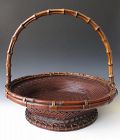
SOLD Japanese Antique woven fruit basket with bent bamboo handle. Woven of split bamboo with a wide and rounded hexagonal, squat form with low walls. The body of the basket is woven with two layers, a wider weave on the outside, and a layer of very thin strips of bamboo in a finer pattern on the inside. The handle and the rim of the basket are made of whole stocks of bent bamboo. The basket is woven with a low foot and has a signature on the underside.
Age: Meiji Period (1868-1912)
Zentner Collection
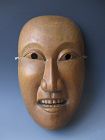
SOLD Antique Japanese carved wooden Kyōgen theatre mask of Zo-onna (middle-aged woman). Still beautiful, she is more serious than her younger counterparts. Her face is longer and narrower and she does not smile but her mouth is open, showing both rows of perfect teeth. Beautifully carved of hinoki (Japanese cypress) wood, signed on the inside.
The characters of the signature read 工藤則朝作 (作, saku, here means "work of _" / "made by _", and the name is 工藤則朝). 工藤 i...
Zentner Collection
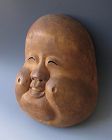
$1,200.00 Antique Japanese carved wood kyōgen theatre mask of the moon faced Otafuku. Her name was once Uzume and evolved into Okame which means "tortoise", a symbol of longevity. Otafuku or Okame is considered the goddess of mirth, a cheerful woman who's name means "abundant good fortune". A bringer of victory and success, she is good-natured, good-humored, good-hearted, generous, kind, serene, and patient. She is smart, strong-willed and competent as well as powerful enough to easily frighten away evil...
|