| Home | | | Items For Sale | | | Shops | | | Current Auctions | | | Auction Information | | | Auction Schedule | | | My Vervendi | | | Seller Registration | | | Bidder Registration (free) |
| Directory: Japanese (12525) |
|
Auctions MAIN CATEGORIES
|
DEVAGATI
Price on Request Four-Panel Folding Screen with Mandarin Ducks, Chrysanthemums, and Autumn Maples
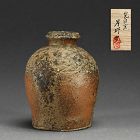
A magnificent Japanese four-panel folding screen depicting an autumnal scene of natural harmony. Painted in mineral pigments and gold on paper, the composition features vibrant chrysanthemums in full bloom, accompanied by finely detailed mandarin ducks (symbols of love and fidelity), and small songbirds among branches of maple leaves turning deep crimson... Crossed “Fence” patterns are scored about the shoulder of this ash encrusted vase by Kishino Kan enclosed in the original signed wooden box titled Iga Yakishime Higakimon Uzukumaru Tsubo. It is 11 cm (4-1/2 inches9 diameter 13.5 cm 5-1/2 inches) tall and in excellent condition.
Kishino Kan was born in Kyoto in 1975, and after graduating art school apprenticed under Fukumori Masatake at the Doraku Kiln in Mie in 1994. He established his own kiln in 2004 in Iga city...
AntiqueTica.com
$750.00 Japanese bronze vase with nice form, used to decorate single flower arrangement in Japanese traditional tea ceremony.
Age: Japan, Showa Period, Early 20th Century
AntiqueTica.com
$780.00 Japanese bronze vase with nice form, used to decorate single flower arrangement in Japanese traditional tea ceremony.
Age: Japan, Showa Period, Early 20th Century
AntiqueTica.com
$800.00 Japanese bronze vase with nice form, used to decorate single flower arrangement in Japanese traditional tea ceremony.
Age: Japan, Showa Period, Early 20th Century
AntiqueTica.com
$950.00 Japanese bronze vase with nice form, used to decorate single flower arrangement in Japanese traditional tea ceremony.
Age: Japan, Showa Period, Early 20th Century
The Kura
sold A bronze vase in the shape of a gourd being wrestled into an upright position by a burly bull frog signed on the base in a circular cartouche what appears to be Issei. Very well cast an unusual form, it is 32 cm (12-1/2 inches) tall and in excellent condition.
Zentner Collection
$635.00 Hand-carved Japanese wooden bear (higuma), shown standing with a salmon firmly clasped in its mouth. The bear is carved in the robust and dynamic style associated with the indigenous Ainu people of Hokkaidō, who developed this art form in the late 19th and early 20th centuries...
Zentner Collection
$875.00 A hand woven antique Japanese rattan bowstring holder (tsuru-oke), crafted in a circular form with intricate basketry technique. This utilitarian yet elegant object was used to safely store spare bowstrings (tsuru) for the yumi, the long asymmetric bow central to Japanese archery. By keeping strings coiled, dry, and protected from tangling, the tsuru-oke ensured a warrior or archer was always prepared in training, hunting, or battle...
Momoyama Gallery
$395.00 A fine and evocative Seto tea bowl, dating to the mid-19th century (late Edo period), exemplifying the wabi-sabi aesthetic cherished in Japanese tea culture. The bowl has a softly irregular form, its undulating rim and natural asymmetry reflecting the hand of the potter and the quiet philosophy of imperfection. The glaze is a subdued ashen-gray with subtle mineral speckling and kiln-born texture, creating a surface both tactile and visually rich...
Lovely Fujian Song style Jianyao stone ware tea bowl with apocryphal “official ware” mark on the foot. Perfect for the practice of chanoyu (茶の湯). Excellent condition. D: 9cm/3.5in and H: 5.3cm/2in.
The Kura
sold The hunched figure of the Daruma, wrapped in robes and seated staring in contemplation at the four lines of calligraphy by 17th century Zen priest Kosetsu mounted as a hanging scroll. Ink on paper in an Edo period mounting of patterned green silk extended with beige silk and featuring ivory rollers. It is 58 x 113 cm (23 x 44-1/2 inches) and is still quite presentable, with some discoloration and stains on the original paper typical of age...
Modern Japanese Ceramics
sold, thank you A squat, eroded form covered in a horrendous blast of natural ash glaze y Kishino Kan enclosed in the original signed wooden box titled Iga Yakishime Uzukumaru Tsubo. It is 12 cm (5 inches) diameter, 11.5 cm (4-12 inches) tall and in excellent condition.
Kishino Kan was born in Kyoto in 1975, and after graduating art school apprenticed under Fukumori Masatake at the Doraku Kiln in Mie in 1994. He established his own kiln in 2004 in Iga city...
Modern Japanese Ceramics
sold, thank you A new radical cup deeply scored by the fingers of Murakoshi Takuma as he raised it on the wheel, half covered in murky green enclosed in the original signed wooden box titled Haiyu Shochu Nomi. Truly a wonderful work with so much texture and variation in color it is a pleasure to both hold and view. It is 13 x 12.5 x 10.5 cm (5 x 5 4 inches) and is in excellent condition, directly from the artist.
Murakoshi Takuma is one of those enigmas who simply lives to work with clay...
The Kura
sold An image of the humble mortar by Hakuin Ekaku in soft ink tones mounted as a scroll suitable for the way of tea or the modesty of monastic life. Hakuin occasionally incorporated household tools like mortars into his Zen paintings and calligraphy, blending folk motifs with spiritual insight. These images often carried humorous or shocking juxtapositions to jolt the viewer out of dualistic thinking...
A spawn cluster of embryonic spheres in galactic reds tinged with blue by Konno Yusuke enclosed in the original signed wooden box titled Yosei (Larva). The colony of globular orbs masses together, not dead, not alive—just potential thickening; seeds of something quietly multiplying, as if the universe itself began to brood… Each hollow sphere is created uniquely, joined together with a tiny shared pinhole, allowing the superheated oxygen to exchange inside the kiln without bursting...
t a t a m i
$380.00 GYOBAN A wooden fish-shaped temple board called a Gyoban, used primarily in Japanese zen temples to announce the time or call monks to assemble. Circa 1950s. 60 × 18 × 6 cm (23.6 × 7.1 × 2.4 in). The fish’s eyes remain open even while sleeping, serving as a reminder to monks to practice diligently day and night without rest...
t a t a m i
$250.00 DEDICATION PLAQUE AND SHRINE ILLUSTRATION A rare original set consisting of a wooden dedication plaque called a munafuda, traditionally affixed to ridge beams or the interior of roofs in Shinto shrines and Buddhist temples to record construction history, and a hand-drawn depiction of the Inari shrine, enshrining the deity of prosperity often depicted as a fox. Edo period, Bunkyū 4 (1864). Plaque 57.7 × 12.5 × 0.8 cm (22.7 × 4.9 × 0.3 in)... |