| Home | | | Items For Sale | | | Shops | | | Current Auctions | | | Auction Information | | | Auction Schedule | | | My Vervendi | | | Seller Registration | | | Bidder Registration (free) |
| Directory: Japanese (12514) |
|
Auctions MAIN CATEGORIES
|
Zentner Collection
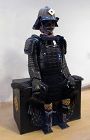
SOLD A High Ranking Military Commander with the Yokohagi Okegawa Dou from the Edo Period (early 19th century). The Kabuto is finished with 64 gilt copper sleeves interlocking onto the iron Ken creating a linear effect on the bowl. The Mempo is in the Nara style with fierce gilt teeth, lacquered upper lip and horse hair mustache detail. The overall mask detail is lacquered in black...
Zentner Collection
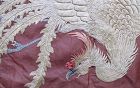
$1,850.00 Antique Japanese long silk altar cloth embroidered with three phoenix birds, also called Hou-ou birds. The mythical birds represents fire, sun, justice, obedience, fidelity, and the southern constellations. The phoenix also symbolizes the imperial household, specifically the empress. The embroiderer expresses flowing movement in in the wings and feathers of the great birds.
Age: Edo Period (early 1800's) Dimensions: 23 1/2" high x 145" long
Zentner Collection
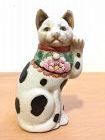
SOLD This is a rare antique Japanese porcelain Maneki Neko (beckoning cat) in a side sitting pose with its left paw raised to bring happiness and good luck to its owner. It was entirely hand painted and features a Botan (Peony) flower as its main collar decoration...
Japanese : Woodblock Prints : Pre 1940
item #1425541
(stock #YoshidaT026)
Era Woodblock Prints
$450 Toshi Yoshida
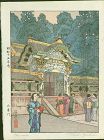
Okaramon Date: 1940. Hand signed and titled. Size: Chuban. Approximately 10.5 x 8.0 inches. Medium: Japanese woodblock print. Condition: Excellent.
Zentner Collection
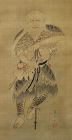
$6,000.00 Japanese Edo Period scroll painting of a yamabushi, a mountain ascetic hermit or holy man. Often believed to be endowed with supernatural powers, the yamabusi follow the Shugendo doctrine, a religion that places heavy emphasis on feats of endurance. Throughout history, they have participated in battles along side samurai. In this painting, the warrior/sage is leaning on a walking stick. He is dressed only in leaves and animal skins...
Zentner Collection
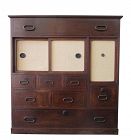
SOLD A rare antique Japanese Cha Tansu (tea chest) made of Kuwanoki (Mulberry) and Kirinoki (Paulownia) woods. The tansu was made using solid Kuwanoki burl wood in front and solid Kuwanoki wood on the case and back. The sliding doors open to a spacious storage area while the lift-out door opens to a split shelf area for book storage...
Zentner Collection
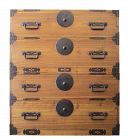
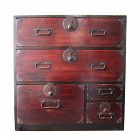
SOLD An antique Japanese Kasane Tansu (stacked chest on chest) made entirely of Kirinoki (Paulownia) wood. Constructed using straight dovetail joinery and hardened wood nails. Alll original hand made iron hardware. Sho Chiku Bai (Pine, Bamboo, Plum) motif on the handle backplates. Interior of drawers feature side handles for ease of carrying...
Zentner Collection
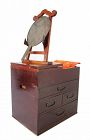
$350.00 An antique Japanese Kyodai Kesho Bako (mirror & make-up box) made of Kurinoki (Chestnut) and Suginoki (Cryptomeria) woods. All original bronze hardware and Urushi lacquer finish. Four drawers and a hinged cover that hides a mirror stand and a bronze hand mirror. The cover flips open to reveal a holding base to which the mirror stand is held in place...
Japanese : Tea Articles : Pre 1990
item #1425419
(stock #TRC230221)
Kyoto Ceramics and Fine Art
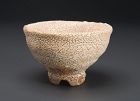
Sold, Thank You! This remarkable tea bowl is from the kilns of Yoshida Shuen (1940-1987)—an apprentice of Miwa Kyusetsu (1910-2012) who was awarded the status of Living National Treasure in 1983. It features a milky translucent glaze somewhat resembling coral, with a few small portions of the foot of the tea bowl exposed, displaying the reddish coarse clay that this piece is fashioned from.
Hagi-yaki has a tradition stretching back over 400 years and is a high-fired stoneware type of pottery...
Zentner Collection
SOLD An antique Japanese Ko Tansu (personal storage chest) made entirely of Suginoki (Cryptomeria) wood. Original wiped Urushi lacquer technique finish with original hand made iron hardware including Gumbai handles...
japanes antique textile saiyuu2
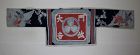
$880.00 This is japanese antique tsutsugaki Umakake used in the Tohoku region of the Edo period. This was used during the occasion. Cotton is hand-spun cotton from the Edo period.It is dyed with indigo.The kanji is written as “Kakode Daikichi”. It means the most auspicious start.The carp waterfall climbing pattern is a symbol of the to pray for the success in life .
And since ancient times, it is a lucky design.
There is a slight fading, but no stains or damage...
Japanese : Tea Articles : Pre 1800
item #1425339
(stock #TRC209211)
Kyoto Ceramics and Fine Art
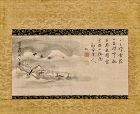
Sold, Thank You! A small cottage perched on the edge of a tranquil lake, fishermen heading out in the morning chill to secure their daily catch. This pastoral scene from the Japanese countryside was captured over 300 years ago by painter, poet, and Buddhist monk Hyakusetsu Genyō (poet) and Kuge Yaou (painter) a monk of the Tenryu-ji sect.
Dharma heir to Chinese monk Gaoquan Xingdun, Hyakusetsu Genyō began his spiritual practice in the Rinzai sect under his teacher Hyakuju...
Lilly Parker Antiques, Inc.
$35.00 Japanese double Cedar Wood Scroll box, early 1900's, 29" long, 12" wide, 8" deep, Kanji Writing inside and outside box, the condition is old and no major damages.
Welcome To Another Century
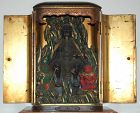
Please enquire Large zushi, made on order for a temple, containing a seated group of En no Gyoja, the father of Shugendo, with his two attendants Zenki and Goki inside a cave. En no Gyoja is sitting with a staff in his right hand, and a hand scroll in his left. The two attendants are crouched before him. The green attendant (Goki) holds a ewer and a stick to ring a bell or mokugyo; the red disciple (Goki) holds an axe...
Japanese : Woodblock Prints : Pre 1900
item #1425307
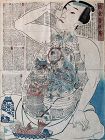
Rare oversized Japanese woodblock print ascribed to Utagawa Kunisada (1786-1865) titled “Mirror of the Physiology of Eating and Drinking” (Inshoku Yojo Kagami), also known as “Rules of Dietary Life,” and believed to date circa 1850. The print depicts a man seated cross-legged drinking a cup of sake with a bowl of fish in front of him. The cross-sectioned torso shows the functions of the internal organs and illustrates the Sino-Japanese concept of digestion. Inscriptions describe the f...
Petrie-Rogers Gallery
$300.00 Oversized limited-edition Japanese woodblock print by Joshua Rome (b. 1953) titled “Fuyu no Hi (Winter's Day)” dated 2/15/1981. The bottom margin is titled, dated, numbered 30/100 and signed in pencil. The artist's red seal is beside the signature. Paper: 9" x 24 5/8" (image: 6 11/16” x 21 5/8"). Very good overall condition. The print is very lightly sunstruck and there are tiny brown spots about the size of the tip of a pin scattered throughout the paper.
Petrie-Rogers Gallery
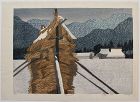
$400.00 Large limited-edition Japanese woodblock print by Joshua Rome (b. 1953) titled “Inawara” dated 12/20/1982. The bottom margin is titled, dated, numbered 28/100 and signed in pencil. The artist's red seal is beside the signature. Paper: 18 1/8" x 25" (image: 15 1/2” x 21 5/8"). Very good overall condition. The print is very lightly sunstruck. The bottom margin corners are a little wrinkled and the paper at the back upper edge is slightly distressed from tape removal.
Welcome To Another Century
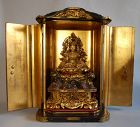
Please enquire A Buddhist shrine, made for a temple, containing the 8-armed, weapon-bearing goddess Benten; her head adorned with a gilt bronze crown in the shape of a Shinto gate, decorated with birds, sun and moon, and beads. On the top of her head sits the snake-bodied water deity Ugajin. Behind her head a circular mandorla with three flaming jewels. Benten sits on a double lotus throne, placed on top of a rock formation.
The figure and the lotus dais are made in wood with gilding over red lacquer, wi... |