| Home | | | Items For Sale | | | Shops | | | Current Auctions | | | Auction Information | | | Auction Schedule | | | My Vervendi | | | Seller Registration | | | Bidder Registration (free) |
| Directory: Japanese (12515) |
|
Auctions MAIN CATEGORIES
|
Haruko Watanabe
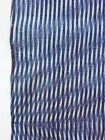
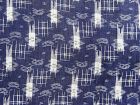
Sold, Thank you. A piece of Iyo-zome cloth which was futonji (bedding). It is made of hand-spun cotton and has katazome (stencil-resist-dye) pattern. The name Iyo-zome is originated from Iyo sudare (bamboo screen) since the pattern looks like wood grain by looking through two layers of them. Stripes are dyed with two katagami (stencil paper), one is vegetable indigo and the other is natural brown dye. Two katagami are dyed by displacing them so that they make wood grain like pattern...
Zentner Collection
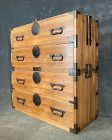
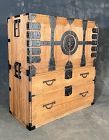
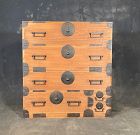
SOLD An antique Japanese Kasane Tansu (section on section) made entirely of Kiri (Paulownia) wood. All original hand forged iron hardware including the Gumbai style handles. Four full width drawers for spacious clothes storage. Side handles to each section for carrying the from place to place.
Age: Meiji Period (1880-1890) Dimensions: 39 5/8" Wide by 40 1/2" High by 17" Deep
Zentner Collection
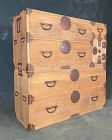
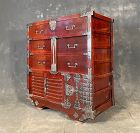
SOLD An antique Japanese Nihonmatsu Kasane Tansu (stacking 2 section chest) made of Kiri (Paulownia) and Sugi (Cryptomeria) woods. All original hand forged iron hardware featuring Warabite style handles and hints of aged red lacquer. Very spacious storage with a hinged door that secures 3 small drawers. Constructed using Japanese joinery techniques and hardened wooden nails.
Age: Meiji Period (1880-1890) Dimensions: 48 1/2" Wide by 48" High by 18 1/4" Deep
Zentner Collection
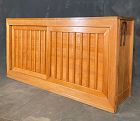
SOLD An antique Getabako Tansu (shoe cabinet) made of Hinoki (Cypress) and Sugi (Cryptomeria) woods. Removable shelf. Single section chest that would make a wonderful buffet or shoe storage cabinet. Top has been reinforced.
Age: Meiji period (1890-1900) Dimensions: 53 1/8" Wide by 27 1/2" High by 15 3/8" Deep
Zentner Collection
SOLD An antique Japanese Kannon Biraki Tansu (wedding Kimono chest) made of Kiri (Paulownia) wood. All original hand forged iron hardware. Upper section features two hinged doors that secure two large and two small drawers. Behind the bottom small drawer is a secret hidden box where important valuables were kept. Bottom section has two full width drawers for additional storage...
Momoyama Gallery
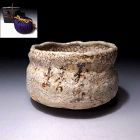
sold Early Edo (1603-1868) Period Shino Chawan with all highlights of the Japanese aesthetics of wabi sabi. Such 17th century Shino tea bowls without cracks and repairs are very rare. It is in perfect antique condition and comes with Gomotsu-bukuro (Shifuku) and a lacquered wooden box with corner protections. Shino-ware dates to the Momoyama period when potters were attempting to recreate white porcelain-wares that were being imported from China at the time...
Momoyama Gallery
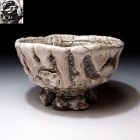
$495.00 Mint and Oni-Hagi masterpiece chawan with notched foot by star potter Seigan Yamane. This extraordinary tea bowl is covered by wonderful different shades of creamy beige on brown pottery. In my opinion it is the one of the most aesthetic chawans that he made. The seal of the artist is stamped on the bottom. Seigan Yamane was born in 1952, and started making Hagi ware in 1987...
Haruko Watanabe
Sold. Thank you. Omi-e-kasuri (pictorial kasuri) with double kasuri pine and bamboo motif. It is handwoven of taima (hemp) and weft yarn with pine tree pattern is clamp-board dye so that the textile has white bar-code like lines in both selvedges. Both choma (ramie) and taima (hemp) textiles were woven from 12th century in Omi region in Shiga prefecture, but kasuri textiles were woven of taima (hemp). In excellent condition but the white lining has light stains and very light two spots in the upper back...
Zentner Collection
SOLD An antique Japanese Kasane Tansu (stacking 2 section chest) made of Kiri (Paulownia) and Sugi (Cryptomeria) woods. All original hand forged iron hardware including the Kakute handles. Full moon lock plates with quarter and semi-circular front drawer corner plates that accentuates the theme. Constructed using straight dovetail joinery and hardened wooden nails. Each section has side carrying handles...
Zentner Collection
$5,000.00 An antique Japanese Choba Kuruma Tansu (wheeled merchant chest) made fo Keyaki (Zelkova), Kiri (Paulownia) and Sugi (Cryptomeria) woods. All original hand forged iron hardware and Urushi lacquer finish. Drawers were made using Kakute handles. Lock bar added additional security for the 2 full width center drawers. Sliding doors open to a spacious storage area and the hinged door secure 2 small drawers behind. Side slats add strength and support...
June Hastings
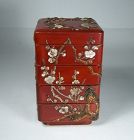
$1,150.00 Edo Era, circa 1850s-1860s, Japanese red lacquer over wood Japanese Bento Box in 5 sections. The exterior features Shibayama style of inlay on a red lacquer ground with the interior and underside being black lacquer. The Shibayama design has several types of stone inlays including MOP with branching, cherry blossoms, leaves, buds and rockery all done in raised work. The workmanship is very good...
Japanese : Woodblock Prints : Pre 1800
item #1459205
(stock #EdoWoodcu)
June Hastings
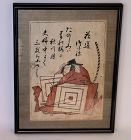
$450.00 Original Japanese woodblock print by Kitao Masanobu (1761 – 1816) from the “Eastern Tune Koyka by Fifty Poets”, date 1786. The color woodblock print depicts an image of a seated warrior with a poem above. Print has toning, spots, and marks throughout, fading to inks, loss of red ink stripes on face, abrasions to lower right corner. Not examined out of frame.
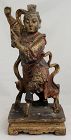
Measures: Sight size: 8.5” high x 6” wide Framed size: 10.75" high x 8" wide x 1" deep Chinese Qing dynasty lacquered wood guardian figure standing on a square base with arms raised and his left black boot resting on a thin circular object embedded in the square platform. He is dressed in elaborately decorated animal head armour painted in red, blue, and black polychrome pigments with fine gilt highlights. 15 7/8" high. 19th century...
June Hastings
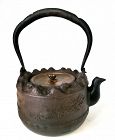
$900.00 A Japanese cast iron tetsubin or water kettle with an undulating rim. The sides are cast in relief with a temple compound amid pines in a generic landscape, the reverse with sparrows in flight, all above a key-fret band. The kettle has a typical stubby "S" spout, wrought iron overhead swing handle, and is fitted with a bronze lid having "garlic clove" knop. Incised to the interior lid "Ryubundo dzu" (Made by Ryubundo).
Dates early Meiji, measures 10.5" high including handle and 8.5" across i...
Momoyama Gallery
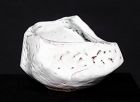
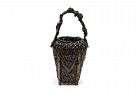
$2,500.00 What a grand statement in clay: Sculptural masterpiece Kurinuki Hagi Chawan by greatest Kaneta Masanao. It comes with its originally signed and sealed wooden box and a profile of the artist. This mountainous tea bowl in creamy-white glaze is in mint condition. Born 1953, Hagi City, Yamaguchi Prefecture, Japan, The eighth-generation Hagi potter, KANETA MASANAO has expanded beyond the tradition of his ancestry to create a more sculptural oeuvre. Perhaps due to his trainin... Ikebana basket (hanakago) made of dark brow varnished bamboo wickerwork, elongated rounded shape, with a handle made of three varnished wooden branches. Thicker bamboo braids on the four sides. The roughness of the handle is a reminder of a raw wood and contrasts with the delicate weaving braiding of the basket.
Ikebana or Ka-do (the way of flowers) is a traditional Japanese art of flower arrangement. Unlike Western floral art, ikebana does not aim to empha...
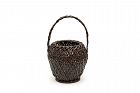
Ikebana basket (hanakago) made of dark brown varnished bamboo wickerwork rounded shape with a twisted handle.
Ikebana or Ka-do (the way of flowers) is a traditional Japanese art of flower arrangement. Unlike Western floral art, ikebana does not aim to emphasize only the beauty of the flowers and the harmony of colours. This art wants to enhance the vase, the stems, the leaves, the branches as much as the flower itself.
The structure of the flor...
GALERIE TIAGO
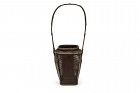
Sold Bamboo and rattan ikebana basket (hanakago), rectangular format stretched in its height and Chinese style. Thicker bamboo braids on the four sides. Includes a bamboo sheet vase intended to receive the floral arrangement.
Ikebana or Ka-do (the way of flowers) is a traditional Japanese art of flower arrangement. Contrary to Western floral art, ikebana does not aim at highlighting only the beauty of flowers and the harmony of colors. This art wants to value th...
|