| Home | | | Items For Sale | | | Shops | | | Current Auctions | | | Auction Information | | | Auction Schedule | | | My Vervendi | | | Seller Registration | | | Bidder Registration (free) |
| Directory: Japanese (12523) |
|
Auctions MAIN CATEGORIES
|
Asian Art By Kyoko
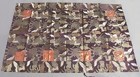
SOLD. THANK YOU! Japanese Kesa, buddhist priests' robe, silk brocades, excellent condition. Circa early 1900 to 1940. Dimensions: 46" x 75"
Asian Art By Kyoko
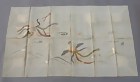
Sold. Thank you! Japanese Kesa, Buddhist priests' robe, "ro" summer silk. 44 1/2" x 77", the color changed evenly to a tannned tone. There are some stains in the front and back, and the handle and the folding lines in the back are soiled.
Asian Art By Kyoko
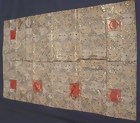
Sold. Thank you! Japanese Kesa, Buddhist Priests' Robe, soft brocades with silk liner. The liner has some discoloration and is soiled. 46" x 77 1/2"
The Kura
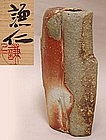
Sold, Thank you A radical Iga vase by unconventional artist Kishimoto Kennin (b. 1934) enclosed in the original signed and stamped wooden box. The free form Terracotta image is covered in lichen-like pale green ash glaze. The vase is 10 inches (25 cm) tall, 5 inches (12.5 cm) wide and in perfect condition. Possibly better known today for celadon, Kennin went through a radical period some 15 years ago working on pieces like this unusually formed Iga ware...
Asian Art By Kyoko
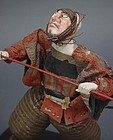
Inquire for Price Japanese Takeda Samurai doll from late Edo to early Meiji, 1800s. Takeda dolls were made to model Kabuki actors and puppet dolls from the late Edo period (1603-1868). The doll is possibly Benkei, a faithful retainer to Yoshitsune (Minamoto).
Many stories were written based on Benkei and Yoshitsune (Minamoto, Genji family). They first met on the bridge of Gojyo in Kyoto when Benkei challenged Yoshitsune...
The Kura
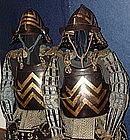
Sold, Thank you! A very rare find indeed, two early to mid Edo period matching Kashi-gusoku Yoroi from the same armory featuring Momonari Kabuto and Hotoke-Ni-Mai Do decorated with jagged bands of gold. A very impressive set. The sleeves are patterned blue and white hemp. The thumb on one sleeve is missing and the two hinge pins...
Asian Art By Kyoko
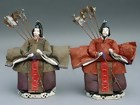
Inquire for Price Japanese antique folk hina dolls, zuishin, the imperial guardsmen and escorts from the Heian period (794-1185). They are often called Daijin minister dolls. The dolls used to belong to the Hina festival (Matsuri) for Girl’s Day. The size of the dolls are 10" tall to the tips of the arrows.
Asian Art By Kyoko
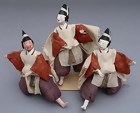
Inquire for Price Antique Japanese folk hina dolls, three servants (Shitei,Shicho) from the Heian Imperial Court (794-1185). The dolls are part of the Hina Matsuri festival for girls in Japan. The standing doll is 8 3/4" tall, and the other two dolls are 7 1/4" to 7 1/2" tall.
Asian Art By Kyoko
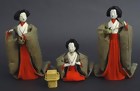
Inquire for Price Antique Japanese folk hina dolls, ladies in waiting from the Heian Imperial Court (794-1185). The dolls are part of the Hina Matsuri Festival for girls in Japan. The approx. height of the tall dolls are 8 1/4" tall, the seated doll is 4 1/2". Made in Osaka, Japan (by NAKAGAWA Kiyojiro)
Zentner Collection
$1,500.00 Japanese choba tansu (merchant's chest), original dark brown translucent lacquer finish, made of sugi (cryptomeria), iron hardware, one shelf on interior of
slider compartment, Meiji Period (1868-1912).
Size: 43" high x 37 1/4" wide x 15 1/4" deep.
Japanese : Pre 1900
item #593942
Asian Art By Kyoko
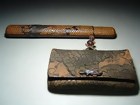
Sold, Thank you! A Japanese lacquered agiro pipe case (kiseruzutsu) finely decorated with a cockerel and hen, signed Shinsen (?). The pouch is tooled leather with iron and silver cockerel and hen inlaid with a gold clasp. The ojime is shaped as Daikoku's mallet in unknown material. The actual color of pipe case is closest to the photo #11. 19th century, late Edo period. Dimensions: Pipe case, 8 1/2 " long, tobacco pouch, 5 1/4 " x 3 "
It is hard to make out the second character of the signature...
Asian Art By Kyoko
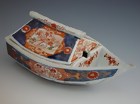
Price on Request Wonderful old Japanese Imari boat, incense burner (koro) or a nice dish for ... sashimi with soy sauce and wasabi in one side, circa Meiji period (1868-1912).
8 1/4" long x 4 1/2" wide x 3 1/2" tall
Asian Art By Kyoko
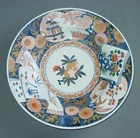
Inquire for Price Beautiful Japanese antique Imari charger, circa Meiji period (1868-1912).
Dimensions: 14 1/4 inches in diameter x 2 1/2 inches deep
Zentner Collection
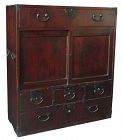
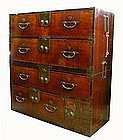
$3,000.00 Beautiful and dramatic antique Japanese isho tansu (clothing chest) from the Nihonmatsu area, 2-sections,
made with keyaki wood front and sugi wood frame, safe box with key, lovely original deep red/orange translucent lacquer finish, iron hardware, Meiji Period (1868-1912).
Size: 47 1/2" high x 45 1/4" wide x 18 1/2" deep.
Japanese Art Site
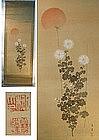
SOLD Sessho was a student of the legendary Tani Buncho. His paintings were collected and much appreciated by Emperor Meiji. He painted this gorgeous flower painting in a deliberately straightforward manner in order to take focus away from his superior technique and have you consider only the beauty of the subject. Silk Canvas and Mount. Mount: 72 x 25 inches, 182.5 x 63 cm. Painting: 44 x 20 inches, 112 x 50.5 cm. cf. C.H...
Japanese : Pre 1940
item #587536
(stock #0125)
Japanese Art Site
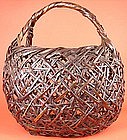
SOLD This is an excellent example of an early 20th Century Japanese Hand Woven Bamboo Basket. Very Good Condition. Height: 15.5 inches (39.5cm), Circumference: 42.5 inches (108cm).
Japanese Art Site
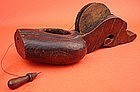
$400.00 Antique Japanese Carpenter Reel, Sumi Tsubo, Ink Line. 9.25 x 3 inches, 23.5 x 8 cm. It is rare to see sumi tsubo (Japanese carpenter's reel or inkline used for layout) fully intact with all its parts, including line and original stick pin, like this one. The Japanese word for tools is Dogu, which was originally the word for an itinerant monk's belongings. It alludes to the spiritual value which craftsmen put on their tools...
Japanese Art Site
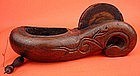
$400.00 Antique Japanese Carpenter Reel, Sumi Tsubo, Ink Line. 8.25 x 3.5 inches, 21 x 9 cm. It is rare to see sumi tsubo (Japanese carpenter's reel or inkline used for layout) fully intact with all its parts, including line and original stick pin, like this one. The Japanese word for tools is Dogu, which was originally the word for an itinerant monk's belongings. It alludes to the spiritual value which craftsmen put on their tools...
|