| Home | | | Items For Sale | | | Shops | | | Current Auctions | | | Auction Information | | | Auction Schedule | | | My Vervendi | | | Seller Registration | | | Bidder Registration (free) |
| Directory: Japanese (12517) |
|
Auctions MAIN CATEGORIES
|
Asian Art By Kyoko
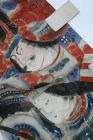
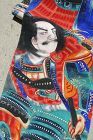
Inquire for Price Japanese nobori banner, hand painted (dyed) with samurai Yoshinaka (Kiso no) and Tomoe Gozen, a woman warrior. Dimensions: 15 3/4" wide and 147 1/2" long. Hand woven soft cotton with hand spun yarn. Early 1900s. Excellent condition but please expect some minor stains because of the age. It may hang better without the side handles on the wall.
Yoshinaka is a member of the Minamoto family (Genji) from the late Heian period (794-1185)...
Japanese : Woodblock Prints : Contemporary
item #671006
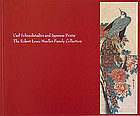
TITLE: Carl Schraubstadter and Japanese Prints: The Robert Louis Mueller Family Collection
EDITORS: Claudia Brown and Laurie Petrie Rogers
8 1/4" x 10", 60 pages, 35 color plates, Hergerger College of the Arts, Arizona State University, 2007
ESSAYS: "The World of Carl Schraubstadter: Collector of Japanese Prints," "The Elegant Craft of Japanese Woodblock Prints, "Social and Historical Foundations of Ukiyo-e," "The Art of Kabuki," "The Katsukawa School of Print Design," "Hiroshige: Life and Ar...
Japanese : Pre 1940
item #670980
Asian Art By Kyoko
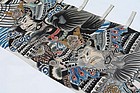
Price on Request The nobori banners, carps, warrior's Yoroi and Kabuto helmets, samurai dolls and swords are all a part of the display used for Boy's Day in Japan. They reflect the parents' wish to inspire their sons in manliness and bravery. This nobori is hand painted (dyed) on cotton, dated from 1920-1950. Excellent condition except one missing handle from the top. Dimensions: 29" x 245" (20'5"), 73.7cm x 6.2m. The length of the design area: 189"(4.8m) long...
Japanese : Pre 1920
item #670671
Asian Art By Kyoko
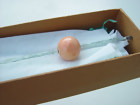
Price on Request Old Japanese Biidoro (vidro, Portuguese) kanzashi made out of glass. Glass making was introduced to the Japanese by the Portuguese in the16th century and there has been glass manufacturers in Japan ever since that date. It was particularly popular in Japan during the 19th century. The style of this kanzashi is called tama (ball) kanzashi. The ball is 3/4" (in diameter) natural coral. It is rare to find a glass Kanzashi in this condition. The kanzashi is 7 7/8" long. Meiji period (1868-1912)...
Japanese : Pre 1910
item #670000
Zentner Collection
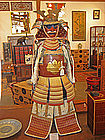
SOLD This is a very beautiful and bold set armor. Reddish lacquer with kiri leaf on chest. Comes with its wooden armour storage box. Showa age. Height:5' Width:17.5" Depth:17"
Japanese : Pre 1920
item #669561
Zentner Collection
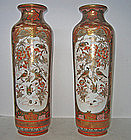
$2,750.00 Pair of Japanese Kutani Vases. There is a hole on the base of both of them, originally drilled for lamps. Signed on bottom. Otheriwise in great condition and good detail. Pictures of birds and flowers in red and black, with gilt. Elegant scale with elongated height. Meiji Period. Circa 1900. Height:18" Depth:5.5"
The Kura
Sold, Thank you! Nita
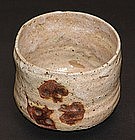
A ring of skulls playfully sojourn on the front of this rather unusual deep Edo Karatsu Chawan. On back another pair tumble helplessly over the thick speckled glaze. The base is bare earth, dark and shiny with age and handling. The skulls are not just resist painted on, but are actually incised, the eyes and nostrils set deep into the southern clay. The bowl is 3-1/2 inches (8.5 cm) tall, roughly 4 inches (10.5 cm) diameter and is in excellent condition, enclosed in a wooden box.
The Kura
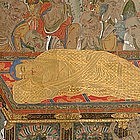
Sold, Thank you! A late Edo period (19th century) image known as the Nehanzu, death of the Buddha. It is absolutely fantastic, one of the best painted I have ever seen. Mourners of all species surround the death bed of Buddha. His mother comes from heaven dropping a bag of magical medicine, which catches on the limb of a tree, unable to reach him in time. Hawk, tiger, elephant, Shishi,...
Welcome To Another Century
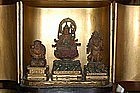
Inquire for Price Reddish brown shrine with three very fine sculptures: Benzaiten in the middle, to her right Daikoku, and Bishamon to her left. Benten is seated on a lotus, depicted in her 8-armed appearance, holding a jewel, her other attributes are lost. On her head a crown with jewels and the snake-shaped Ugajin. Bishamonten stands on a demon and holds a pagoda, his staff now lost. Daikoku stands on two rice bales and holds a hammer and a bag. All of them on separate rock shaped bases...
The Kura
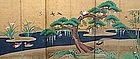
Sold, Thank you! Gold clouds border a spectacular and rare scene of birds flying amid wisteria (fuji) on this fine 19th century gold screen. The screen is roughly 68 by 148 inches (172 x 376 cm). We are offering this screen as is, to allow the buyer to pursue restoration to a level they deem satisfactory. In need of restoration, there are scratches in the gold over the birds, three marks low in panel three and a number of thin tears along the lower portions of the 6 panels. For detailed photos please inquire...
Asian Art By Kyoko
Price on Request Nobori banners, carps, warrior's Yoroi and Kabuto helmets, samurai dolls and swords were all a part of the display used for Boy's Day (renamed Children's Day) on May 5th in Japan. They reflect the parents' wish to inspire their sons in manliness, discipline, bravery and the honor codes which are associated with them.
Originally, nobori were used on the battlefield to identify the troops; some were to show the warriors where their taisho (general) was, others were used to shift the troops...
Asian Art By Kyoko
Inquire for Price The nobori banners, carps, warrior's Yoroi and Kabuto helmets, samurai dolls and swords were all a part of the display used for Boy's Day (renamed Children's Day) on May 5th in Japan...
The Kura
Sold, Thank you! A humorous looking dragon twists up the paper canvas, eyes on the prize, a tama or Buddhist jewel underlying a dramatically written inscription. What is extraordinary is that the dragons scaled body is performed with a single stroke of the brush! Over this has been added a shadow for the back, and embellishment of the head. It is signed Fujiki Shuchokusai, and comes enclosed in the original signed and age darkened wooden box. Bordered with patterned green silk extended with beige and featuri...
Asian Art By Kyoko
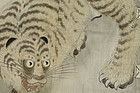
Inquire for Price Japanese antique nobori banner, hand painted on cotton, a tiger in bamboo grove. The style of the painting is derived from ancient Korean paintings of tigers. It is a style that became popular in Japan from the 16th century and you will see many screens and scrolls of tigers painted in this manner. The popularity of these paintings in this style continued throughout the Edo period(1608-1868) and into the Meiji era. The quality of the artwork tells us that this nobori is likely to have been done ...
Asian Art By Kyoko
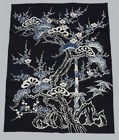
Sold. Thank you! Japanese cloth taken from an old futon bed cover, decorated with an auspicious motif of pine, bamboo and plum blossoms. The evergreen pine symbolizes the strength and devotion of men; plum blossoms are the purity, subtle beauty and inner strength of women. Bamboos are often used to describe the personality of men and women; for example, a person being as straight (honest) as bamboo, it could also mean flexible (bendable) to a large extent. When pine (matsu, SHO), bamboo (take, CHIKU) and plum ...
Asian Art By Kyoko
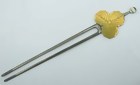
Price on Request Antique Japanese silver kanzashi, the upper design part is gold plated with finely engraved three oak leaves. *This was one of the most popular crests among the warrior samurai class particularily among close devotees of Shinto. Top quality hand cut metal work. Circa (we think) Meiji period (1868-1912). 6 3/4" long and 1 3/8" in width.
*The Elements of Japanese Desgn by John W. Dower
Asian Art By Kyoko
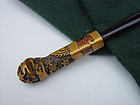
Price on Request Japanese Kanzashi hairpin, maki-e on hand carved wood. A dadaiko (large drum used for court music) and maku (outdoor fence made out of cloth) under the maple trees. They are pictorial subjects from chapter 7 of The Tale Of Genji, Momiji no Ga (An Autumn Excursion). There is a famous scene frequently illustrated from this chapter; Genji, a young and handsome grandson of the emperor, danced 'Sei Kai Ha", Waves of the Blue Ocean, with a maple branch on his crown, which made all the jaws of court ...
Asian Art By Kyoko
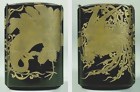
Price on Request Antique Japanese inro, makie designs of phoenix (ho-o bird) on black lacquer. These large inro are sometimes referred to as sumo wrestler's inro, written "Kahei nuri". The last letter (kao like) is probably "nuri" which means painted or coated with. To roughly quote the Wrangham Index of Inro Artists – according to Soken Kisho, Kahei was a mysterious makie artist that lived in Kyoto during the 18th century. He was prominent enough to have his work called Kahei–nuri, after his name. ...
|